Temperature22 – 26 °C
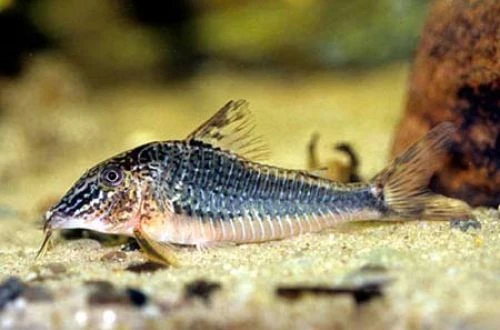
Corydoras semiaquilus, also known as the Black Peruvian Cory, bears the scientific name Corydoras semiaquilus and is a member of the Callichthyidae family, which unites armored catfish. These catfish originate from South America, specifically from the upper Amazon River basin. Their natural habitat spans territories in Peru and the western states of Brazil. They prefer to live in small tributaries and streams with sandy shoals, and are also found in areas of flooded tropical forests.
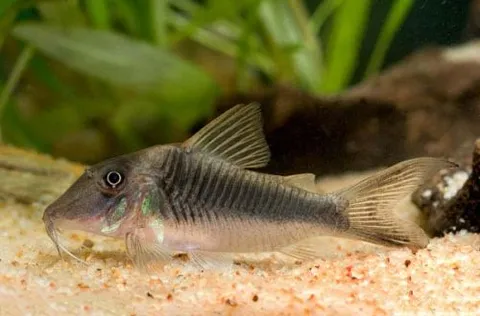
Adults of this fish reach an average length of 6 cm. They have the characteristic body shape of Corydoras, but their snout stands out for its elongated form, distinguishing them from most members of the genus. As the name suggests, the coloration of the Black Peruvian Cory is dominated by dark tones in the dorsal region, while the belly has a contrasting light shade.
The species inhabits the Amazon River basin in Brazil, Colombia, and Peru. It prefers the bottom layers of water bodies with sandy substrate. In nature, it is found in tropical conditions with water temperatures of 22–26°C, pH 6.0–8.0, and general hardness of 2–25 dGH.
This fish is distinguished by its calm and peaceful disposition, coexisting perfectly with other unobtrusive species of similar size and temperament. They prefer to be in a group of their own kind. It is worth noting that males of some long-snouted Corydoras species can sometimes show unfriendliness towards each other. This is especially noticeable in small groups, so it is recommended to acquire them in schools of 5–6 individuals. Such behavior, in addition to Corydoras semiaquilus, may be characteristic of closely related species such as Corydoras acutus, Corydoras blochi, and Corydoras treitlii.
For a group of 5–6 individuals, an aquarium of at least 70 liters is optimal. Although the Black Peruvian Cory is not demanding in terms of decor, it is desirable to recreate elements of their natural environment when decorating. An excellent solution would be to use a sandy substrate, which will allow the catfish to dig, as well as placing natural snags and leaves of some trees on the bottom. Creating areas with dense vegetation will also be beneficial. Lighting should be subdued, or, alternatively, floating plants can be used to create shade.
In nature, it is omnivorous, feeding on small invertebrates such as worms, crustaceans, insect larvae, as well as plant detritus. In the aquarium, it is recommended to use specialized sinking foods for bottom-dwelling fish, supplementing the diet with frozen foods. It is important to ensure that portions are eaten within a few minutes, as leftover food quickly pollutes the water.
Spawning is paired or in groups, with eggs laid on a substrate, such as broad plant leaves or flat stones. Parents do not care for their offspring and may eat the eggs. Stimulation is provided by imitating the rainy season: frequent water changes with cooler water and increased feeding. After spawning, the parents should be removed.
The species has a strong immune system when kept under proper conditions. The main risks are associated with poor water quality, the accumulation of ammonia and nitrites, and injuries to sensitive barbels from rough or sharp substrate. It is recommended to use soft sand and perform regular water changes.
When purchasing, choose active fish without visible damage to fins or skin. It is important to pay attention to the integrity of the barbels, as their absence is a sign of improper keeping. Healthy individuals should show interest in searching for food on the bottom and stay in a school.
The essentials: size, tank volume, water parameters and care
An adult reaches 6 cm in length. Plan the tank around the maximum size: the fish quickly outgrows a cramped setup.
The recommended volume is 70 L. A smaller tank speeds up nitrate build-up and raises stress levels.
Temperature 22–26 °C, pH 6–8, hardness 2–25 dGH. Stability matters more than exact values: sudden swings are harder on the fish than a small deviation from the ideal.
Around 5 years when kept properly. Lifespan depends directly on tank volume, water quality and a varied diet.
Temperament: peaceful (regular). Keep this in mind when choosing tank mates.
Recommended setup: small group (5–6 individuals). Ignoring this is a common cause of stress and disease.
Diet type: sinking (any). Feed small portions that are finished within a couple of minutes — overfeeding does more harm than underfeeding.
The scientific name of the species is Corydoras semiaquilus, family Armored Catfish (Callichthyidae).
The water suits 197 of 208 plants in the catalogue — the easiest ones are shown first.
Afzelius's AnubiasAnacharisAnubiasBrazilian PennywortDwarf CloverDwarf CloverDwarf HygrophilaDwarf SagittariaDwarf ValGuppy GrassHornwortJava FernJava MossMoneywortMud SwordNair's LagenandraNarrow Leaf AnacharisNarrow-leaf CloverStringy MossSüsswassertangTaiwan MossTape GrassTemple PlantUssuri Watermilfoil
Matched by family, categories and overlapping keeping conditions
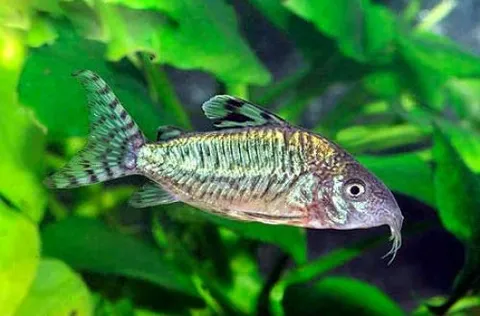
Corydoras geryi
The Bolivian Corydoras, scientifically known as Corydoras geryi, belongs to the family Callichthyidae (Armored Catfishes). This fish originates from South America, with its natural habitat concentrated in the Mamoré…
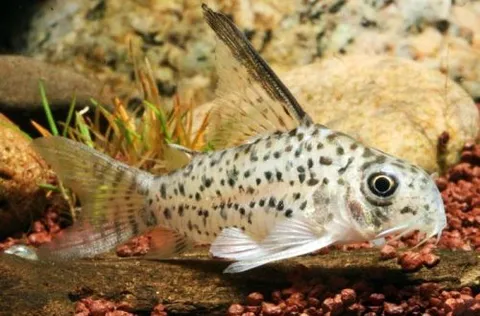
Corydoras armatus
Corydoras armatus, also known as the Armored Corydoras, belongs to the family Callichthyidae (armored catfish), and its scientific name is Corydoras armatus. The word “armatus” itself comes from Latin and translates as…
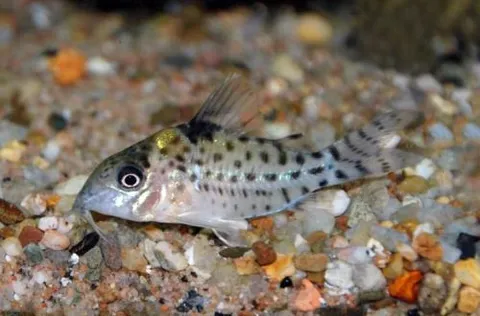
Corydoras ambiacus
The scientific name Corydoras ambiacus is applied to the Corydoras ambiacus catfish, or Cory Ambiacus catfish, which belongs to the family Callichthyidae (Armored or Callichthyid Catfish). Its homeland is South America,…
Corydoras treitlii
Corydoras treitlii, scientifically known as Corydoras treitlii, is a representative of the Callichthyidae family, also known as Armored Catfishes. This fish comes from the coastal drainages of north-eastern Brazil, in…