Temperature20 – 27 °C
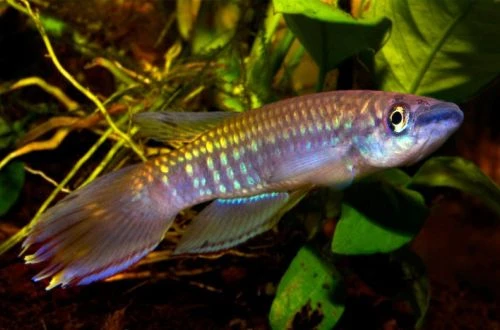
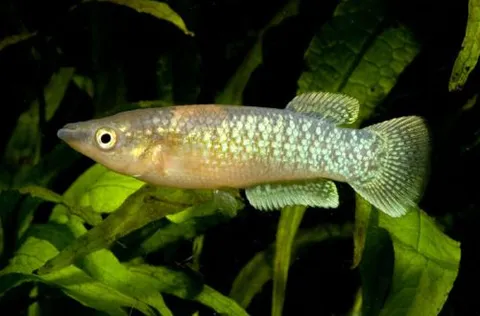
Epiplatys fasciolatus, also known as the Banded Epiplatys, is a member of the Nothobranchiidae family. This iridescent fish is characterized by a beautiful combination of bright pink and green hues. It is often confused with the so-called “Asian killifish” due to its similar appearance, but this species originates specifically from the African continent.
The body of the Epiplatys is elongated, with large anal and dorsal fins positioned closer to the caudal peduncle. This structure allows the fish to make swift bursts from a standstill. Males are usually larger and more brightly colored; females appear rather subdued in comparison. The fish's coloration is iridescent, dominated by pink, blue, and greenish tones, which can vary depending on the population's region of origin.
The natural habitat of this species extends across Northwest Africa, occupying the coastal strip from Guinea-Bissau to western Liberia. Here, the fish inhabits freshwater swamps and small river tributaries characterized by abundant aquatic vegetation. Depending on the specific population, Epiplatys can be found in both grassy savannas and tropical forests. There are several geographical groups of this species, designated by their regions of distribution, for example: the Conakry, Freetown, Monrovia groups – these are large cities in the vicinity of which the fish were discovered. To maintain the purity of the lineage, many professional breeders pay special attention to not cross-breeding individuals from different localities, hence the additional clarifications in their names.
This peaceful and friendly species coexists well with other fish of similar size and temperament. However, it is advisable to avoid keeping them with large or aggressive species. Epiplatys get along wonderfully with their conspecifics; they can be kept in pairs or small groups.
A pair of these fish will feel comfortable in an aquarium of about 100 liters; smaller volumes are permissible, but excessive crowding can negatively affect their well-being. Soft sand is suitable as a substrate, supplemented with several shelters made of driftwood, intertwined roots, or branches. An interesting solution would be to add dried fallen leaves, which will not only give the aquarium a natural look but also enrich the water with humic substances characteristic of their natural habitat. Alder cones can serve as an alternative to leaves. It is important to regularly replace leaves and cones to prevent them from decaying. Since Epiplatys fasciolatus prefers subdued lighting, the choice of aquarium plants becomes somewhat limited. Areas with dense vegetation of shade-loving species can be used, and several floating plants should also be present on the surface. The standard set of aquarium equipment includes a filtration system, an aerator, a heater, and lighting fixtures. Aquarium care involves weekly partial water changes with fresh water, cleaning the glass of organic film, and siphoning the substrate as needed. The latter procedure should be performed very carefully and infrequently to avoid disturbing the colonies of beneficial nitrifying bacteria.
Epiplatys are predators that naturally feed on small terrestrial and aquatic invertebrates, as well as zooplankton. In a home aquarium, it is recommended to feed them meaty foods such as Artemia, Daphnia, bloodworms, or grindal worms, supplementing their diet with dry foods. Adult fish can also consume insects (e.g., flies, Drosophila, mosquitoes), but it is advisable to give them a portion of dry flakes containing plant components beforehand. This will help their digestive system better cope with the chitinous exoskeleton of insects.
For breeding, a separate spawning tank with fine-leaved plants or synthetic substrates is used, where the female lays several eggs daily for two to three weeks. It is recommended to keep the breeding pair separately for 1-2 weeks before spawning, after which they are placed in a group of one male and several females. Since the fish are prone to eating their offspring, the substrate with eggs should be regularly transferred to an incubator. The incubation period is 8 to 14 days. Fry require starter food like infusoria, as well as sorting by size to prevent cannibalism.
Under favorable and appropriate keeping conditions, these fish generally do not experience health problems. The main cause of possible ailments is often the environmental conditions: in a neglected aquarium with dirty and old water, the risk of developing diseases significantly increases. Symptoms can vary.
When purchasing, choose active fish with clean fins and no visible skin damage. It is important to ensure there are no signs of emaciation or unnatural behavior, such as constantly staying at the bottom, as healthy individuals prefer the upper water layers. It is recommended to ask the seller about the fish's origin, as avoiding hybridization between different populations is important for maintaining pure lines. In the store, the fish should look vibrant, with a species-specific pattern, and their breathing should be steady.
The essentials: size, tank volume, water parameters and care
An adult reaches 8 cm in length. Plan the tank around the maximum size: the fish quickly outgrows a cramped setup.
The recommended volume is 100 L. A smaller tank speeds up nitrate build-up and raises stress levels.
Temperature 20–27 °C, pH 5–7, hardness 1–12 dGH. Stability matters more than exact values: sudden swings are harder on the fish than a small deviation from the ideal.
Around 3 years when kept properly. Lifespan depends directly on tank volume, water quality and a varied diet.
Temperament: peaceful, active/mobile. Keep this in mind when choosing tank mates.
Recommended setup: pair (male/female). Ignoring this is a common cause of stress and disease.
Diet type: sinking (meat / protein). Feed small portions that are finished within a couple of minutes — overfeeding does more harm than underfeeding.
The scientific name of the species is Epiplatys fasciolatus, family Nothobranchiidae. It also appears in the literature as: Aplocheilus fasciolatus, Epiplatys dorsalis, Epiplatys fasiolatus.
The water suits 198 of 208 plants in the catalogue — the easiest ones are shown first.
Afzelius's AnubiasAnacharisAnubiasBrazilian PennywortDwarf CloverDwarf CloverDwarf HygrophilaDwarf SagittariaDwarf ValGuppy GrassHornwortJava FernJava MossMoneywortMud SwordNair's LagenandraNarrow Leaf AnacharisNarrow-leaf CloverStringy MossSüsswassertangTaiwan MossTape GrassTemple PlantUssuri Watermilfoil
Matched by family, categories and overlapping keeping conditions
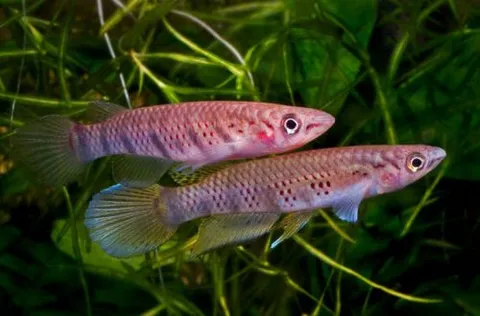
Epiplatys sexfasciatus
The Six-banded Epiplatys, or Six-banded Panchax, scientifically known as Epiplatys sexfasciatus, belongs to the family Nothobranchiidae. This species is a rare exception among Killifish, adapting perfectly to life in…
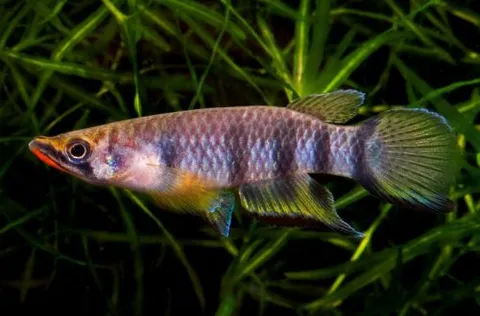
Epiplatys dageti
The Epiplatys dageti, also known as the Black-jaw Panchax, belongs to the family Nothobranchiidae. This peaceful and elegant fish is a perfect fit for a community aquarium. They are moderately hardy and undemanding,…
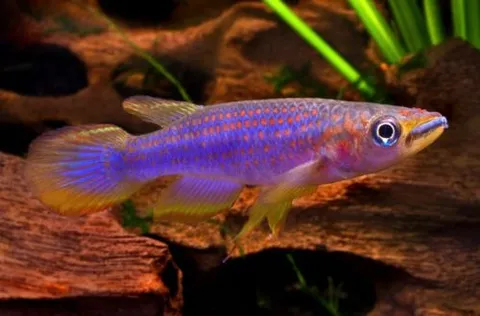
Epiplatys lamottei
The Red-spotted Panchax, also known as Lamotte's Epiplatys (Epiplatys lamottei), belongs to the family Nothobranchiidae. Thanks to its original and remarkably colorful pattern, which is not often found among freshwater…
Pachypanchax arnoulti
Pachypanchax arnoulti, or Arnoult's Panchax, is a member of the Aplocheilidae family. This fish readily adapts to aquarium conditions and does not require complex care, but tankmates small enough to swallow are likely…