Temperature20 – 28 °C
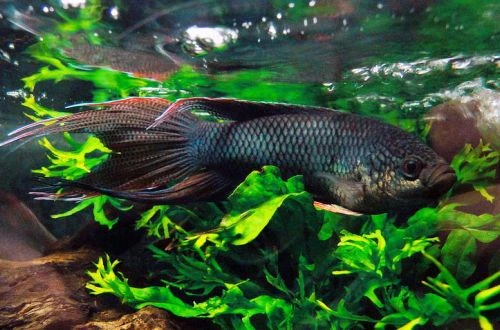
The Black Paradise Fish, scientifically known as Macropodus spechti, belongs to the family Osphronemidae. Previously, it was often referred to as the Macropodus concolor, considered a color variation of the classic Paradise Fish, but since 2006, it has been recognized as a distinct species. This beautiful and hardy fish is easy to keep and breed, adapting well to various conditions, making it suitable for beginner aquarists.
Adults of this fish species reach a length of up to 8 cm. Their bodies are dark brown, almost black. A distinctive feature of males is their longer and wider fins, as well as a tail with a pronounced dark crimson hue, which distinguishes them from females.
Although it was initially believed that the homeland of this species was the islands of Indonesia, no representatives of the genus Macropodus have been found in this region to date. The species is known with certainty from the Thu Bồn river system in Quảng Nam province and the Hương river basin in Thừa Thiên-Huế province, central Vietnam. The full extent of their range remains unclear due to ongoing confusion in the nomenclature and classification of species within the genus. The Black Paradise Fish inhabits lowland areas, populating numerous tropical swamps, streams, and quiet backwaters of small rivers where the current is slow and aquatic vegetation is abundant.
These fish show tolerance towards other species of similar size and often become inhabitants of community tanks. Schooling Danios or Rasboras are good tank mates. However, males tend to show aggression towards each other, especially during spawning, so it is preferable to keep one male with several females.
For a pair or trio of fish, a tank of at least 100 L will be required. The aquarium setup can be arbitrary, but several key points should be considered: low lighting, the presence of shelters in the form of driftwood or other decorative elements, and dense thickets of shade-loving plants. This species demonstrates high adaptability to a wide range of pH and dGH values, but tolerates cool water less well than the related paradise fish: the lower limit is 20°C, so a heater is required. The minimum equipment set includes lighting and filtration; the filter should be set so that it does not create a strong internal current, as the fish tolerate it poorly. The Black Paradise Fish is known for its jumping ability, which means it can easily jump out of an open aquarium or get injured by internal lid components. Therefore, it is crucial to pay attention to a tight-fitting lid, ensuring it securely fits the edges, and that internal lights and wires are well-insulated. It is recommended to maintain the water level 10–15 cm below the edge of the aquarium.
These fish readily accept high-quality dry foods, but for a complete diet, they need to be supplemented with live or frozen foods such as bloodworms, Daphnia, mosquito larvae, or Artemia. It is important to remember that a monotonous diet, for example, consisting only of one type of dry food, can negatively affect the fish's overall well-being and lead to a noticeable dulling of their coloration.
During the breeding season, the male builds an unusual nest of bubbles and plant fragments at the water's surface, where the eggs will later be laid. For spawning, it is recommended to use a separate tank of at least 60 L. The setup for such an aquarium can include clusters of hornwort, and the equipment required will be a heater, a simple air-driven filter, and a tight-fitting lid with a low-power light. The water level should not exceed 20 cm, imitating shallow water. The tank is filled with water from the main aquarium just before introducing the fish. Spawning is stimulated by raising the temperature to 22–24°C in the main aquarium (a heater will also be necessary here) and including a large amount of live or frozen food in the diet. Soon, the female will become noticeably rounded, and the male will begin to build the nest. At this point, he should be transferred to the separate tank, where he will complete the nest construction. During construction, the male may show aggression, even towards potential partners, so the females are left in the main aquarium during this period and added later. Spawning itself occurs under the nest and resembles an “embrace” as the pair presses closely against each other. At the culmination, milt and eggs are released, and fertilization occurs. The eggs are buoyant and immediately fall into the nest; those that accidentally float away are carefully returned by the parents. A total of up to 800 eggs can be laid, although a batch of 200–300 is more common. After spawning, the male remains to guard the clutch, fiercely defending it. The female becomes indifferent to the process and returns to the main aquarium. The incubation period lasts about 48 hours, after which the hatched fry remain in the nest for another couple of days. The male protects the offspring until they begin to swim freely, after which his parental instincts weaken, and he can be returned to the main tank.
The main cause of most diseases in these fish is unsuitable keeping conditions and poor-quality nutrition. If initial symptoms are observed, it is first necessary to check water parameters and the concentration of dangerous substances such as ammonia, nitrites, and nitrates. If the indicators deviate from the norm, they should be brought back into order, and only then should treatment begin.
When choosing a black paradise fish at a pet store, it should be noted that hybrids with the common paradise fish are often sold under this name, so finding a purebred specimen can be difficult. Inspect the fish for fin damage, ulcers, or white spots on the body, which indicate infections. A healthy specimen should be active, curious, and have clear, unclouded eyes. Avoid purchasing fish that appear lethargic, stay at the surface or bottom in a corner of the aquarium, or show signs of emaciation. Since the species is highly territorial, observe their behavior in the community tank: aggressive skirmishes between individuals in the store can lead to injuries that will become entry points for diseases after moving to your aquarium.
The essentials: size, tank volume, water parameters and care
An adult reaches 8 cm in length. Plan the tank around the maximum size: the fish quickly outgrows a cramped setup.
The recommended volume is 100 L. A smaller tank speeds up nitrate build-up and raises stress levels.
Temperature 20–28 °C, pH 6–8, hardness 5–20 dGH. Stability matters more than exact values: sudden swings are harder on the fish than a small deviation from the ideal.
Around 6 years when kept properly. Lifespan depends directly on tank volume, water quality and a varied diet.
Temperament: semi-peaceful (including aggression during spawning / intraspecific conflicts). Keep this in mind when choosing tank mates.
Recommended setup: pair (male/female). Ignoring this is a common cause of stress and disease.
Diet type: any (universal). Feed small portions that are finished within a couple of minutes — overfeeding does more harm than underfeeding.
The scientific name of the species is Macropodus spechti, family Osphronemidae. It also appears in the literature as: Macropodus concolor, Macropodus opercularis.
The water suits 197 of 208 plants in the catalogue — the easiest ones are shown first.
Afzelius's AnubiasAnacharisAnubiasBrazilian PennywortDwarf CloverDwarf CloverDwarf HygrophilaDwarf SagittariaDwarf ValGuppy GrassHornwortJava FernJava MossMoneywortMud SwordNair's LagenandraNarrow Leaf AnacharisNarrow-leaf CloverStringy MossSüsswassertangTaiwan MossTape GrassTemple PlantUssuri Watermilfoil
Matched by family, categories and overlapping keeping conditions
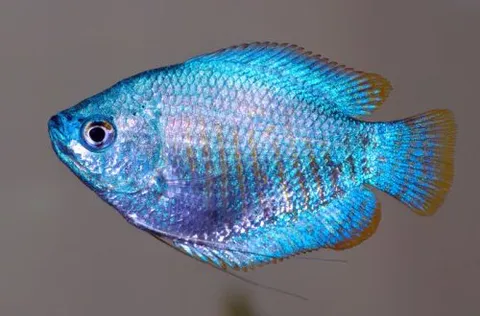
Trichogaster lalius
The Blue Dwarf Gourami, scientifically known as Trichogaster lalius, belongs to the family Osphronemidae. This beautiful miniature fish is an artificially bred variety of the common Dwarf Gourami. It stands out for its…
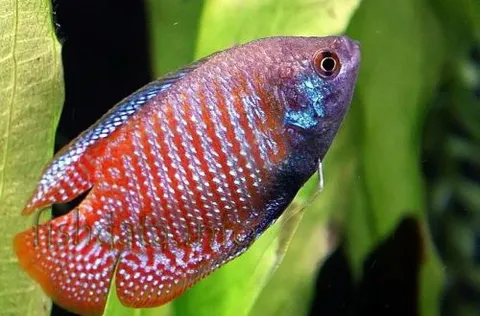
Trichogaster lalius
The Dwarf Gourami (Trichogaster lalius), a member of the Osphronemidae family, has maintained its status as one of the most sought-after aquarium species for many years. Its appeal stems not only from its vibrant…
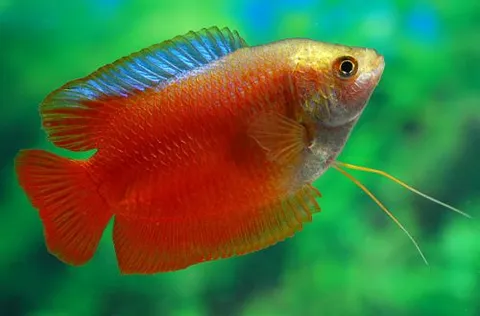
Trichogaster lalius
The Flame Gourami, also known as the Flame Dwarf Gourami and officially named Trichogaster lalius, is a member of the family Osphronemidae. This is an artificially bred variety, which appeared as a result of long and…
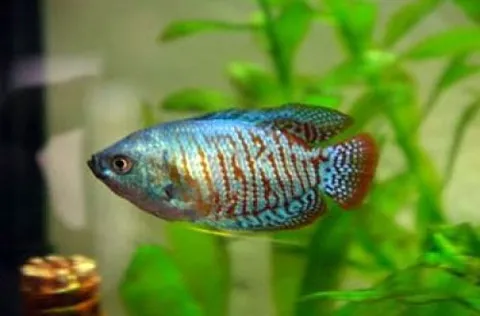
Trichogaster lalius
Trichogaster lalius, also known as the Neon Dwarf Gourami, is a member of the Osphronemidae family. This variety of Dwarf Gourami is widespread and highly popular, standing out among others due to the intensity of its…