Temperature23 – 27 °C
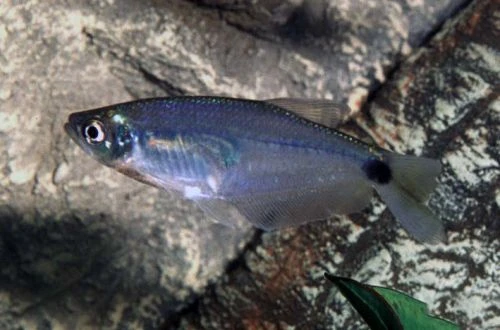
Belonging to the family Characidae, the fish known as Paragoniates alburnus or Blue Glass Tetra is scientifically named Paragoniates alburnus. Its natural range covers territories in Brazil, Colombia, Bolivia, Ecuador, Peru, and Venezuela, where it is found in the upper and middle reaches of the Amazon, as well as in numerous tributaries of the Orinoco. In these habitats, typically at medium depths, the fish prefers to stay among dense aquatic vegetation.
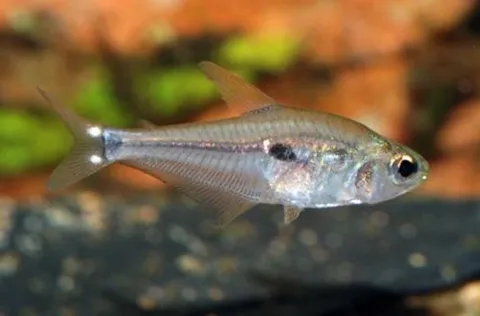
Despite its wide distribution in its natural environment, this fish is not often seen in home aquariums. Adults reach about 6 cm in total length. The figure of up to 12 cm that is sometimes quoted is not supported. A distinctive feature is its translucent body, reflected in the name "glass," which takes on bluish hues under subdued lighting. A large black spot adorns the caudal peduncle. Sexual dimorphism in the species is weakly expressed; males and females look almost identical, with males sometimes only slightly larger than females.
The species inhabits the basins of the middle and upper reaches of the Amazon River, including territories in Brazil, Peru, and Venezuela. In nature, it prefers freshwater biotopes with a tropical climate. The water in its habitats is characterized by an acidic or slightly acidic reaction (pH 5.6–7.8) and moderate hardness levels.
This fish exhibits a relatively peaceful nature and gets along well with members of its own species, although it is not strictly schooling. It also coexists with other non-aggressive fish of comparable size. However, it has been observed that in confined spaces, the Blue Glass Tetra may attack smaller aquarium inhabitants.
For keeping a small group of 4–5 individuals, a tank with a volume of at least 100 L will be required. It is important to provide decor with a dark substrate and offer hiding places in the form of dense plant thickets, as well as maintain subdued lighting, as bright light can negatively affect the fish's coloration, making it dull. Optimal water parameters are considered to be acidic pH values (5.5–7.0) and soft water (2–10 dH). The Blue Glass Tetra is sensitive to strong currents, which often arise from the operation of filtration systems; this aspect should be considered when choosing them. Due to the rarity of the species on the market, even in Europe, there is a possibility of acquiring wild-caught fish. For such specimens, it is crucial to carefully select their diet, as they may ignore dry foods, preferring frozen or live small invertebrates. It is recommended to consult with the seller or breeder before purchase.
Due to its rarity, even on the European market, some specimens offered for sale may be wild-caught fish. When choosing a diet for such individuals, special care should be taken, as they often refuse dry foods in favor of small, live or frozen invertebrates. We strongly recommend consulting with the seller or breeder before purchasing. This fish is generally peaceful and gets along well with its conspecifics, although it does not exhibit strong schooling behavior. It can also coexist with other non-aggressive aquarium inhabitants if they are comparable in size. However, it should be noted that in aquariums with insufficient volume, the Blue Glass Tetra may sometimes show aggression towards smaller tankmates.
The fish are egg-layers and do not exhibit parental care. Spawning occurs by free scattering of eggs in the water column or among plants. For successful breeding, it is recommended to use a separate breeding tank with fine-leaved plants or a protective mesh at the bottom, as adult fish tend to eat their eggs. Sexual maturity is reached at 4–5 months of age.
The species is highly resistant to diseases when kept under proper conditions. Major health problems usually arise from poor water quality or stress caused by unsuitable environmental parameters and the absence of a schooling environment. Like other members of the family, the fish are sensitive to the accumulation of organic waste, which can provoke bacterial infections, such as fin rot or skin lesions. Prevention involves regular water changes, maintaining stable biofiltration, and avoiding sharp fluctuations in temperature and acidity.
When selecting individuals, attention should be paid to the cleanliness of the skin, the absence of white spots, ulcers, or fin damage. A healthy fish should be active, stay with its group, and show no signs of emaciation or unnatural behavior, such as constantly staying at the surface or bottom. Avoid purchasing fish from tanks where dead specimens have been observed.
The essentials: size, tank volume, water parameters and care
An adult reaches 6 cm in length. Plan the tank around the maximum size: the fish quickly outgrows a cramped setup.
The recommended volume is 100 L. A smaller tank speeds up nitrate build-up and raises stress levels.
Temperature 23–27 °C, pH 5.5–7, hardness 2–10 dGH. Stability matters more than exact values: sudden swings are harder on the fish than a small deviation from the ideal.
Around 5 years when kept properly. Lifespan depends directly on tank volume, water quality and a varied diet.
Temperament: peaceful (regular). Keep this in mind when choosing tank mates.
Recommended setup: small group (3–4 individuals). Ignoring this is a common cause of stress and disease.
Diet type: any (universal). Feed small portions that are finished within a couple of minutes — overfeeding does more harm than underfeeding.
The scientific name of the species is Paragoniates alburnus, family Characidae.
The water suits 198 of 208 plants in the catalogue — the easiest ones are shown first.
Afzelius's AnubiasAnacharisAnubiasBrazilian PennywortDwarf CloverDwarf CloverDwarf HygrophilaDwarf SagittariaDwarf ValGuppy GrassHornwortJava FernJava MossMoneywortMud SwordNair's LagenandraNarrow Leaf AnacharisNarrow-leaf CloverStringy MossSüsswassertangTaiwan MossTape GrassTemple PlantUssuri Watermilfoil
Matched by family, categories and overlapping keeping conditions
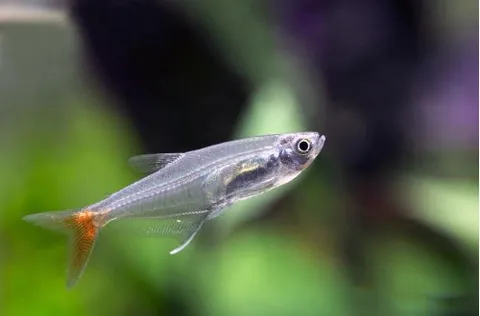
Prionobrama filigera
The Glass Tetra, scientifically known as Prionobrama filigera, is a member of the Characidae family. Its main feature is its almost completely transparent body, which contrasts with its bright red caudal fin. Another…
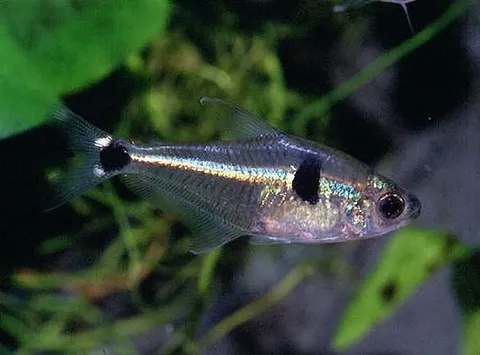
Phenacogaster calverti
The fish Phenacogaster calverti, known as Phenacogaster calverti, belongs to the family Characidae. Its natural habitat is the numerous coastal river systems of the Brazilian states of Ceará and Paraíba in the east of…
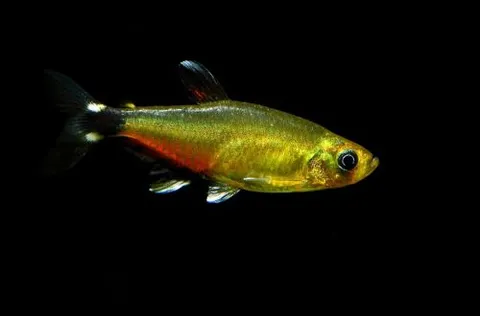
Aphyocharax nattereri
Aphyocharax nattereri, also known as Natterer's Aphyocharax, belongs to the Characidae family. This species is not as commonly found in pet stores as its tetra relatives, yet it possesses no less attractiveness and…
Phenacogaster tegatus
Phenacogaster tegatus, or Six-eyed Tetra (scientific name Phenacogaster tegatus), belongs to the Characidae family. This fish is perhaps not often seen in aquariums, as its subdued coloration does not allow it to stand…