Temperature22 – 28 °C
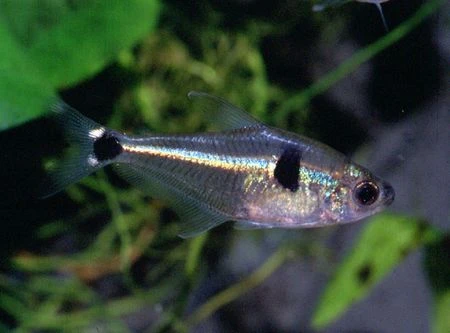
The fish Phenacogaster calverti, known as Phenacogaster calverti, belongs to the family Characidae. Its natural habitat is the numerous coastal river systems of the Brazilian states of Ceará and Paraíba in the east of the country. This species is most often found in areas rich in aquatic vegetation.
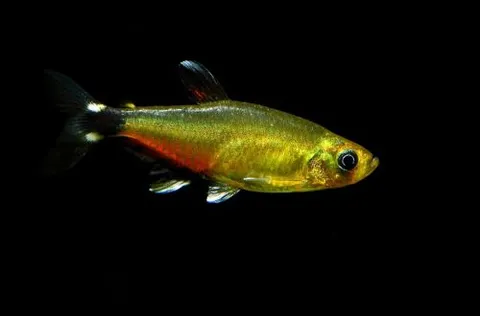
Adult Phenacogaster calverti reach approximately 6 cm in length. Their coloration is predominantly gray-silver, with a bright iridescent stripe running along the lateral line of the body. Two large black spots are visible above the belly and closer to the tail. The fins of these fish are translucent. Sexual dimorphism is extremely weak, making it almost impossible to distinguish males from females by external characteristics. The information presented is brief.
The species inhabits South America, predominantly in the coastal river basins of the states of Ceará and Paraíba in Brazil. In nature, the fish inhabit tropical freshwater bodies, preferring the bottom and middle water layers. Characteristic environmental conditions include warm water with a temperature range of 23–27 degrees Celsius.
This fish is distinguished by its peaceful nature and high activity. It prefers to live in a school of its own kind, so keeping a single specimen is undesirable. Phenacogaster calverti is well compatible with most other aquarium fish species of comparable size and similar temperament.
Optimal conditions for keeping Phenacogaster calverti include warm water (up to 28°C), soft and slightly acidic. An aquarium of 60 to 80 liters will be sufficient for a school of 5–6 individuals. An important aspect is maintaining high water quality, which is achieved through effective filtration and regular maintenance. The latter involves weekly partial water changes with fresh water and timely removal of organic residues, such as uneaten food and excrement. The aquarium decor can be varied, but it is desirable to ensure a balance between open areas for swimming and sheltered zones created by dense plant thickets. Moderate or subdued lighting is recommended; floating plants can be used to create additional shade. In a home aquarium, these fish readily accept common types of dry, frozen, and live foods of appropriate size.
In a home aquarium, these fish readily accept common types of dry, frozen, and live foods of appropriate size. Phenacogaster calverti is a peaceful and active fish that is most comfortable in a school of its kind; solitary keeping is not recommended for it. It is well compatible with most other aquarium fish species of similar size and temperament.
There is no information on aquarium breeding. This is a small, semi-transparent characin; as in most related species, spawning probably takes place in open water or among plants, with no care for the offspring. No external sexual differences have been described.
No diseases that affect only this species have been described. Under suitable conditions — clean water, a balanced diet and calm tank mates — health problems usually do not arise. The most common cause of illness is a decline in conditions: it weakens the immune system, and the fish becomes vulnerable to infections that are always present in an aquarium. At the first signs of trouble — lethargy, wasting, refusal of food or clamped fins — check the basic water parameters and the levels of ammonia, nitrite and nitrate first. Restoring acceptable conditions often lets the fish recover on its own.
When selecting individuals, attention should be paid to the overall health and activity of the fish. Healthy specimens should exhibit natural mobility, have clean fins without signs of erosion or plaque, and tightly pressed scales. It is recommended to avoid purchasing fish with visible skin damage or signs of emaciation, as adaptation to new conditions may be difficult in the presence of stress factors.
The essentials: size, tank volume, water parameters and care
An adult reaches 6 cm in length. Plan the tank around the maximum size: the fish quickly outgrows a cramped setup.
The recommended volume is 60 L. A smaller tank speeds up nitrate build-up and raises stress levels.
Temperature 22–28 °C, pH 6–7, hardness 3–10 dGH. Stability matters more than exact values: sudden swings are harder on the fish than a small deviation from the ideal.
Around 4 years when kept properly. Lifespan depends directly on tank volume, water quality and a varied diet.
Temperament: peaceful (regular). Keep this in mind when choosing tank mates.
Recommended setup: medium group (6–8 individuals). Ignoring this is a common cause of stress and disease.
Diet type: any (universal). Feed small portions that are finished within a couple of minutes — overfeeding does more harm than underfeeding.
The scientific name of the species is Phenacogaster calverti, family Characidae. It also appears in the literature as: Grammabrycon calverti.
The water suits 197 of 208 plants in the catalogue — the easiest ones are shown first.
Afzelius's AnubiasAnacharisAnubiasBrazilian PennywortDwarf CloverDwarf CloverDwarf HygrophilaDwarf SagittariaDwarf ValGuppy GrassHornwortJava FernJava MossMoneywortMud SwordNair's LagenandraNarrow Leaf AnacharisNarrow-leaf CloverStringy MossSüsswassertangTaiwan MossTape GrassTemple PlantUssuri Watermilfoil
Matched by family, categories and overlapping keeping conditions
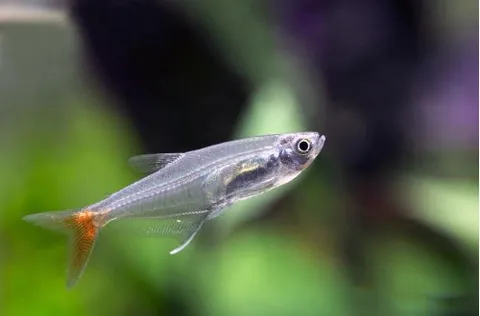
Prionobrama filigera
The Glass Tetra, scientifically known as Prionobrama filigera, is a member of the Characidae family. Its main feature is its almost completely transparent body, which contrasts with its bright red caudal fin. Another…
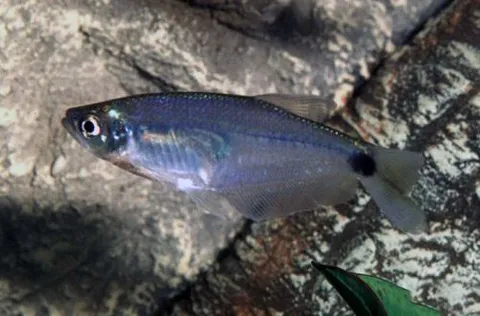
Paragoniates alburnus
Belonging to the family Characidae, the fish known as Paragoniates alburnus or Blue Glass Tetra is scientifically named Paragoniates alburnus. Its natural range covers territories in Brazil, Colombia, Bolivia, Ecuador,…
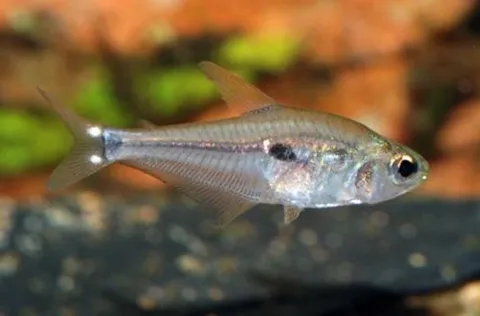
Phenacogaster tegatus
Phenacogaster tegatus, or Six-eyed Tetra (scientific name Phenacogaster tegatus), belongs to the Characidae family. This fish is perhaps not often seen in aquariums, as its subdued coloration does not allow it to stand…
Aphyocharax nattereri
Aphyocharax nattereri, also known as Natterer's Aphyocharax, belongs to the Characidae family. This species is not as commonly found in pet stores as its tetra relatives, yet it possesses no less attractiveness and…