Temperature22 – 25 °C
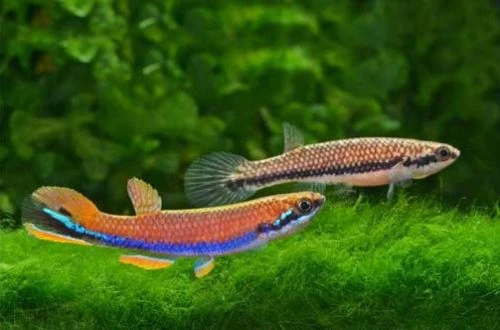
The Blue-striped Rivulus, scientifically known as Laimosemion xiphidius (formerly Rivulus xiphidius), is a member of the Rivulidae family. Its natural habitat is located in South America, specifically in the Oyapock River basin, which flows through French Guiana. It prefers shallow areas of small rivers that wind through tropical rainforests. The water in these areas acquires a rich brown color due to the high concentration of tannins formed by decomposing vegetation.
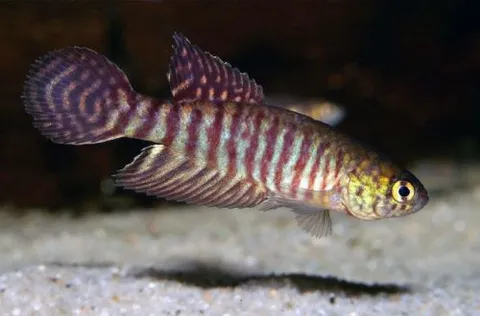
Reaching four centimeters in length as adults, these fish have slender bodies and rounded fins. Sexual differentiation in fry becomes noticeable by three months of age. A distinctive feature of males is their bright coloration, dominated by orange hues, complemented by a wide blue stripe running along the body, and several turquoise and black strokes. Females, in turn, are colored in gray tones, and instead of a blue stripe, they have a black line along the body. It is important to note that, unlike many other Killifish species, the Blue-striped Rivulus is not an annual species and, under favorable captive conditions, can live for more than three years.
The species inhabits waters in French Guiana, Suriname, and bordering regions of Brazil. In nature, it occupies shallow areas of streams, often with stagnant or slow-moving water, shaded by tropical forest. A typical biotope is characterized by the presence of fallen leaves on the bottom, soft acidic water with very low mineralization, and temperatures in the range of 22–25 °C.
Males display rivalry for the attention of females. For stable long-term keeping, it is recommended to adhere to a ratio of 1:3, meaning one male for every three females. These fish behave peacefully towards other species of similar size, provided they can adapt to similar living conditions. Suitable tank mates include small characins, such as tetras and neons, as well as miniature cyprinids, for example, rasboras.
Keeping and breeding this species are considered quite challenging. For successful maintenance, it is necessary to recreate conditions as close as possible to their natural environment. A 40-liter aquarium will be sufficient for a group of 3–4 individuals. The decor should include an abundance of aquatic plants, a soft substrate covered with a layer of fallen leaves, and driftwood from certain tree species. Lighting should be subdued. Water hydrochemical parameters should be maintained within a low pH and dGH range at a temperature of 22–25°C. In the wild, when threatened by predators, these fish can jump out of the water onto land, where they can remain for some time before returning. This characteristic, combined with their skittishness, can lead to regular jumps out of the aquarium. To prevent this, a secure lid should be provided, and many floating plants should be placed in the aquarium.
Individual dietary preferences may vary depending on the batch of fish. While some suppliers adapt Blue-striped Rivulus to dry substitute foods, others prefer to feed them exclusively live organisms, such as small invertebrates. The basis of their diet should always correspond to what they were fed previously.
The fish reach sexual maturity by 10 months. This species is characterized by low productivity, laying only a few dozen eggs per spawning season. The eggs are quite large for such a small fish — their diameter reaches 2 mm. Breeding is a complex task, only manageable by experienced aquarists. The main difficulties are associated with stimulating spawning, which requires regular partial water changes with fresh water, mimicking the rainy season, and feeding live foods. An improper diet can lead to the fish eating their own eggs. Feeding the newly hatched fry presents no less difficulty. Here, too, the main problem is the correct selection of food. Professional breeders use Artemia nauplii, adding a few drops of liquid vitamins to them before feeding to the fry.
The species has moderate resilience but is sensitive to abrupt changes in water parameters and environmental quality. If keeping conditions are violated, such as the accumulation of organic waste or high levels of nitrogenous compounds, the fish are susceptible to bacterial infections, including fin rot. Ectoparasite infestations, such as those causing Ichthyophthiriasis, are also possible under stress or weakened immunity. Disease prevention is based on maintaining stable parameters of soft acidic water and regular partial water changes. It is important to avoid overfeeding, as excess organic matter quickly degrades water quality. When introducing new individuals, quarantine is mandatory to prevent the introduction of pathogens into the main aquarium.
When selecting individuals, attention should be paid to the fish's overall activity and fin integrity. Healthy specimens should show interest in their surroundings, have no visible skin damage, ulcers, or signs of emaciation. It is recommended to avoid purchasing fish that appear sluggish, stay at the water surface without obvious reasons, or have unnaturally clamped fins, which may indicate stress or hidden diseases.
The essentials: size, tank volume, water parameters and care
An adult reaches 4 cm in length. Plan the tank around the maximum size: the fish quickly outgrows a cramped setup.
The recommended volume is 40 L. A smaller tank speeds up nitrate build-up and raises stress levels.
Temperature 22–25 °C, pH 5–6, hardness 4–9 dGH. Stability matters more than exact values: sudden swings are harder on the fish than a small deviation from the ideal.
Around 3 years when kept properly. Lifespan depends directly on tank volume, water quality and a varied diet.
Temperament: peaceful (regular). Keep this in mind when choosing tank mates.
Recommended setup: small group (3–4 individuals). Ignoring this is a common cause of stress and disease.
Diet type: any (universal). Feed small portions that are finished within a couple of minutes — overfeeding does more harm than underfeeding.
The scientific name of the species is Laimosemion xiphidius, family Rivulidae. It also appears in the literature as: Rivulus xiphidius.
The water suits 170 of 208 plants in the catalogue — the easiest ones are shown first.
African Onion PlantAmazon FrogbitAmazon SwordAnacharisAnubiasArrowhead CryptAsian WatermossDwarf CloverDwarf CloverDwarf HygrophilaDwarf SagittariaGuppy GrassHornwortJava FernJava MossMoneywortMud SwordNarrow Leaf AnacharisNarrow-leaf CloverStringy MossSüsswassertangTaiwan MossTemple PlantUssuri Watermilfoil
Matched by family, categories and overlapping keeping conditions
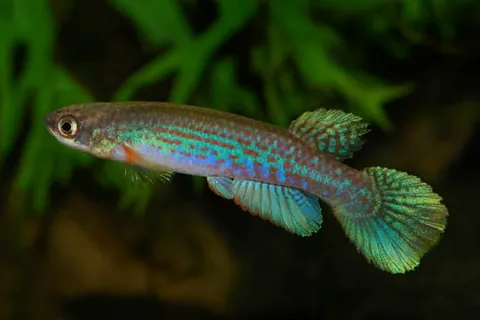
Laimosemion agilae
Laimosemion agilae, also known as Rivulus agilae, belongs to the family Rivulidae. These fish originate from South America, where they can be found in French Guiana, Suriname, and Guyana. They are named after the…
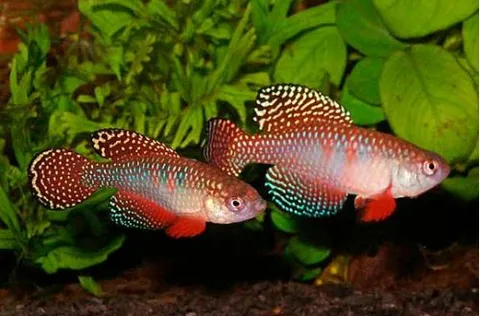
Hypsolebias picturatus
Hypsolebias picturatus is the scientific name for this fish. This species belongs to the family Rivulidae and is found in the water bodies of the eastern states of Brazil, within the São Francisco River basin. Its…
Xenurolebias myersi
Myers' Killifish, scientifically known as Xenurolebias myersi, belongs to the Rivulidae family. This striking striped fish was named in honour of the American ichthyologist George Sprague Myers. Its discovery and…