Temperature20 – 27 °C
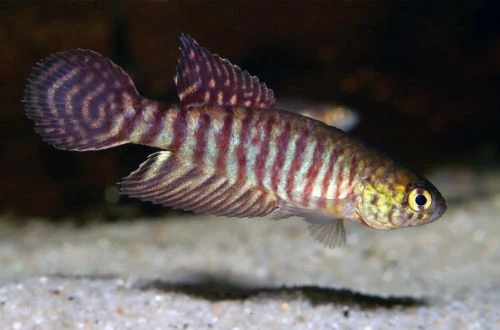
Myers' Killifish, scientifically known as Xenurolebias myersi, belongs to the Rivulidae family. This striking striped fish was named in honour of the American ichthyologist George Sprague Myers. Its discovery and inclusion in international catalogs occurred relatively recently, in 1971.
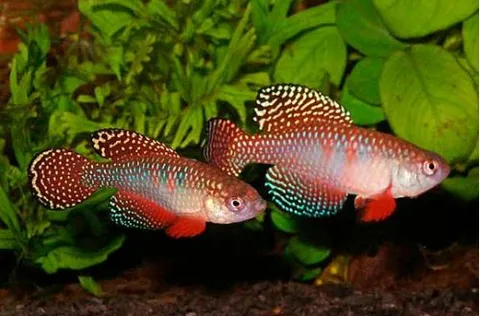
These miniature fish have slender, elongated bodies and luxuriant fins. Their dorsal and anal fins are pointed, and the caudal fin is rounded. This species exhibits pronounced sexual dimorphism. Males are larger than females, and their coloration can be brownish-yellow or greenish-blue, complemented by 10–15 dark crimson or dark brown vertical stripes. Females, on the other hand, are lighter brown, and their bodies are adorned with 9–12 wide dark stripes.
The species comes from temporary pools on the Atlantic Forest coastal plains of eastern Brazil — the Itaúnas river basin and adjacent small drainages in the state of Espírito Santo. The fish inhabit small bodies of water, streams, and swampy areas, which are primarily fed by rainfall. These areas are characterized by periodic drying. For example, almost every year from July to November, the habitat of Myers' Killifish completely dries up. Adult fish die during this period, but the eggs survive in a layer of silty soil, and with the onset of the rainy season, fry emerge from them.
A species-specific aquarium, organized on a harem principle (2–3 females per male), is most preferable. If several males are kept in an aquarium without a sufficient number of females, serious conflicts and skirmishes between them are highly likely. Adding other fish species to such an aquarium is generally undesirable.
For a pair of fish, the minimum aquarium volume should be about 40 liters. When setting up the tank, it is important to consider their breeding characteristics. Plastic containers filled with dark, soft substrate based on peat or coconut fiber are used as substrate, and these should be easily removable from the aquarium. A volumetric background can be installed as decor. Floating plants are preferred, for example, two large clumps, but the entire water surface should not be completely overgrown. Simple sponge filters, heaters, air pumps, and lighting systems are sufficient equipment. It is important to set up the filter and air pump so that they do not create strong water movement, as Myers' Killifish tolerate moderate and strong currents poorly. Aquarium care includes weekly partial water changes, usually 15 to 30% of the total volume, depending on the number of fish and the size of the tank. If necessary, the glass should be cleaned of organic film.
These fish feed on meaty foods, preferring live or frozen fare. In a home aquarium, the optimal diet includes bloodworms, daphnia, mosquito larvae, and glassworms (white mosquito larvae). It is recommended to feed them 2–3 times a day, providing an amount of food that will be consumed within 3–5 minutes. To maintain water cleanliness, it is important to remove any uneaten food from the aquarium.
As mentioned earlier, in their natural environment, these fish live for only one season. Before the water bodies dry up, they manage to lay eggs in the substrate, after which the adult fish die. The eggs remain viable until the wet season arrives. In a home aquarium, it is possible to extend their lifespan to two seasons and obtain offspring annually. In June, the water level and temperature are gradually lowered to 21–23°C, which stimulates spawning. The female lays eggs directly into the substrate, which is then removed along with the container. After this, the aquarium temperature is returned to normal values, and the fish continue their lives. The container with substrate and eggs is stored in a dark place at an air temperature of 21–23°C for 2–4 months. After this period, the substrate is placed in a tank with water, and after some time, fry appear. They grow very quickly and reach sexual maturity within a month. The uniqueness of this breeding method allows for the postal shipment of eggs during the warm season.
These fish are highly resistant to diseases. However, a threat can arise for the eggs: when stored in humid conditions, there is a possibility of mold formation.
When purchasing, choose active individuals with clean fins and no visible body damage. It is important to note that this species is seasonal (annual), so pet stores often sell adult fish whose life cycle is nearing its end. It is recommended to clarify the age of the individuals and their keeping conditions with the seller. Avoid buying fish that appear apathetic, stay at the surface, or show signs of emaciation, as due to their specific metabolism, they are extremely sensitive to stress during transportation and changes in water parameters.
The essentials: size, tank volume, water parameters and care
An adult reaches 4 cm in length. Plan the tank around the maximum size: the fish quickly outgrows a cramped setup.
The recommended volume is 40 L. A smaller tank speeds up nitrate build-up and raises stress levels.
Temperature 20–27 °C, pH 5.5–7, hardness 1–5 dGH. Stability matters more than exact values: sudden swings are harder on the fish than a small deviation from the ideal.
Around 1 years when kept properly. Lifespan depends directly on tank volume, water quality and a varied diet.
Temperament: territorial (often aggressive). Keep this in mind when choosing tank mates.
Recommended setup: harem (1 male and several females). Ignoring this is a common cause of stress and disease.
Diet type: sinking (meat / protein). Feed small portions that are finished within a couple of minutes — overfeeding does more harm than underfeeding.
The scientific name of the species is Xenurolebias myersi, family Rivulidae. It also appears in the literature as: Cynolebias myersi, Nematolebias myersi.
The water suits 197 of 208 plants in the catalogue — the easiest ones are shown first.
Afzelius's AnubiasAnacharisAnubiasBrazilian PennywortDwarf CloverDwarf CloverDwarf HygrophilaDwarf SagittariaDwarf ValGuppy GrassHornwortJava FernJava MossMoneywortMud SwordNair's LagenandraNarrow Leaf AnacharisNarrow-leaf CloverStringy MossSüsswassertangTaiwan MossTape GrassTemple PlantUssuri Watermilfoil
Matched by family, categories and overlapping keeping conditions
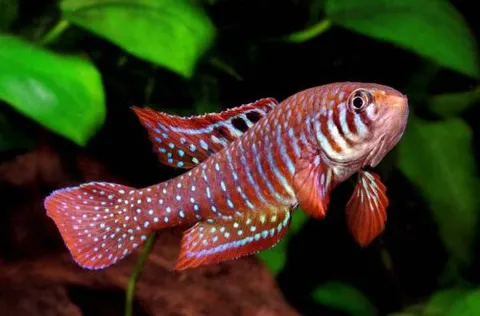
Simpsonichthys santanae
Simpsonichthys santanae, or Santana's Pearlfish, belongs to the family Rivulidae. These fish are closely related to Nothobranchius, which inhabit a different continent—Africa, and this connection is evident in almost…
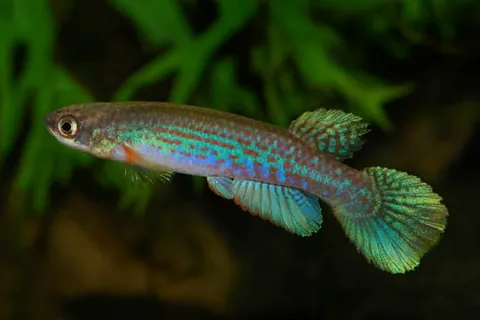
Laimosemion agilae
Laimosemion agilae, also known as Rivulus agilae, belongs to the family Rivulidae. These fish originate from South America, where they can be found in French Guiana, Suriname, and Guyana. They are named after the…
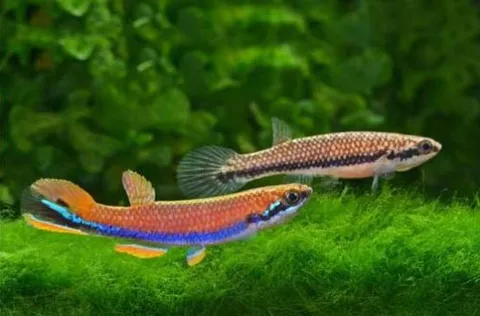
Laimosemion xiphidius
The Blue-striped Rivulus, scientifically known as Laimosemion xiphidius (formerly Rivulus xiphidius), is a member of the Rivulidae family. Its natural habitat is located in South America, specifically in the Oyapock…
Hypsolebias picturatus
Hypsolebias picturatus is the scientific name for this fish. This species belongs to the family Rivulidae and is found in the water bodies of the eastern states of Brazil, within the São Francisco River basin. Its…