Temperature23 – 29 °C
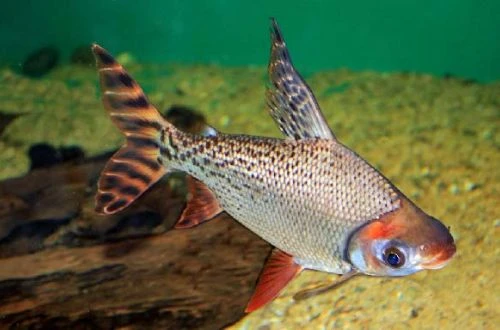
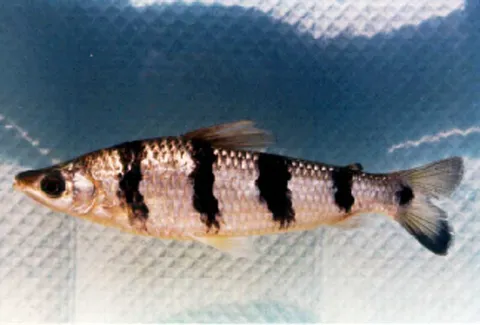
The Many-Barred Semaprochilodus, also known as the Brazilian Haraki (scientific name Semaprochilodus insignis), belongs to the family Prochilodontidae. In its natural habitat, this species is widely distributed across various biotopes of the Amazon basin in South America — from overgrown shallow lakes and swampy river sections to swift forest streams.
Adults of this species reach approximately 35 cm in length. They are characterized by a massive body, culminating in a large, slightly flattened head. The body coloration is usually silvery, sometimes with noticeable yellowish hues. The caudal and anal fins have a characteristic red color with thin black horizontal stripes. In young fish, black speckles can be observed on the caudal fin, which usually disappear as they mature. The Semaprochilodus taeniurus, mentioned earlier, has a similar coloration, but its black speckles persist into adulthood.
The species inhabits the central and western parts of the Amazon River basin, including its tributaries in Brazil, Colombia, Ecuador, Peru, and Guyana. The fish inhabit floodplain water bodies and channels, undertaking long-distance seasonal migrations for spawning. In nature, they prefer areas with soft water, rich in organic deposits, which form the basis of their diet.
In limited aquarium space, the behavior of the Many-Barred Semaprochilodus differs significantly from that of its wild counterparts. In spacious aquariums, with a low stocking density, Haraki exhibit peacefulness even towards small species such as neon tetras and rasboras. However, in smaller tanks or when kept in large schools, they may display intraspecific aggression, resulting in weaker individuals being constantly attacked. In such cases, solitary or paired keeping with other species of comparable size is preferable.
Successful keeping of these fish largely depends on a spacious aquarium. For a small group of 3–4 individuals, a tank volume of 500 liters or more is recommended. The Brazilian Charaki (Semaprochilodus insignis) has no special requirements for decoration; the choice and arrangement of decorative elements are at the discretion of the aquarist. However, it is important to provide enough open swimming space, avoiding excessive plant growth, which, by the way, can be damaged due to their diet. In case of threat, the Brazilian Charaki demonstrates the ability to jump out of the water to a significant height, so a reliable aquarium lid is a mandatory condition. Thanks to the diversity of their natural biotopes, these fish are highly adaptable to various conditions: they thrive in a wide range of pH and dH values, and can also tolerate periods of reduced dissolved oxygen content. The diet should consist mainly of foods with a high content of plant components. Feeding exclusively live or frozen foods, or products with low fiber content, can lead to digestive problems. An optimal diet is considered to be a combination of popular dry foods (such as flakes and granules) with the addition of blanched vegetables (for example, cucumber, spinach, zucchini) and lettuce leaves.
Foods with a high content of plant components should form the basis of the daily diet. Exclusively live or frozen foods, as well as products with low fiber content, can provoke digestive problems. An optimal diet is considered to be a combination of popular dry foods (flakes, granules) with blanched vegetables such as cucumber, spinach, zucchini, and lettuce leaves. The behavior of the Many-banded Semaprochilodus (Semaprochilodus insignis) in the confined space of an aquarium differs significantly from the habits of wild individuals. In large tanks with low stocking density, Charaki behave peacefully, even towards small species, such as neon tetras and rasboras. However, in small aquariums or when kept in large groups, they may exhibit intraspecific aggression, where weaker individuals are constantly attacked. Solitary or paired keeping with other species of similar size is recommended. In nature, the breeding process is preceded by a long migration, directly related to the change of rainy seasons in the Amazon region. Recreating such conditions in an artificial environment is very difficult. Therefore, the Many-banded Semaprochilodus (Semaprochilodus insignis) is usually sold as juveniles caught from rivers or raised on specialized fish farms. This species is known for its hardiness and unpretentiousness. Major health problems are often associated with poor nutrition, an unsuccessful choice of tank mates, or overly cramped living conditions. In the latter case, the fish often get injured by bumping into the aquarium walls.
In natural conditions, reproduction is preceded by a prolonged migration, closely linked to the seasonal rain cycles in the Amazon. Replicating these conditions in an artificial environment is extremely difficult. For this reason, the Many-banded Semaprochilodus (Semaprochilodus insignis) is usually sold as juveniles caught from rivers or raised on specialized aquaculture farms.
This species is considered hardy and quite unpretentious. Health problems most often arise due to inadequate nutrition, improper selection of tank mates, or cramped living conditions. In the latter case, the fish can get injured by forcefully bumping into the aquarium walls.
When purchasing, choose active individuals with clean scales and no fin damage. It is important to pay attention to the fish's behavior in the store: healthy specimens should show interest in food and swim actively. Avoid individuals with signs of emaciation, sunken bellies, or unnatural spots on the body. Since this is a schooling species, it is recommended to acquire a group of several individuals to reduce stress and aggression.
The essentials: size, tank volume, water parameters and care
An adult reaches 35 cm in length. Plan the tank around the maximum size: the fish quickly outgrows a cramped setup.
The recommended volume is 500 L. A smaller tank speeds up nitrate build-up and raises stress levels.
Temperature 23–29 °C, pH 6–8, hardness 1–20 dGH. Stability matters more than exact values: sudden swings are harder on the fish than a small deviation from the ideal.
Around 10 years when kept properly. Lifespan depends directly on tank volume, water quality and a varied diet.
Temperament: semi-peaceful (including aggression during spawning / intraspecific conflicts). Keep this in mind when choosing tank mates.
Recommended setup: mixed (solitary / pair / group). Ignoring this is a common cause of stress and disease.
Diet type: plant-based (algae, vegetables). Feed small portions that are finished within a couple of minutes — overfeeding does more harm than underfeeding.
The scientific name of the species is Semaprochilodus insignis, family Prochilodontids (Prochilodontidae). It also appears in the literature as: Prochilodus amazonensis, Prochilodus insignis, Prochilodus theraponura.
The water suits 197 of 208 plants in the catalogue — the easiest ones are shown first.
Afzelius's AnubiasAnacharisAnubiasBrazilian PennywortDwarf CloverDwarf CloverDwarf HygrophilaDwarf SagittariaDwarf ValGuppy GrassHornwortJava FernJava MossMoneywortMud SwordNair's LagenandraNarrow Leaf AnacharisNarrow-leaf CloverStringy MossSüsswassertangTaiwan MossTape GrassTemple PlantUssuri Watermilfoil
Matched by family, categories and overlapping keeping conditions
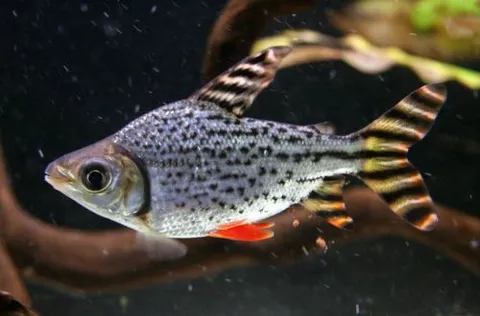
Semaprochilodus taeniurus
Semaprochilodus taeniurus, scientifically known as Semaprochilodus taeniurus, is a member of the family Prochilodontidae, or Prochilodontids. This is a rather large species that requires a special diet rich in plant…
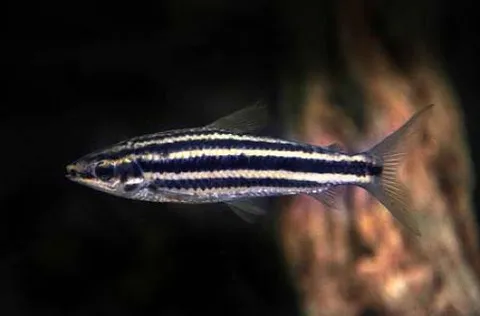
Leporinus striatus
The Four-lined Leporinus, also known as Leporinus striatus, belongs to the family Anostomidae. This fish species inhabits the waters of South America, particularly in the Paraná and Paraguay river basins, covering the…
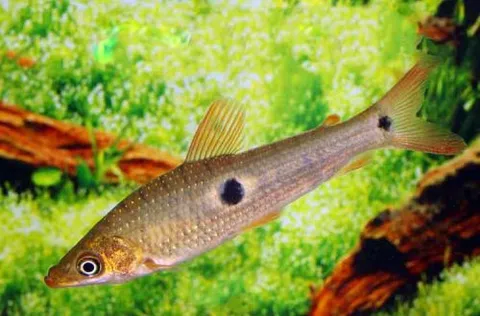
Pseudanos trimaculatus
The Three-spot Anostomus, scientifically known as Pseudanos trimaculatus, belongs to the family Anostomidae, or Headstanders. Previously, this fish was classified as Anostomus trimaculatus, and this name is still found…
Schizodon fasciatus
The scientific name Schizodon fasciatus refers to the banded Schizodon, a member of the family Anostomidae. This fish is native to South America, where it can be found both in the upper reaches of the Amazon and in…