Temperature20 – 28 °C
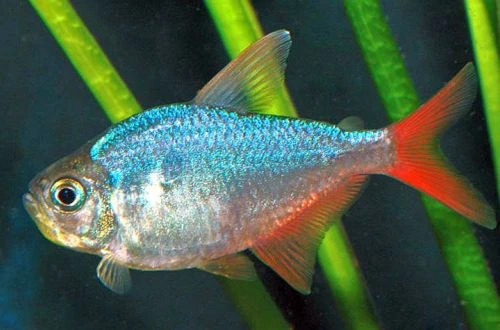
The Colombian Tetra (Hyphessobrycon columbianus) is an attractive and peaceful fish belonging to the family Acestrorhamphidae. Its care is straightforward, making it an excellent choice for aquarists. It harmonizes well with other non-aggressive species and is also suitable for small freshwater aquariums.
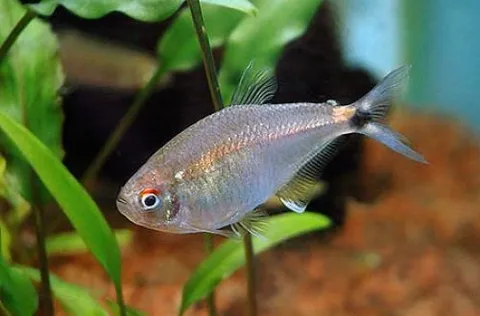
These fish grow to approximately 5–6 cm in length. A distinctive feature of males is their coloration, combining blue hues on the back and silvery tones on the belly, while the tail is bright red. Females are typically less vibrantly colored, with a predominant silvery tone. The fins of both sexes are translucent.
The homeland of this fish is South America, specifically the basin of the small Acandí River, which flows along the border of Colombia and Panama. The upper reaches of the river flow through tropical forests, while in the middle and lower reaches, the river is surrounded by vast meadows. The water here is usually turbid, and the bottom is predominantly sandy-gravel substrate. It is interesting to note that in the dialect of the indigenous population, the word “Acanti” translates to “river of stones.”
This peaceful fish is schooling, so it is recommended to keep them in groups of at least 8–10 individuals. They coexist well with other species of similar size and temperament. However, aggressive or overly large fish that could create stressful conditions for them should be avoided.
For a small group of these fish, a suitable aquarium should have a volume of at least 80 liters. There are no special restrictions regarding décor: the Colombian Tetra feels comfortable both in dense plant thickets and in an aquarium with minimal decorations. The choice of décor elements and aquatic plants completely depends on the aquarist's preferences or the requirements of other inhabitants. Their care is relatively simple and does not require significant effort. Key points for maintaining water cleanliness and preventing the accumulation of organic waste include an effective filter, regular weekly water changes of 15–20% of the volume with fresh water, and periodic gravel vacuuming.
The Colombian Tetra readily accepts a variety of foods, both dry and live or frozen, but it is important to ensure the presence of plant-based supplements in their diet. To maintain a complete diet, it is recommended to include several types of food in their menu. For example, flakes or granules can be combined with bloodworms or brine shrimp. Even without live foods, these fish can be successfully kept using high-quality feed mixes from trusted manufacturers.
Colombian Tetras are capable of breeding even in a community tank, but the survival rate of the fry will be low. Fry can fall victim not only to other fish but also to their own parents. If the goal is successful breeding, a separate spawning tank will be required. For its setup, artificial spawning substrate or thickets of low-growing plants and mosses, such as Java moss, are excellent. Lighting should be subdued. Equipment needed includes a heater, a low-power light, and a simple air-driven sponge filter. The latter will provide necessary cleaning and biological filtration while remaining safe for the fry. To fill the spawning tank, water should be taken from the main aquarium. The approach of spawning can be determined by the noticeably swollen belly of the females, indicating the presence of eggs. After this, several females and one of the brightest and largest males are transferred to the spawning tank. After spawning, the parents are returned. The incubation period lasts approximately 24–36 hours. In the first days, the fry feed on the remnants of the yolk sac, then switch to microscopic foods. Excellent food sources at this stage are infusoria or specialized powdered fry foods, with particles not exceeding 50 microns. As the fry grow, their diet can be gradually expanded to include brine shrimp nauplii.
Health problems in these fish arise only in the presence of injuries or keeping in unsuitable conditions, which leads to a weakening of the immune system and the subsequent occurrence of various diseases. At the first signs of illness, it is necessary first to check the water parameters for exceeding permissible values or the presence of toxic substances (such as nitrites, nitrates, ammonia). If deviations are found, all indicators should be normalized, and then treatment should begin.
When purchasing, choose active, mobile fish with clean scales and vibrant coloration. Avoid individuals with damaged fins, signs of emaciation, or an unnaturally bloated belly. Since Colombian Tetras are schooling fish, it is recommended to acquire a group of 6–8 individuals at once, which will help them adapt more quickly to new conditions and reduce stress levels. Inspect the aquarium in the store for the absence of dead fish and signs of disease in tank mates. Healthy Tetras should show interest in food and actively move through the water column, rather than staying near the surface or in corners in an apathetic state. Remember that in a stressed state or under poor lighting in the store, the fish's coloration may be temporarily pale, which is normal for adaptation.
The essentials: size, tank volume, water parameters and care
An adult reaches 5–7 cm in length. Plan the tank around the maximum size: the fish quickly outgrows a cramped setup.
The recommended volume is 80 L. A smaller tank speeds up nitrate build-up and raises stress levels.
Temperature 20–28 °C, pH 5–7.5, hardness 1–10 dGH. Stability matters more than exact values: sudden swings are harder on the fish than a small deviation from the ideal.
Around 5 years when kept properly. Lifespan depends directly on tank volume, water quality and a varied diet.
Temperament: peaceful (regular). Keep this in mind when choosing tank mates.
Recommended setup: group (8–10 individuals). Ignoring this is a common cause of stress and disease.
Diet type: any (universal). Feed small portions that are finished within a couple of minutes — overfeeding does more harm than underfeeding.
The scientific name of the species is Hyphessobrycon columbianus, family Acestrorhamphidae.
The water suits 198 of 208 plants in the catalogue — the easiest ones are shown first.
Afzelius's AnubiasAnacharisAnubiasBrazilian PennywortDwarf CloverDwarf CloverDwarf HygrophilaDwarf SagittariaDwarf ValGuppy GrassHornwortJava FernJava MossMoneywortMud SwordNair's LagenandraNarrow Leaf AnacharisNarrow-leaf CloverStringy MossSüsswassertangTaiwan MossTape GrassTemple PlantUssuri Watermilfoil
Matched by family, categories and overlapping keeping conditions
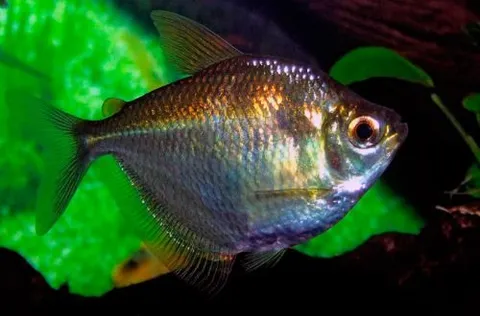
Brachychalcinus orbicularis
The scientific name Brachychalcinus orbicularis is assigned to the Orbicular Tetra, also known as the Discus Tetra, belonging to the Acestrorhamphidae family. This fish received its second name due to the similarity of…
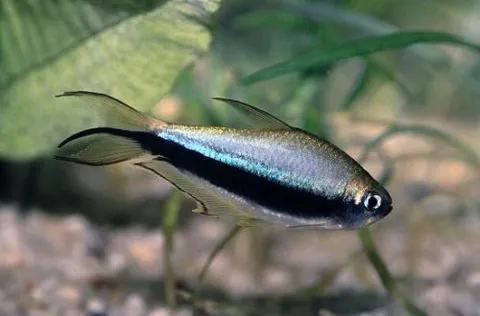
Nematobrycon palmeri
Nematobrycon palmeri, known as the Emperor or Royal Tetra, belongs to the family Acestrorhamphidae. Its popularity is due to its striking coloration, peaceful disposition, ease of care, and relatively high hardiness.…
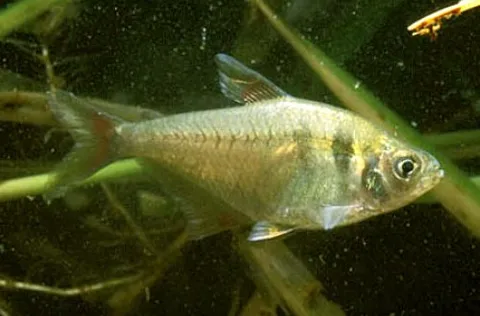
Hyphessobrycon bifasciatus
The Yellow Tetra (Hyphessobrycon bifasciatus), a member of the Acestrorhamphidae family, possesses a pleasant yellow hue that allows it to stand out in an aquarium. These fish are readily available, easy to keep and…
Astyanax bimaculatus
The two-spotted Astyanax, scientifically known as Astyanax bimaculatus, is a member of the Characin family. Despite its undemanding nature in terms of care and ease of breeding, as well as excellent compatibility with…