Temperature20 – 28 °C
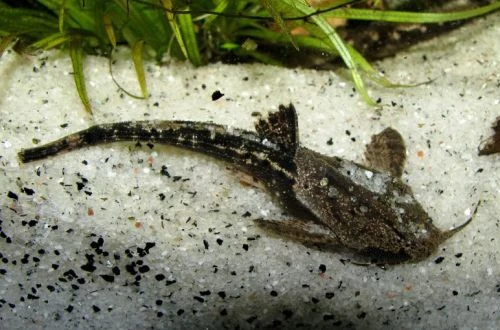
The Bunocephalus coracoideus, or driftwood catfish, is a very curious fish, distinguished by its unusual body shape. Thanks to this unique appearance, in Latin America, it is affectionately called Guitarrita, meaning "little guitar," due to its obvious resemblance to this musical instrument.
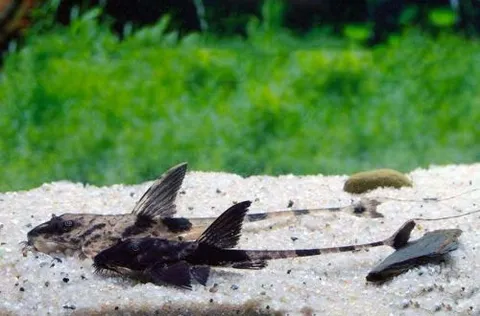
Adults grow up to 15 cm in length. Their body is very characteristic: a wide, flattened head transitions into a long, thin body. It is compressed laterally and covered with horizontal rows of large, wart-like growths. The catfish's eyes are small and quite difficult to discern. The pectoral fins are not uniform in size, and the caudal fin is long. The Bunocephalus has an interesting feature: the absence of an adipose fin, which has atrophied during evolution. Its small size and sedentary lifestyle make it vulnerable to many predators, so to compensate, it has developed effective camouflage, allowing it to masterfully blend into its natural habitat.
The driftwood catfish (Bunocephalus coracoideus), described by researcher Cope in 1874, is sometimes found in publications under the name Dysichthys coracoideus. There are a number of varieties of this fish, but they are all united under a common name. Initially, it was assumed that its homeland was the waters of Peru, but over time, its habitat range was significantly clarified: Bunocephalus is found throughout the Amazon basin in Peru, Bolivia and Brazil, and also further south in Uruguay. It prefers small streams, ponds, and lakes where the current is weak or absent. It lives in areas with an abundance of natural "debris" — sunken trees, bushes, often hiding under fallen leaves. It is an omnivorous creature, readily consuming plant detritus. In its natural environment, it can be found both alone and in groups.
This fish embodies a peaceful nature. Bunocephalus coexists perfectly with many fish of similar size and temperament. It is recommended to avoid keeping it with noisy or aggressive species, as this can lead to sad consequences. An aggressor can be injured by the catfish's spines, while the catfish itself will also experience stress and possibly injuries.
The driftwood catfish does not require complex care. The only important condition for maintaining its health is weekly substrate cleaning with a siphon, which is necessary to remove decaying food and plant debris, which are sources of free ammonia. An aquarium of at least 80 liters is recommended, and its decor should include shelters: driftwood, grottoes, and plants with broad bottom leaves. Free areas should be provided around these shelters, which will serve as feeding spots where sinking food will fall. Given the fish's nocturnal activity, LED night lighting can be installed in the aquarium to observe the pet. Water changes should be performed weekly, replacing 20–25% of the total tank volume. These catfish can withstand pH fluctuations without harm to their health.
Although the driftwood catfish can consume a variety of foods, it prefers live food, such as bloodworms or small earthworms. It will also not refuse frozen foods, flakes, pellets, or tablets, especially those that sink to the bottom. It is important to note that these fish are primarily nocturnal, so they generally do not feed during daylight hours.
Both sexes are visually indistinguishable, although the female may appear somewhat fuller. The catfish reaches sexual maturity at a body length of about 11 cm. The pair prefers to lay eggs in shelters or caves with a sandy bottom. In the absence of suitable shelters, the catfish can independently prepare a spot by stripping plants and using them to line the bottom. Spawning usually occurs in the dark. Over several nights, the female lays a total of hundreds of eggs. The pair guards the clutch until the fry hatch, but to increase the chances of survival, it is recommended to move the eggs along with the female from the main aquarium. After the fry appear, the female is returned. In the first days, the fry should be fed specialized food or finely crushed dry flakes or pellets.
The driftwood catfish (Bunocephalus coracoideus) demonstrates resistance to most diseases, provided proper maintenance and correct adaptation. Like many other fish, it is very sensitive to ammonia, which emphasizes the importance of regular substrate cleaning. These features make it an interesting aquarium inhabitant.
When choosing a black-lined panaque, carefully examine the fish for signs of emaciation, as young specimens are often sold underfed. A healthy fish should have rounded sides, not a sunken belly, and be active during twilight hours. Avoid specimens with damaged dermal plates, ulcers, body film, or unnaturally clamped fins, as these may indicate bacterial infections or poor water quality during transport. Since the species is territorial and exhibits intraspecific aggression, when purchasing multiple individuals, it is important to assess their behavior in the store's aquarium. The fish should not have nipped fins or signs of fighting. It is also recommended to clarify the origin region of the specimen, as coloration and stripe patterns can vary significantly, and some morphs require specific keeping conditions.
The essentials: size, tank volume, water parameters and care
An adult reaches 15 cm in length. Plan the tank around the maximum size: the fish quickly outgrows a cramped setup.
The recommended volume is 80 L. A smaller tank speeds up nitrate build-up and raises stress levels.
Temperature 20–28 °C, pH 5–8, hardness 5–19 dGH. Stability matters more than exact values: sudden swings are harder on the fish than a small deviation from the ideal.
Around 10 years when kept properly. Lifespan depends directly on tank volume, water quality and a varied diet.
Temperament: peaceful (regular). Keep this in mind when choosing tank mates.
Recommended setup: both solitary and in group (flexible). Ignoring this is a common cause of stress and disease.
Diet type: sinking (any). Feed small portions that are finished within a couple of minutes — overfeeding does more harm than underfeeding.
The scientific name of the species is Bunocephalus coracoideus, family Aspredinidae. It also appears in the literature as: Chaetostomus nigrolineatus, Cochliodon nigrolineatus.
The water suits 198 of 208 plants in the catalogue — the easiest ones are shown first.
Afzelius's AnubiasAnacharisAnubiasBrazilian PennywortDwarf CloverDwarf CloverDwarf HygrophilaDwarf SagittariaDwarf ValGuppy GrassHornwortJava FernJava MossMoneywortMud SwordNair's LagenandraNarrow Leaf AnacharisNarrow-leaf CloverStringy MossSüsswassertangTaiwan MossTape GrassTemple PlantUssuri Watermilfoil
Matched by family, categories and overlapping keeping conditions
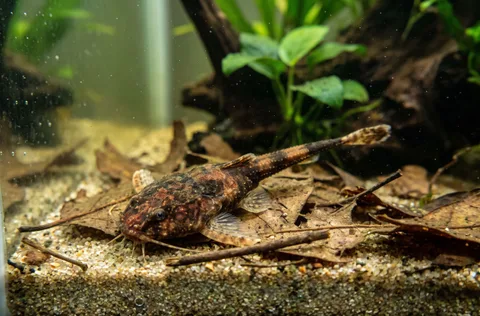
Acanthobunocephalus nicoi
The Banjomouth Catfish, also known by its scientific name Acanthobunocephalus nicoi, is a member of the Aspredinidae family. Its distinctive appearance, reminiscent of a musical instrument, led to the unofficial but…
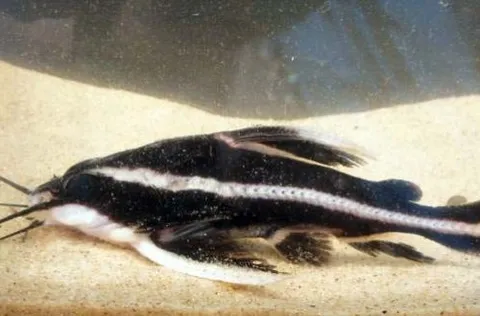
Platydoras hancockii
Platydoras hancockii, also known as the Blue-eyed Platydoras, is a member of the Doradidae family, or Thorny Catfishes. This species of catfish originates from the vast waters of South America, where it can be found…
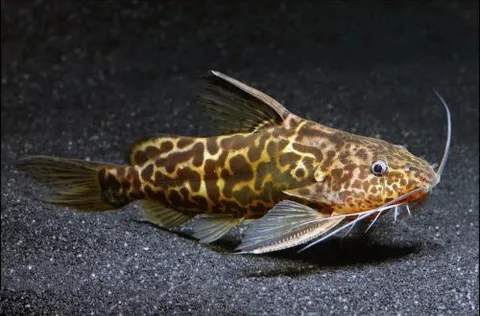
Synodontis schoutedeni
The Marbled Synodontis, or Synodontis schoutedeni, also known as Schouteden's Synodontis, belongs to the family Mochokidae. This catfish is popular due to its peaceful nature and unusual body pattern, as well as being…
Loricaria simillima
The Marbled Whiptail, also known as Loricaria simillima (scientific name Loricaria simillima), is a member of the family Loricariidae, or Armored Catfishes. The native habitat of this fish is South America, where it is…