Temperature20 – 25 °C
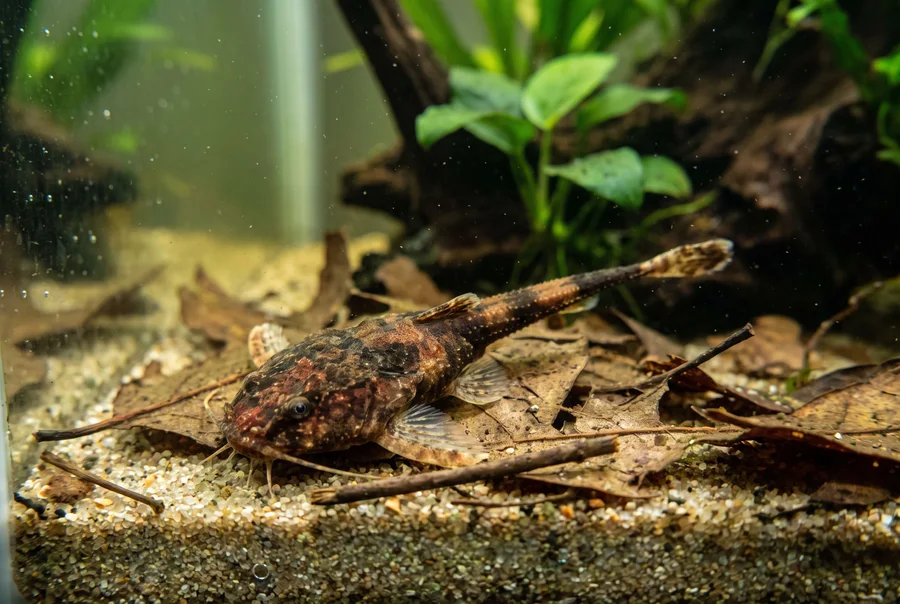
The Banjomouth Catfish, also known by its scientific name Acanthobunocephalus nicoi, is a member of the Aspredinidae family. Its distinctive appearance, reminiscent of a musical instrument, led to the unofficial but widely adopted name “Banjomouth Catfish” among North American aquarists.
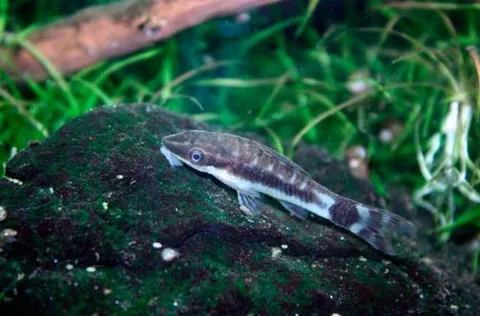
Adults of this species reach a modest 2 cm in length. A distinguishing feature of this catfish is its flattened body, which contrasts with a relatively large head and a slender caudal peduncle. The pectoral fins of the fish are modified: their first rays are noticeably thickened and have transformed into sharp spines. These structures do not serve for locomotion but perform a defensive function, protecting the catfish from potential small predators. Additional protection is provided by hard dermal coverings, creating a armored feel. The fish's coloration is typically dark gray or brownish. Sexual dimorphism in Acanthobunocephalus nicoi is weakly expressed, and external differences between males and females are practically absent. This miniature catfish outwardly resembles a popular species of its family – the Banjo Catfish, which also has a “musical” name – Guitarrita.
This fish originates from South America, specifically from the upper Orinoco River basin in Venezuela, where its range is limited. It prefers shallow areas of small rivers and streams that flow under a dense canopy of tropical forest, staying in the bottom layer. In such places, the Banjomouth Catfish finds refuge among dense aquatic vegetation, under snags, and among natural plant debris such as fallen leaves and branches.
This species leads a secretive, predominantly nocturnal lifestyle. The fish are peaceful and do not show aggression towards tank mates; however, due to their miniature size, it is not recommended to keep them with large or active species that could swallow them. Intraspecific conflicts are practically absent, so both solitary and group keeping are possible.
This catfish leads a predominantly nocturnal lifestyle, so during the day, it actively seeks shelter. When setting up an aquarium for it, it is crucial to provide a sufficient number of places where it can hide. These can be dense plant thickets, various snags, or other natural and artificial decor elements. Another key element of the setup is a sandy substrate, in which the catfish will not only dig for food but also burrow, using it as a hiding place. Acanthobunocephalus nicoi is undemanding in its diet and is an omnivorous species. It readily accepts most sinking foods of appropriate size. It is recommended to feed the catfish shortly before the aquarium lighting is turned off. When cohabiting with other species, it will pick up leftover food from its tank mates. Optimal conditions for its keeping include acidic and soft water with a temperature not exceeding 25°C. Regular aquarium maintenance is critically important to prevent the accumulation of organic waste, which is especially significant for bottom dwellers. It is well compatible with many other fish species of comparable size that prefer to inhabit the water column or near its surface.
In its natural habitat, it feeds primarily on zooplankton. In aquarium conditions, it accepts most types of high-quality sinking foods for bottom-dwelling fish. Given the species' nocturnal activity, feeding is recommended immediately before turning off the lighting, so that the fish have time to find food.
Breeding has not been described. Banjo catfishes are known to use different strategies: some species deposit their eggs on the bottom, while in certain estuarine genera the female carries the clutch attached to her belly. Which of these applies to this dwarf species is unknown — it is very rarely seen in aquaria and reaches the trade only as wild-caught fish.
No diseases that affect only this species have been described. Under suitable conditions — clean water, a balanced diet and calm tank mates — health problems usually do not arise. The most common cause of illness is a decline in conditions: it weakens the immune system, and the fish becomes vulnerable to infections that are always present in an aquarium. At the first signs of trouble — lethargy, wasting, refusal of food or clamped fins — check the basic water parameters and the levels of ammonia, nitrite and nitrate first. Restoring acceptable conditions often lets the fish recover on its own. Catfish of this group have naked, scaleless skin and are therefore more sensitive to medication than most aquarium fish. Products based on malachite green and copper should be used with care and at about half the dose stated on the packaging.
When purchasing, choose active individuals with undamaged skin and fins. It is important to ensure there are no external signs of parasitic or bacterial infections, such as ulcers, film, or unnatural spots on the body. Since the fish tend to be secretive, they may be in hiding in the store, which is a normal state for a healthy individual.
The essentials: size, tank volume, water parameters and care
An adult reaches 1.6–2 cm in length. Plan the tank around the maximum size: the fish quickly outgrows a cramped setup.
The recommended volume is 40 L. A smaller tank speeds up nitrate build-up and raises stress levels.
Temperature 20–25 °C, pH 5.5–7, hardness 2–10 dGH. Stability matters more than exact values: sudden swings are harder on the fish than a small deviation from the ideal.
Around 5 years when kept properly. Lifespan depends directly on tank volume, water quality and a varied diet.
Temperament: peaceful (regular). Keep this in mind when choosing tank mates.
Recommended setup: both solitary and in group (flexible). Ignoring this is a common cause of stress and disease.
Diet type: sinking (any). Feed small portions that are finished within a couple of minutes — overfeeding does more harm than underfeeding.
The scientific name of the species is Acanthobunocephalus nicoi, family Aspredinidae.
The water suits 197 of 208 plants in the catalogue — the easiest ones are shown first.
Afzelius's AnubiasAnacharisAnubiasBrazilian PennywortDwarf CloverDwarf CloverDwarf HygrophilaDwarf SagittariaDwarf ValGuppy GrassHornwortJava FernJava MossMoneywortMud SwordNarrow Leaf AnacharisNarrow-leaf CloverStringy MossSüsswassertangTaiwan MossTape GrassTemple PlantUssuri WatermilfoilWater Wisteria
Matched by family, categories and overlapping keeping conditions
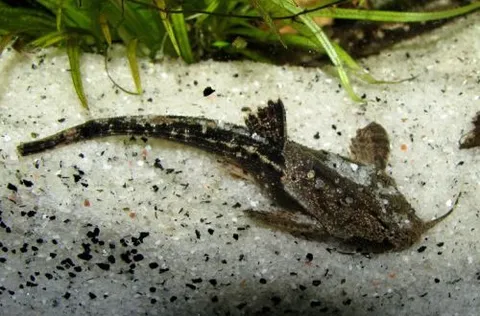
Bunocephalus coracoideus
The Bunocephalus coracoideus, or driftwood catfish, is a very curious fish, distinguished by its unusual body shape. Thanks to this unique appearance, in Latin America, it is affectionately called Guitarrita, meaning…
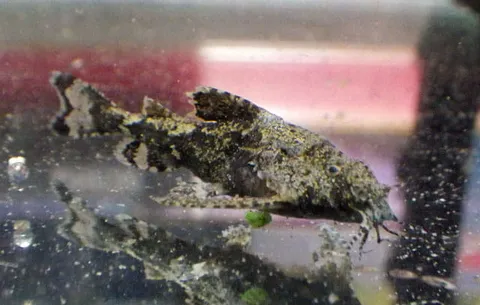
Hara hara
The Hara Catfish (Hara hara), a member of the Erethistidae family, originates from Asia. It can be found in various river systems in southern China, India, Nepal, and Bangladesh. These fish prefer areas with weak…
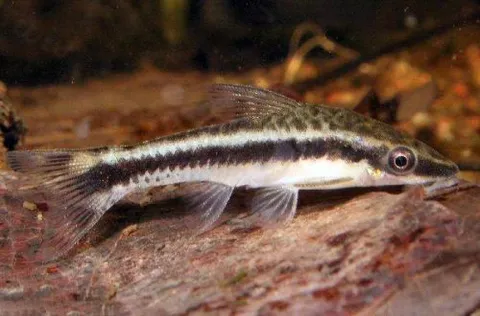
Otocinclus vittatus
Otocinclus vittatus, the scientific name for the dwarf oto, belongs to the armored catfish family (Loricariidae). This species is often used in aquariums to control algae growth. Despite its unassuming coloration, the…
Otocinclus hoppei
Hoppe's Otocinclus, Otocinclus hoppei — its scientific name — is a member of the armored catfish family (Loricariidae). This fish is native to South America, where it inhabits the Madeira and Ucayali river basins, part…