Temperature20 – 25 °C
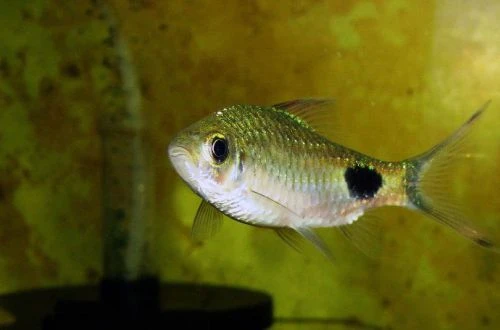
A member of the Cyprinidae family, known as the Filament Barb (scientific name Dawkinsia filamentosa), is an active schooling fish. Its compatibility with many popular aquarium species makes it attractive to enthusiasts. This fish is easy to care for and breed, making it suitable even for beginner aquarists.
These cyprinids reach significant sizes: adults grow to approximately 12 cm in length. Males are usually smaller than females, but their coloration is more vibrant, and the dorsal fin has unusual features — its rays in adult males become greatly elongated, resembling filaments. During spawning, small tuberculate growths appear on the males' heads, around the mouth. The fish's body has a silvery coloration with a noticeable dark spot at the base of the tail, the tips of which are often adorned with a red stripe.
The natural habitat of this species is limited to the southern tip of the Indian subcontinent. The fish is found along the Western Ghats mountain range, located in the modern Indian states of Kerala, Tamil Nadu, and Karnataka. They most often inhabit shallow lowland river floodplains and marshy coastal areas, where brackish seawater often penetrates.
This species is schooling, preferring to stay in groups of 8 to 10 individuals. The fish are highly active, but their activity is mainly directed at their conspecifics, so the barb will not bother other aquarium inhabitants. It is friendly towards other fish of similar size and temperament. However, despite its peaceful nature, it is not recommended to keep it with very small fish, as they may be perceived as food.
For a small school of these fish, a tank of at least 250 liters will be sufficient. The aquarium can be decorated with stones and boulders, sand as a substrate, and several snags, roots, or tree branches to create shelters. In addition, groups of undemanding plants such as mosses, ferns, and Anubias will be well-suited. For the Filament Barb, water quality is extremely important, as it cannot tolerate organic and other waste pollution. Special attention should be paid to an effective filtration system and regular water changes, which should be performed at least once a week, replacing 30–50% of the aquarium volume. Another important aspect is a high level of dissolved oxygen. For this, it is recommended to use several air stones placed in different parts of the tank. Although the fish can live in brackish water in nature, brackish water is not required in aquarium conditions if the fish has not previously been kept in such conditions. A freshwater aquarium will be the best choice.
This omnivorous species readily accepts a variety of foods: dry, frozen, and live. It is important to provide a balanced diet, which may include flakes or pellets in combination with bloodworms, daphnia, and small worms, available in both live and frozen forms. Feed 2–3 times a day, offering portions that the fish consume within 5 minutes, and any leftover food should be promptly removed.
Barbs are egg-laying species. In a home aquarium, spawning can occur at any time of the year. Females lay eggs in the water, and males fertilize them; after this, the eggs are left without parental care. Since parental instincts in barbs are poorly developed, they can eat their eggs immediately after spawning. If the goal is to preserve the offspring, then breeding should be carried out in a separate spawning tank. For this, coarse substrate is used, such as pebbles or decorative glass marbles, with sufficient gaps between particles. The eggs fall into these gaps, becoming inaccessible for consumption. As additional protection, a fine mesh can be placed over the substrate. Any plants are acceptable, and additional decoration is generally not required. Equipment needed includes a heater, an aerator, a low-power lamp, and a simple sponge filter. The aquarium is filled with water from the main tank. The period of courtship begins when the females become noticeably rounded, and characteristic light tubercles appear on the males' heads. At this point, the females and one or two of the strongest males are transferred to the spawning tank. After spawning, the fish are returned. Fry appear after 24–28 hours and begin to swim freely after approximately one day. It is recommended to feed them specialized micro-food, which can be purchased at pet stores.
A balanced aquarium ecosystem, providing suitable conditions for the species and proper nutrition, is the best prevention for various diseases. Most often, diseases arise as a consequence of unsatisfactory environmental conditions, and this is what should be addressed first. However, knowing treatment methods and symptoms of common ailments is also useful.
When choosing Filament Barbs, it is important to assess the overall activity of the school in the aquarium. Healthy individuals should be mobile, constantly moving, and show interest in food. Avoid fish with signs of lethargy, scale damage, or unnatural behavior, such as prolonged hovering at the surface or bottom. Carefully inspect the condition of the fins and skin. In healthy fish, the fins should be spread out, without signs of rot, white growths, or ulcers. The coloration should correspond to the age: in young individuals, it is usually less intense, with clear dark stripes, while adult fish exhibit a characteristic silvery sheen and a dark spot at the base of the tail. Do not confuse the natural breeding tubercles on the heads of males with signs of disease. — Choose individuals from aquariums where no dead or obviously sick fish are observed. — Pay attention to plumpness: a sunken abdomen may indicate emaciation or internal parasitic infections. — Keep in mind that this species is schooling, so it is recommended to acquire a group of 6–8 individuals to reduce stress levels during relocation.
The essentials: size, tank volume, water parameters and care
An adult reaches 12 cm in length. Plan the tank around the maximum size: the fish quickly outgrows a cramped setup.
The recommended volume is 250 L. A smaller tank speeds up nitrate build-up and raises stress levels.
Temperature 20–25 °C, pH 6–7, hardness 3–15 dGH. Stability matters more than exact values: sudden swings are harder on the fish than a small deviation from the ideal.
Around 8 years when kept properly. Lifespan depends directly on tank volume, water quality and a varied diet.
Temperament: peaceful, active/mobile. Keep this in mind when choosing tank mates.
Recommended setup: schooling (usually from 5–6 individuals and more). Ignoring this is a common cause of stress and disease.
Diet type: any (universal). Feed small portions that are finished within a couple of minutes — overfeeding does more harm than underfeeding.
The scientific name of the species is Dawkinsia filamentosa, family Cyprinids (Cyprinidae). It also appears in the literature as: Barbus filamentosa, Leuciscus filamentosus, Puntius filamentosus.
The water suits 196 of 208 plants in the catalogue — the easiest ones are shown first.
Afzelius's AnubiasAnacharisAnubiasBrazilian PennywortDwarf CloverDwarf CloverDwarf HygrophilaDwarf SagittariaDwarf ValGuppy GrassHornwortJava FernJava MossMoneywortMud SwordNarrow Leaf AnacharisNarrow-leaf CloverStringy MossSüsswassertangTaiwan MossTape GrassTemple PlantUssuri WatermilfoilWater Wisteria
Matched by family, categories and overlapping keeping conditions
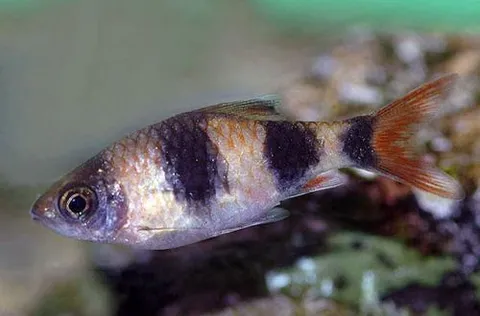
Dawkinsia arulius
The Arulius Barb, scientifically known as Dawkinsia arulius and belonging to the family Cyprinidae, does not impress with its bright coloration or unique body pattern. However, its lively activity and unpretentiousness…
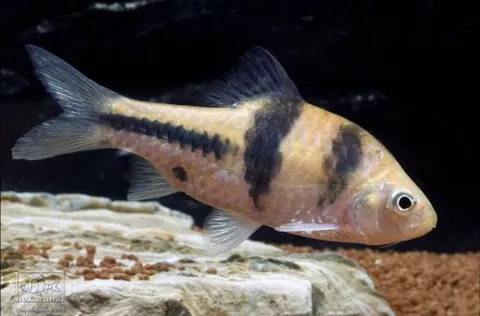
Striuntius lateristriga
The Cross Barb, scientifically known as Striuntius lateristriga, belongs to the carp family (Cyprinidae). This active schooling fish reaches significant size and is constantly in motion. The only significant limitation…
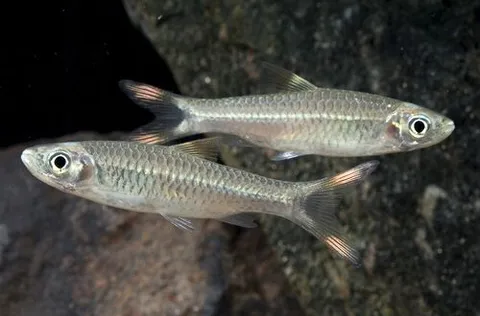
Rasbora caudimaculata
Rasbora caudimaculata, known as the Scissortail Rasbora, belongs to the family Cyprinidae. It is an active, schooling fish of medium size. Although its coloration is not particularly bright, it compensates for this with…
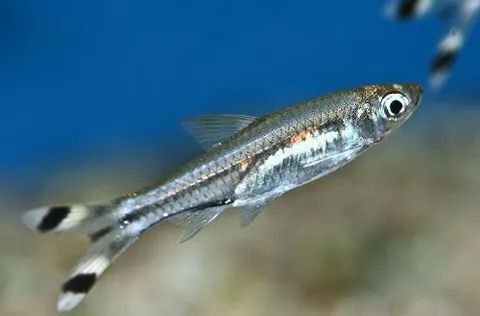
Rasbora trilineata
Rasbora trilineata, known as the Three-lined Rasbora, belongs to the family Cyprinidae. This fish is an excellent choice for a beginner aquarist, as it demonstrates high endurance, easily adapts to changing living…