Temperature20 – 26 °C
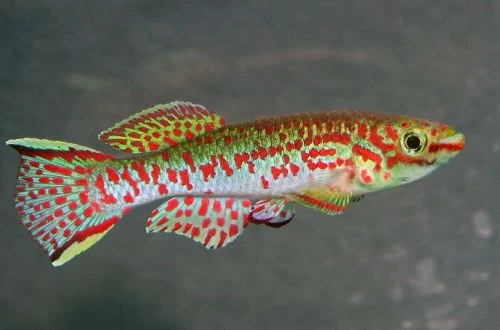
Gardner's Killifish, also known as Fundulopanchax gardneri (scientific name Fundulopanchax gardneri), belongs to the family Nothobranchiidae. This vibrant and attractive fish is easy to keep and successfully breed, and its peaceful nature towards other species makes it an excellent choice for a community tank. It is also perfectly suited for beginner aquarists as a first pet.
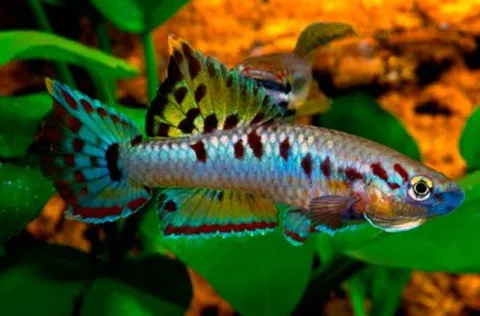
Adults reach up to 6 cm in length. Males are usually larger than females and have more elongated fins. Body coloration can vary even among individuals of the same species; it depends on the fish's region of origin or selective breeding. The most common varieties have a bluish tint, displaying steel or golden coloration. A distinctive feature of all forms is the numerous reddish-brown speckles on the body and a pronounced edging on the fins.
Its natural range covers Nigeria and Cameroon in Africa, where Fundulopanchax gardneri is found in the Niger and Benue river systems, as well as in coastal waters located where rivers and streams flow into the sea. These fish inhabit diverse conditions, from humid tropical forests to arid savannas, where water bodies can completely dry up.
Towards representatives of other non-aggressive species of similar size, this fish exhibits a peaceful and friendly character. However, intraspecific relationships can be less harmonious. Males tend to be territorial and may engage in skirmishes with each other in a small aquarium. Additionally, during the breeding season, they show increased attention to females, which may force the latter to seek cover. Therefore, an optimal group composition is considered to be one male and 3–4 females.
For a group of 3–4 fish, an aquarium of at least 60 liters will suffice. When decorating, provide an abundance of aquatic vegetation: both floating on the surface and rooted. It is important to leave open spaces for free swimming. The type of substrate is not critical and is chosen based on the needs of the plants. Decorative elements are not critically important and can be placed at the aquarist's discretion. It should be noted that the aquarium must be equipped with a lid to prevent accidental jumps by the fish. Aquarium equipment, particularly the filter, must be set up so that it does not create a strong internal current, which Gardner's Killifish is not accustomed to. Otherwise, this species is quite undemanding and does not require special care. To maintain optimal conditions, it is sufficient to perform weekly water changes of 15–20% of the volume with fresh water and regularly clean the substrate of organic deposits.
These fish readily accept all types of food: dry, frozen, and live. For a complete daily diet, it is recommended to combine various products, such as flakes and granules with added plant components, and also use bloodworms, daphnia, or brine shrimp. Specialized foods developed for specific fish families, which contain all the necessary substances for normal growth and development, can be a good alternative.
The unpredictability of natural living conditions, caused by frequent periods of drought, has led to the formation of a unique adaptive mechanism in these fish: the eggs are able to remain viable for more than a month under a layer of dried silt or plants if the water body dries up. In a home aquarium, the fish can reproduce a couple of times a year. For successful spawning, dense thickets of low-growing plants or mosses, or their artificial counterparts, will be required, among which the eggs will be laid. Fertilized eggs are recommended to be immediately transferred to a separate tank with identical water parameters to minimize the risk of them being eaten by the parents. The incubation period usually ranges from 14 to 21 days, depending on the water temperature.
Health problems in these fish arise only in the presence of injuries or keeping in unsuitable conditions, which leads to a weakening of the immune system and the subsequent occurrence of various diseases. At the first signs of illness, it is necessary first to check the water parameters for exceeding permissible values or the presence of toxic substances (such as nitrites, nitrates, ammonia). If deviations are found, all indicators should be normalized, and then treatment should begin.
When selecting individuals, attention should be paid to their activity and the cleanliness of their skin. Healthy fish should show curiosity, have bright coloration, and actively respond to food. Avoid specimens with signs of emaciation, fin damage, film on the body, or unnatural behavior, such as prolonged hovering near the surface or at the bottom in the corner of the aquarium. It is advisable to acquire a group of fish consisting of one male and several females to reduce the level of intraspecific stress during adaptation in a new aquarium.
The essentials: size, tank volume, water parameters and care
An adult reaches 5–6 cm in length. Plan the tank around the maximum size: the fish quickly outgrows a cramped setup.
The recommended volume is 60 L. A smaller tank speeds up nitrate build-up and raises stress levels.
Temperature 20–26 °C, pH 6–7.5, hardness 1–10 dGH. Stability matters more than exact values: sudden swings are harder on the fish than a small deviation from the ideal.
Around 3 years when kept properly. Lifespan depends directly on tank volume, water quality and a varied diet.
Temperament: peaceful (regular). Keep this in mind when choosing tank mates.
Recommended setup: harem (1 male and several females). Ignoring this is a common cause of stress and disease.
Diet type: high protein (predominantly meat). Feed small portions that are finished within a couple of minutes — overfeeding does more harm than underfeeding.
The scientific name of the species is Fundulopanchax gardneri, family Nothobranchiidae. It also appears in the literature as: Aphyosemion brucei, Aphyosemion gardneri, Aphyosemion meridionale.
The water suits 197 of 208 plants in the catalogue — the easiest ones are shown first.
Afzelius's AnubiasAnacharisAnubiasBrazilian PennywortDwarf CloverDwarf CloverDwarf HygrophilaDwarf SagittariaDwarf ValGuppy GrassHornwortJava FernJava MossMoneywortMud SwordNair's LagenandraNarrow Leaf AnacharisNarrow-leaf CloverStringy MossSüsswassertangTaiwan MossTape GrassTemple PlantUssuri Watermilfoil
Matched by family, categories and overlapping keeping conditions
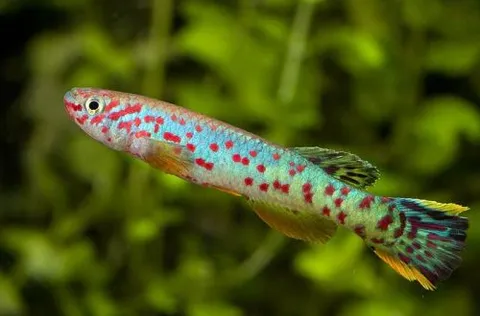
Fundulopanchax scheeli
Fundulopanchax scheeli, known as Aphyosemion scheeli, belongs to the family Nothobranchiidae. This fish was named in honor of the Danish ichthyologist Jorgen Jacob Scheel (1916–1989). Interestingly, until 2002, the…
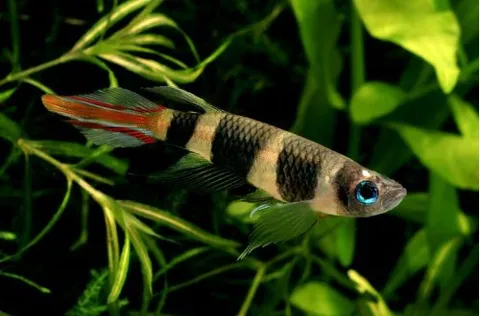
Epiplatys annulatus
The Torch Epiplatys, or Clown Killifish (scientific name Epiplatys annulatus), belongs to the family Nothobranchiidae. This fish attracts with its vibrant coloration, activity, and unique appearance. It is considered…
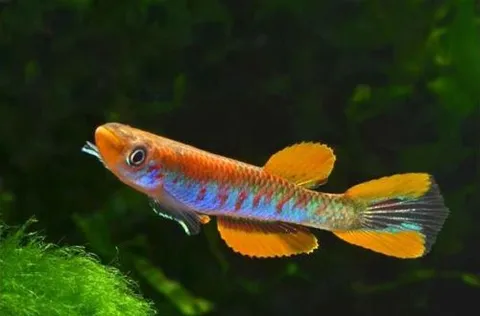
Aphyosemion mimbon
Aphyosemion mimbon, known in the aquarium hobby as Mimbon Killifish, belongs to the family Nothobranchiidae. This small fish attracts attention with its bright, rich coloration. Its keeping does not present any…
Aphyosemion bivittatum
Aphyosemion bivittatum, known as the Two-striped Aphyosemion, belongs to the family Nothobranchiidae. Its natural habitat is in Africa, where the fish inhabits small river systems and streams. These bodies of water are…