Temperature22 – 27 °C
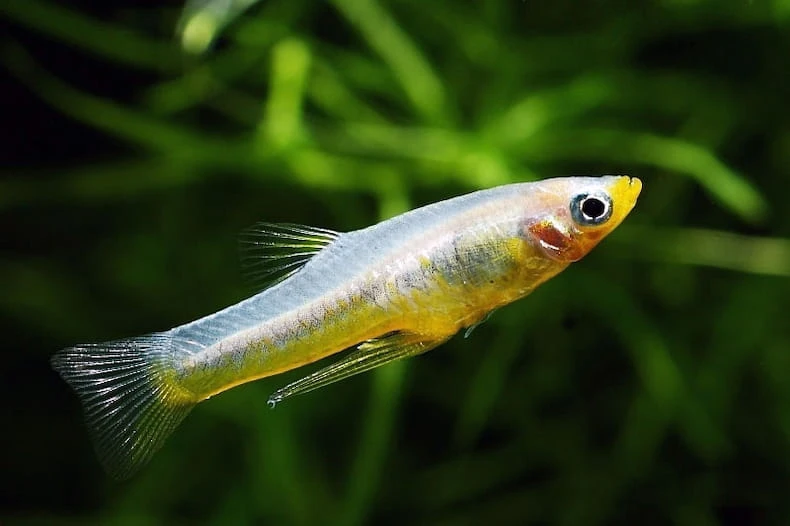
Girardinus metallicus, or metallic livebearer, belongs to the family Poeciliidae. This fish was once very popular among aquarists in the early 20th century, largely due to its exceptional hardiness and resilience. Today, it is not often seen, as its modest appearance does not attract much attention, and it is typically bred as a source of live food for predatory species.
Adult Girardinus metallicus exhibit pronounced sexual dimorphism. Females are significantly larger than males, reaching up to 7 cm in length, while males rarely exceed 4 cm. The body coloration is gray, with a silvery belly; the fins and caudal fin are transparent. A distinctive feature of male individuals is the black color of the lower body.
Their natural range covers the Caribbean region: wild populations are known from Cuba and Costa Rica. They inhabit silty bodies of water, such as ponds and small lakes, often preferring brackish waters, and are also found in small rivers and canals.
Girardinus metallicus are exceptionally peaceful and calm fish that coexist well with other species of similar size and temperament. Their ability to adapt to various water conditions significantly expands the range of potential tank mates.
For a group of Girardinus, the minimum aquarium volume should be at least 40 liters. Although the decor can be chosen arbitrarily, dense thickets of both floating and rooted plants provide the greatest comfort for the fish. As for water conditions, they can vary within a fairly wide range of pH and GH values, which greatly simplifies water preparation during aquarium maintenance. These fish can also be kept in brackish water, with the salt concentration not exceeding 5 grams per 1 liter.
These fish are quite undemanding regarding food and readily accept all types of appropriately sized feeds: dry, frozen, or live. It is important to ensure that vegetable additives make up at least 30% of the total diet.
Girardinus metallicus is a livebearing species: females do not lay eggs but give birth to fully formed fry, as the entire incubation period occurs inside their bodies. In a favorable environment, females can produce up to 50 fry every 3 weeks. However, parental instincts in these fish are poorly developed, which can lead to adults eating their own offspring. Therefore, it is recommended to move newborn fry to a separate tank with identical water parameters.
Health problems usually arise only as a result of injuries or keeping in unsuitable conditions, which leads to a weakening of the immune system and, as a rule, provokes the development of various diseases. At the first signs of illness, the primary task is to check the water parameters for excesses or dangerous concentrations of toxic substances (nitrates, nitrites, ammonia, etc.). After bringing all indicators back to normal, treatment can begin.
When selecting individuals, attention should be paid to the overall activity of the fish: healthy Girardinus should be active, curious, and not constantly hiding in the corners of the aquarium. Avoid specimens with signs of emaciation, sunken bellies, or damaged scales. It is important to inspect the fins for integrity — any signs of erosion or whitish growths may indicate bacterial infections or improper keeping conditions at the store. Since the species exhibits pronounced sexual dimorphism, when purchasing a group, it is advisable to maintain a proportion of one male to two or more females. This will help reduce stress levels in females due to persistent male attention. It is also recommended to assess the coloration: in healthy fish, the colors should be clear, and the metallic sheen pronounced. If dead individuals are observed in the tank with the fish for sale, it is best to refrain from purchasing them.
The essentials: size, tank volume, water parameters and care
An adult reaches 4–7 cm in length. Plan the tank around the maximum size: the fish quickly outgrows a cramped setup.
The recommended volume is 40 L. A smaller tank speeds up nitrate build-up and raises stress levels.
Temperature 22–27 °C, pH 6.5–8, hardness 5–20 dGH. Stability matters more than exact values: sudden swings are harder on the fish than a small deviation from the ideal.
Around 4 years when kept properly. Lifespan depends directly on tank volume, water quality and a varied diet.
Temperament: peaceful (regular). Keep this in mind when choosing tank mates.
Recommended setup: both solitary and in group (flexible). Ignoring this is a common cause of stress and disease.
Diet type: any (universal). Feed small portions that are finished within a couple of minutes — overfeeding does more harm than underfeeding.
The scientific name of the species is Girardinus metallicus, family Poeciliidae. It also appears in the literature as: Girardinus garmani, Girardinus pygmaeus.
The water suits 197 of 208 plants in the catalogue — the easiest ones are shown first.
Afzelius's AnubiasAnacharisAnubiasBrazilian PennywortDwarf CloverDwarf CloverDwarf HygrophilaDwarf SagittariaDwarf ValGuppy GrassHornwortJava FernJava MossMoneywortMud SwordNair's LagenandraNarrow Leaf AnacharisNarrow-leaf CloverStringy MossSüsswassertangTaiwan MossTape GrassTemple PlantUssuri Watermilfoil
Matched by family, categories and overlapping keeping conditions
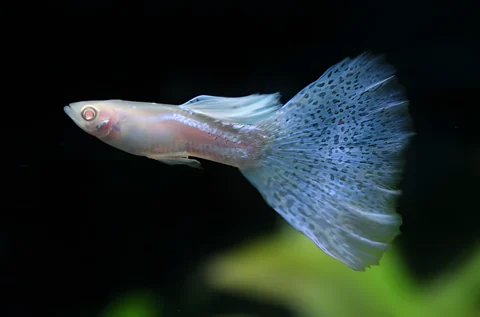
Poecilia reticulata
The Albino Guppy, belonging to the Poeciliidae family, is known by its scientific name Poecilia reticulata (Albino variety). A distinctive feature of this fish is the congenital absence of melanin – the black pigment in…
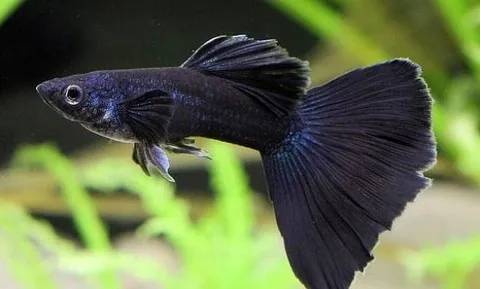
Poecilia reticulata
Black Monk Guppies, also known as Black Guppies, are a breed of Poecilia reticulata (Black strain) from the Poeciliidae family. One of the main features of this variety is the pronounced dark body coloration in males.…
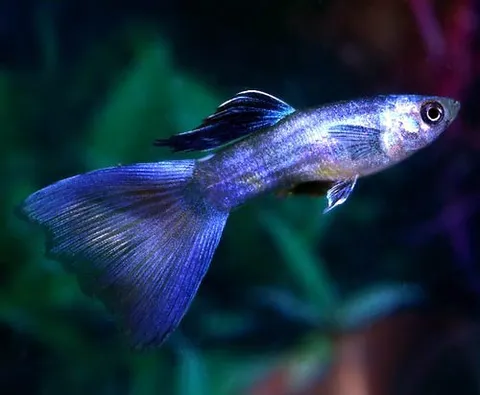
Poecilia reticulata
Blue Guppies, known scientifically as Poecilia reticulata (Blue variety), belong to the Poeciliidae family. This name is a generalization and encompasses various breeds where blue is the dominant color. It is mainly…
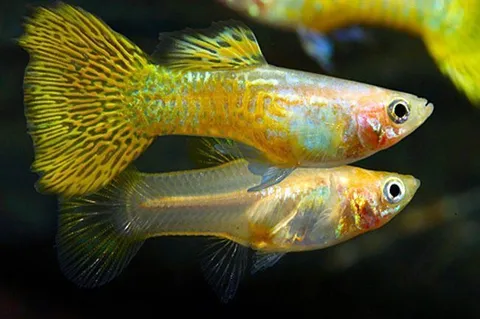
Poecilia reticulata
The Cobra Guppy, scientifically known as Poecilia reticulata (Cobra variety), belongs to the family Poeciliidae. Its distinctive feature is a pattern of vertical stripes running along the posterior part of its body. The…