Temperature23 – 25 °C
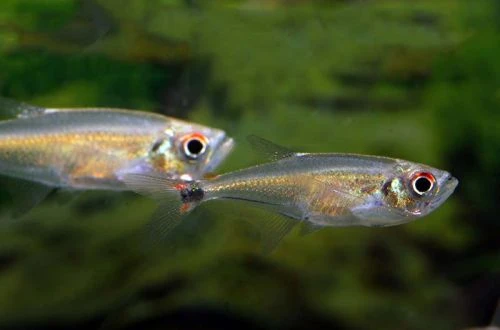
Steindachner's Gnathocharax, scientifically known as Gnathocharax steindachneri, belongs to the family Acestrorhynchidae. Previously, this species was a rather rare guest in amateur aquariums. Its appearance in aquariums was more often accidental, when individual specimens ended up in shipments of Tetras from South American breeders, rather than a result of targeted deliveries. However, the situation changed in 2017 when a number of German aquarium fish importers established regular deliveries to European countries.
Adults of this species reach a modest 5 cm in length. However, despite its size, Steindachner's Gnathocharax is a true predator, distinguished by a large head and an impressive mouth studded with sharp teeth. Its prey, however, consists of creatures as small as the predator itself. It poses a threat only to fry and fish up to 1 cm in size. It does not possess vibrant coloration. The body has a silvery hue. The base of the caudal peduncle is adorned with a black spot, accompanied by two light yellow or red specks. The upper part of the iris is reddish. The fins and tail remain translucent. The pectoral fins are positioned in a way that resembles miniature wings pressed against the body.
South American regions are the native habitat of this fish. It inhabits almost the entire vast basin of the Amazon and Orinoco rivers. It lives in small streams and rivers that flow under the dense cover of the tropical forest. Often, the water in these bodies of water acquires a rich brown tint due to the large amount of tannins formed from decomposing plant organic matter.
As noted earlier, fish exceeding 1 cm in length are completely safe from the teeth of this predator. Thus, compatibility can be achieved with almost any non-aggressive species of comparable size.
In natural conditions, this fish prefers the upper water layers, which should be taken into account when choosing and setting up an aquarium. For keeping 1–2 fish, a tank of at least 100 L is recommended, where the length (from 80 cm) should significantly exceed the height. Floating plants are allowed in moderation so as not to restrict free movement. The decoration of the middle and lower parts of the aquarium is not critical for Gnathocharax and is chosen at the discretion of the aquarist or taking into account the needs of other inhabitants. Long-term and successful keeping requires maintaining stable hydrochemical water parameters and regular aquarium maintenance. The latter includes weekly partial water changes, prophylactic care and cleaning of equipment, as well as the removal of organic waste such as food remnants and excrement.
Despite their predatory nature, the basis of their daily diet can consist of live or frozen invertebrates, such as small worms, bloodworms, and fruit flies, as well as other insects. Steindachner's Gnathocharax successfully adapts to dry, non-sinking foods with a high protein content (it does not feed from the bottom). It is important to remember that when kept with spawning fish, their fry may become prey for this miniature predator.
There is no information on aquarium breeding. This is a small, shoaling predatory characin which, judging by its build and way of life, spawns in open water and gives no care to its offspring. No external features that would reliably separate males from females have been described; all fish in the trade are wild-caught.
No diseases that affect only this species have been described. Under suitable conditions — clean water, a balanced diet and calm tank mates — health problems usually do not arise. The most common cause of illness is a decline in conditions: it weakens the immune system, and the fish becomes vulnerable to infections that are always present in an aquarium. At the first signs of trouble — lethargy, wasting, refusal of food or clamped fins — check the basic water parameters and the levels of ammonia, nitrite and nitrate first. Restoring acceptable conditions often lets the fish recover on its own.
When purchasing, attention should be paid to the activity of the fish and the cleanliness of their skin. Healthy individuals should be active, without visible damage, spots, or signs of emaciation. Since the species is a miniature predator, it is important to ensure that the fish in the store do not show pronounced aggression towards tank mates and actively respond to offered food. It is recommended to acquire a group of several individuals, as these fish may experience stress when alone.
The essentials: size, tank volume, water parameters and care
An adult reaches 5 cm in length. Plan the tank around the maximum size: the fish quickly outgrows a cramped setup.
The recommended volume is 100 L. A smaller tank speeds up nitrate build-up and raises stress levels.
Temperature 23–25 °C, pH 5.8–7, hardness 1–8 dGH. Stability matters more than exact values: sudden swings are harder on the fish than a small deviation from the ideal.
Around 5 years when kept properly. Lifespan depends directly on tank volume, water quality and a varied diet.
Temperament: semi-peaceful (including aggression during spawning / intraspecific conflicts). Keep this in mind when choosing tank mates.
Recommended setup: small group (3–4 individuals). Ignoring this is a common cause of stress and disease.
Diet type: meat / protein (live, frozen, fresh). Feed small portions that are finished within a couple of minutes — overfeeding does more harm than underfeeding.
The scientific name of the species is Gnathocharax steindachneri, family Acestrorhynchidae.
The water suits 195 of 208 plants in the catalogue — the easiest ones are shown first.
Afzelius's AnubiasAnacharisAnubiasBrazilian PennywortDwarf CloverDwarf CloverDwarf HygrophilaDwarf SagittariaDwarf ValGuppy GrassHornwortJava FernJava MossMoneywortMud SwordNarrow Leaf AnacharisNarrow-leaf CloverStringy MossSüsswassertangTaiwan MossTape GrassTemple PlantUssuri WatermilfoilWater Wisteria
Matched by family, categories and overlapping keeping conditions
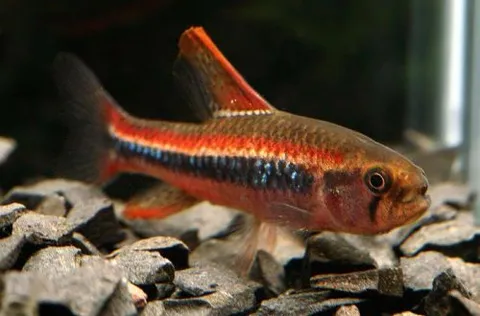
Poecilocharax weitzmani
Poecilocharax weitzmani, also known as the Black Morpho Tetra or Weitzman's Pencilfish, belongs to the family Crenuchidae. It is rarely found in home aquariums due to its high level of care difficulty. This species is…
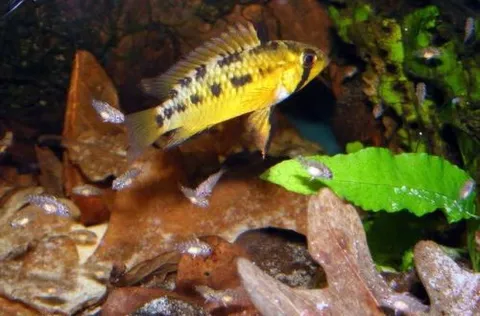
Apistogramma macmasteri
Apistogramma macmasteri, also known as the Red-tailed Dwarf Cichlid (scientific name Apistogramma macmasteri), belongs to the family Cichlidae. This fish attracts attention with its beauty, but its temperament can be…
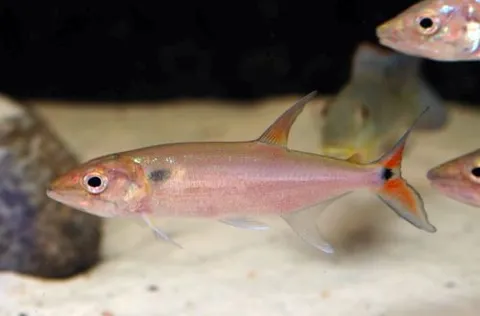
Acestrorhynchus falcatus
The Sickle Barracuda, scientifically known as Acestrorhynchus falcatus, belongs to the family Acestrorhynchidae. This fish earned the name "barracuda" due to its external resemblance to marine barracudas, although there…
Anostomus anostomus
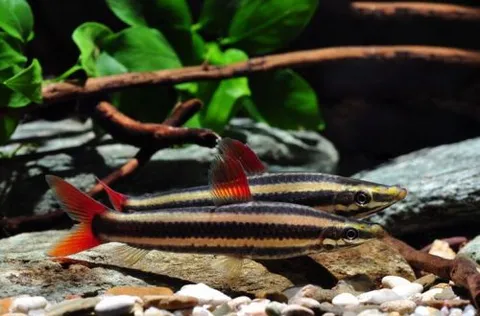
Anostomus anostomus, or the Common Anostomus, belongs to the family Anostomidae. This fish is one of the two most recognizable representatives of its family, along with the Threespot Anostomus. Its keeping is relatively…