Temperature20 – 28 °C
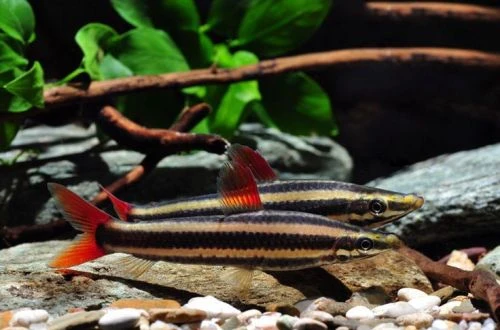
Anostomus anostomus, or the Common Anostomus, belongs to the family Anostomidae. This fish is one of the two most recognizable representatives of its family, along with the Threespot Anostomus. Its keeping is relatively straightforward, but it requires the creation of certain, somewhat specific conditions.
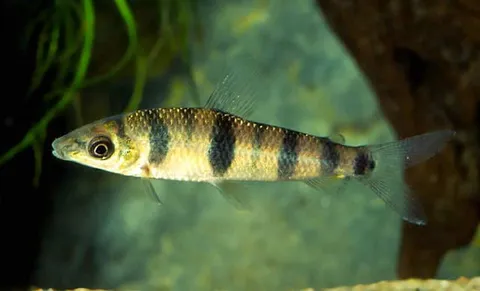
Adults can range in length from 15 to 20 cm. Sexual dimorphism in this species is weakly expressed; mature males are only slightly larger than females. The fish has an elongated body and a pointed head. Its coloration consists of alternating horizontal stripes of dark and light shades. The caudal fin and other fins are red.
The natural habitats of this species are in South America, where it is widespread. Anostomus anostomus is found in the upper reaches of the Amazon river systems and in the Orinoco River basin. Its extensive range covers the territories of Peru, Brazil, Venezuela, and Guyana. It prefers fast-flowing rivers with rocky banks, rarely found in flat areas.
Despite forming large schools in their natural environment, Common Anostomus are not particularly friendly towards their conspecifics. Therefore, in an aquarium setting, they should be kept either in a group of six or more individuals, or singly. They are calm towards other fish species and can be compatible with those that can adapt to similar fast-flowing conditions.
For comfortable living, a single fish requires an aquarium of at least 100 liters, while a group of six or more individuals will need a tank with a capacity exceeding 500 liters. A rocky or sandy substrate is preferred for decoration, supplemented with a large number of smooth stones, rock formations, and driftwood. Aquatic plants are generally not recommended, as they are likely to be quickly eaten or damaged. Intense lighting, which stimulates algae growth, can serve as an additional food source for the fish. Creating a moderate to strong current in the aquarium is important to mimic their natural habitat. This task is usually handled by a filtration system based on internal filters, but additional pumps can be installed if necessary. Since Anostomus anostomus originates from flowing waters, it is extremely sensitive to water quality. It is important to prevent the accumulation of organic waste and sudden fluctuations in hydrochemical parameters.
This is an omnivorous species. In their natural environment, the main food sources are algae and small invertebrates, which the fish scrape off rock surfaces. In a home aquarium, it is recommended to use sinking foods balanced in plant and protein components. Additionally, chopped cucumber pieces, blanched spinach, lettuce leaves, and other types of garden greens can be added to the diet.
At the time of publication of this material, there have been no documented cases of successful breeding of this species in home aquariums. For commercial purposes, they are bred in South America and Asian countries.
In most cases, the occurrence of various diseases in fish is directly related to unsuitable living conditions. The appearance of the first symptoms usually indicates negative changes in the external environment, such as an increase in the concentration of nitrogen cycle products (ammonia, nitrites, nitrates), sharp fluctuations in pH or dGH values, or the use of low-quality food. When such problems are detected, it is first necessary to restore the balance of the aquarium's biological system. If symptoms persist, medicinal treatment should be initiated.
When choosing an Anostomus, carefully inspect the fish for intact fins and the absence of scale damage, as the species is sensitive to water quality and prone to stress. A healthy specimen should be active, display the species' characteristic inclined swimming posture, and show interest in foraging. Avoid specimens with sunken bellies or signs of apathy, as this may indicate emaciation or hidden infections caused by poor keeping conditions at the store.
The essentials: size, tank volume, water parameters and care
An adult reaches 15–20 cm in length. Plan the tank around the maximum size: the fish quickly outgrows a cramped setup.
The recommended volume is 100 L. A smaller tank speeds up nitrate build-up and raises stress levels.
Temperature 20–28 °C, pH 5.5–7.5, hardness 1–18 dGH. Stability matters more than exact values: sudden swings are harder on the fish than a small deviation from the ideal.
Around 5 years when kept properly. Lifespan depends directly on tank volume, water quality and a varied diet.
Temperament: semi-peaceful (including aggression during spawning / intraspecific conflicts). Keep this in mind when choosing tank mates.
Recommended setup: both solitary and in group (flexible). Ignoring this is a common cause of stress and disease.
Diet type: plant-based with meat additives. Feed small portions that are finished within a couple of minutes — overfeeding does more harm than underfeeding.
The scientific name of the species is Anostomus anostomus, family Anostomidae. It also appears in the literature as: Anostomus gronovii, Anostomus salmoneus, Leporinus anostomus.
The water suits 198 of 208 plants in the catalogue — the easiest ones are shown first.
Afzelius's AnubiasAnacharisAnubiasBrazilian PennywortDwarf CloverDwarf CloverDwarf HygrophilaDwarf SagittariaDwarf ValGuppy GrassHornwortJava FernJava MossMoneywortMud SwordNair's LagenandraNarrow Leaf AnacharisNarrow-leaf CloverStringy MossSüsswassertangTaiwan MossTape GrassTemple PlantUssuri Watermilfoil
Matched by family, categories and overlapping keeping conditions
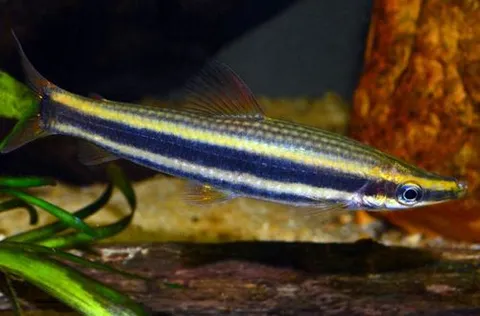
Anostomus ternetzi
Anostomus ternetzi, or Ternetz's Anostomus, belongs to the family Anostomidae. This species was named after the Swiss ichthyologist Carl Ternetz (1870–1928), who collected the holotype. Along with the Common Anostomus,…
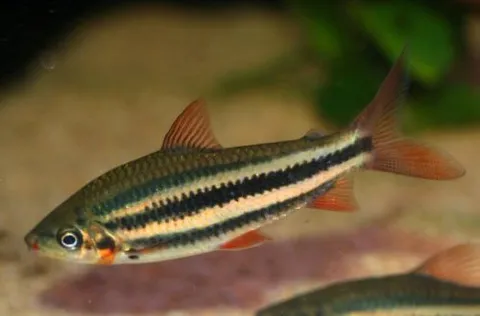
Leporinus arcus
Leporinus arcus, also known as the Red-lipped Leporinus, belongs to the family Anostomidae. This is a rather large fish with modest coloration and a challenging temperament, requiring a spacious aquarium. All these…
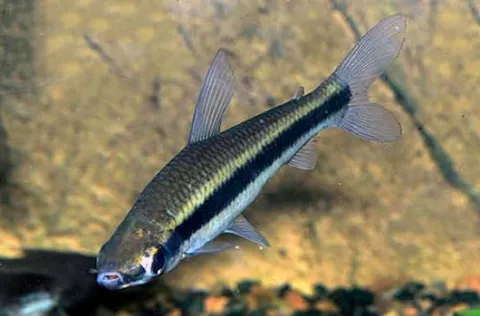
Laemolyta taeniata
Laemolyta taeniata, also known as the striped laemolyta, belongs to the family Anostomidae. It is quite rare in aquariums. Often, it arrives in batches with more brightly colored fish species, but due to its unassuming…
Leporinus pellegrinii
Leporinus pellegrinii, also known as Pellegrin's Leporinus, is a member of the family Anostomidae. Its homeland is the vast expanses of South America; in particular, it is widely distributed throughout the entire length…