Temperature20 – 28 °C
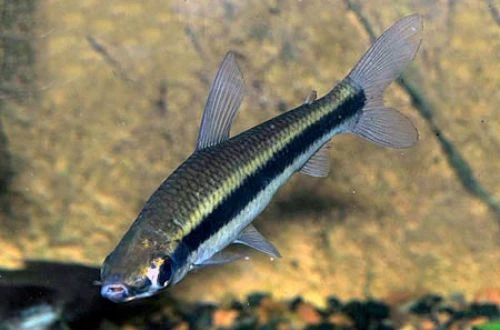
Laemolyta taeniata, also known as the striped laemolyta, belongs to the family Anostomidae. It is quite rare in aquariums. Often, it arrives in batches with more brightly colored fish species, but due to its unassuming coloration, it does not attract much attention from aquarists.
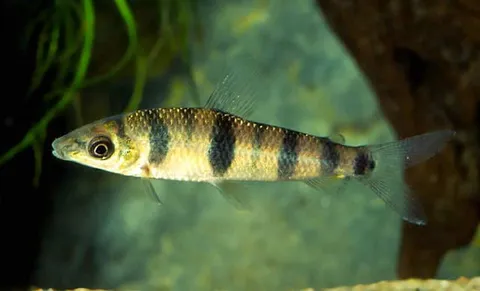
The maximum recorded length of this fish exceeds 28 cm, although on average, individuals reach 20–25 cm. Sexual dimorphism is weakly expressed; males and females are practically indistinguishable in appearance. The fish's coloration is dark: the back is gray, and the belly is silvery. A prominent wide black stripe runs along the body, from head to tail. The fins and tail remain translucent.
Its natural habitat is in South America, in the central Amazon basin (Brazil) and the Orinoco River basin (Venezuela). These fish are widespread in the main river channels, their tributaries, floodplain lakes, and in flooded areas of the tropical forest during the rainy season.
These fish are peaceful towards other species. They get along well with non-aggressive tankmates of comparable size. It is preferable to keep them in groups of at least 3–4 individuals; if there are fewer or they are kept alone, the fish may become nervous, which can negatively affect the overall well-being of the aquarium and its inhabitants.
For comfortable keeping of a group of 3–4 striped laemolyta, an aquarium of at least 400 L will be required. The choice of decorative elements is not critical. Typically, elements such as sandy substrate, snags and tree roots, various aquatic vegetation, and dried leaves are used. Note that the latter, upon decomposition, release tannins, which have a beneficial effect on the water's chemical composition, bringing it closer to natural habitat conditions. Dim or moderate lighting is recommended; accordingly, shade-tolerant plant species should be preferred. Laemolyta taeniata requires stable water parameters, which must remain within acceptable hydrochemical and temperature ranges. The constancy of these conditions is achieved through the uninterrupted operation of aquarium equipment and regular aquarium maintenance procedures.
In natural conditions, the diet of Laemolyta taeniata consists of algae and small invertebrates. In a home aquarium, it readily accepts most offered foods: dry pellets, frozen, and live products. It is extremely important to ensure a sufficient amount of plant components in the diet.
This species has not been bred in aquaria. Anostomids are migratory fish: spawning is tied to rising water in the rainy season, the eggs are adhesive and there is no parental care. In captivity the gonads develop, but final maturation and ovulation usually do not follow, so fish farms resort to hormonal induction. No reliable external differences have been described; females are presumed to grow slightly larger and rounder-bellied than males.
Laemolyta taeniata is a hardy and undemanding fish if provided with a suitable habitat. However, deterioration of water quality, such as high levels of pollution, inevitably weakens its immune system, making the fish susceptible to various infections. Often, if the fish is placed in optimal conditions, the symptoms of the disease disappear on their own. If improvement does not occur, medicinal treatment may be required.
When purchasing, choose active individuals with clean fins and no visible body damage. It is important to ensure that the fish shows interest in food and has no signs of emaciation, as individuals may be weakened by long transport due to rare imports to pet stores. It is recommended to carefully inspect the eyes and gills for the absence of parasites or inflammation. Since the species is schooling, it is advisable to acquire a group of several fish at once to minimize stress during adaptation to new conditions.
The essentials: size, tank volume, water parameters and care
An adult reaches 20–25 cm in length. Plan the tank around the maximum size: the fish quickly outgrows a cramped setup.
The recommended volume is 400 L. A smaller tank speeds up nitrate build-up and raises stress levels.
Temperature 20–28 °C, pH 4–7.5, hardness 2–12 dGH. Stability matters more than exact values: sudden swings are harder on the fish than a small deviation from the ideal.
Around 7 years when kept properly. Lifespan depends directly on tank volume, water quality and a varied diet.
Temperament: semi-peaceful (including aggression during spawning / intraspecific conflicts). Keep this in mind when choosing tank mates.
Recommended setup: small group (3–4 individuals). Ignoring this is a common cause of stress and disease.
Diet type: plant-based with meat additives. Feed small portions that are finished within a couple of minutes — overfeeding does more harm than underfeeding.
The scientific name of the species is Laemolyta taeniata, family Anostomidae. It also appears in the literature as: Anostomus taeniata, Schizodon taeniatus.
The water suits 198 of 208 plants in the catalogue — the easiest ones are shown first.
Afzelius's AnubiasAnacharisAnubiasBrazilian PennywortDwarf CloverDwarf CloverDwarf HygrophilaDwarf SagittariaDwarf ValGuppy GrassHornwortJava FernJava MossMoneywortMud SwordNair's LagenandraNarrow Leaf AnacharisNarrow-leaf CloverStringy MossSüsswassertangTaiwan MossTape GrassTemple PlantUssuri Watermilfoil
Matched by family, categories and overlapping keeping conditions
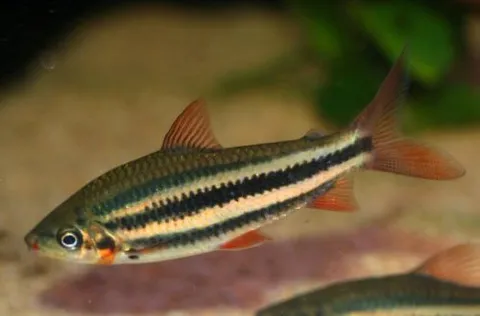
Leporinus arcus
Leporinus arcus, also known as the Red-lipped Leporinus, belongs to the family Anostomidae. This is a rather large fish with modest coloration and a challenging temperament, requiring a spacious aquarium. All these…
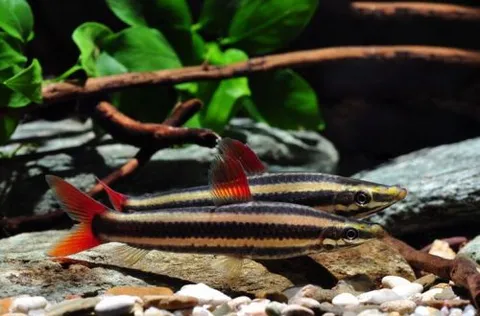
Anostomus anostomus
Anostomus anostomus, or the Common Anostomus, belongs to the family Anostomidae. This fish is one of the two most recognizable representatives of its family, along with the Threespot Anostomus. Its keeping is relatively…
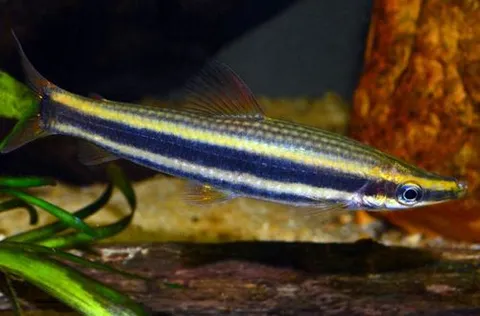
Anostomus ternetzi
Anostomus ternetzi, or Ternetz's Anostomus, belongs to the family Anostomidae. This species was named after the Swiss ichthyologist Carl Ternetz (1870–1928), who collected the holotype. Along with the Common Anostomus,…
Leporinus pellegrinii
Leporinus pellegrinii, also known as Pellegrin's Leporinus, is a member of the family Anostomidae. Its homeland is the vast expanses of South America; in particular, it is widely distributed throughout the entire length…