Temperature17 – 28 °C
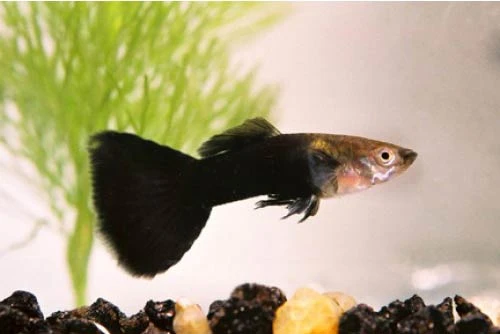
The Guppy 'Black Prince', also known as the Half Black Guppy with the scientific name Poecilia reticulata (Half Black subspecies), is a member of the Poeciliidae family. This designation likely encompasses several different breeds that share similar body coloration. Examples include not fully colored Black Guppies or black and white Tuxedo Guppies.
The Guppy 'Black Prince' is a selective breeding form of livebearing fish, distinguished by its rich dark body and fin coloration. Unlike their wild ancestors, these fish possess a deep black color that can vary from charcoal to dark blue or grey. Many individuals retain lighter areas on the belly or specks of red and yellow on the tail. Males are typically smaller than females, reaching 3–4 cm, and have more expressive fins and intense coloration. Females are larger, growing up to 6 cm, and their coloration is often less saturated.
This breed is not found in nature, as it is the result of many years of selective breeding. The original species is Poecilia reticulata, which inhabits fresh and brackish waters of South America. In aquarium conditions, these fish adapt to a wide range of water parameters, successfully tolerating both soft and high hardness, making them suitable for most home aquariums provided the environment remains stable.
These are peaceful and active fish, suitable for community tanks with similarly sized and calm species such as tetras, rasboras, or corydoras. They prefer to live in shoals, so it is recommended to keep a group of 5–6 individuals or more. The fish are quite agile and can jump out of the water, so a cover glass or a tight mesh on the aquarium is an essential safety measure.
Guppy 'Black Prince' and other selective breeding forms are the result of deliberate human activity; they are not found in the wild. Nevertheless, they have retained from their wild ancestors an outstanding ability to adapt and low requirements for keeping conditions. These fish adapt perfectly to various aquarium conditions, making them an excellent choice for aquarists just starting their journey. Caring for these fish is simple, and they do not require complex aquarium setup systems. Often, even a simple air-driven filter is sufficient. A lighting system is primarily necessary to ensure the healthy growth of live plants. In its absence, the fish feel good in natural light coming from the room. Water heating will be required if heat-loving fish species are kept in the aquarium or if the aquarium itself is in a cool place where the temperature drops below 20°C. It is important to note that the listed conditions (absence of additional lighting, heater), although permissible, are not optimal for the overall well-being of the fish. The choice of decorative elements is entirely left to the aquarist's discretion and creative impulse. When sexually mature males and females are kept together, offspring are inevitable. To protect the fry from adult fish, it is desirable to create places in the aquarium where they can find shelter. Dense thickets of fine-leaved plants such as Riccia, Vesicularia dubyana, or various species of Hornwort will make excellent hiding places. Feeding: Guppies readily accept any food they can swallow. This can include dry flakes, pellets, live or frozen brine shrimp, bloodworms, daphnia, mosquito larvae, and much more. Behavior and compatibility: These fish exhibit a peaceful character both towards each other and towards other species. They get along well with aquarium inhabitants of comparable size and temperament.
The species is omnivorous and undemanding in its food choices. The diet should include high-quality dry flakes or pellets, supplemented with live or frozen foods such as brine shrimp, daphnia, or bloodworms. Feeding is recommended 2–3 times a day in small portions that the fish can consume within 2–3 minutes. It is important to avoid overfeeding to prevent water pollution and obesity in the fish.
Breeding is highly productive and straightforward. The fish are livebearers, and the female's gestation lasts about 4–5 weeks. To preserve the offspring, it is recommended to use aquariums with dense thickets of fine-leaved plants where the fry can hide from adult fish. Newborn fry are fed specialized small foods, rotifers, or Artemia nauplii.
Due to the specifics of selective breeding, this breed may exhibit increased sensitivity to water quality and keeping conditions compared to wild forms. The main risks are bacterial infections and fungal lesions, which arise from the accumulation of organic waste. Prevention involves regular water changes, maintaining a stable temperature, and avoiding overpopulation of the aquarium.
When selecting individuals, attention should be paid to their activity and fin integrity. Healthy fish should show interest in their surroundings, have no film on their body, no damage, or signs of emaciation. It is recommended to acquire juveniles aged 3–4 months, when their coloration is already formed, but the fish have not yet reached sexual maturity. It is best to contact specialized breeders to obtain high-quality breeding stock.
The essentials: size, tank volume, water parameters and care
An adult reaches 3–6 cm in length. Plan the tank around the maximum size: the fish quickly outgrows a cramped setup.
The recommended volume is 40 L. A smaller tank speeds up nitrate build-up and raises stress levels.
Temperature 17–28 °C, pH 7–8.5, hardness 10–30 dGH. Stability matters more than exact values: sudden swings are harder on the fish than a small deviation from the ideal.
Around 3 years when kept properly. Lifespan depends directly on tank volume, water quality and a varied diet.
Temperament: peaceful (regular). Keep this in mind when choosing tank mates.
Recommended setup: mixed (solitary / pair / group). Ignoring this is a common cause of stress and disease.
Diet type: any (universal). Feed small portions that are finished within a couple of minutes — overfeeding does more harm than underfeeding.
The scientific name of the species is Poecilia reticulata, family Poeciliidae. It also appears in the literature as: Acanthophacelus guppii, Acanthophacelus reticulatus, Girardinus guppii.
The water suits 114 of 208 plants in the catalogue — the easiest ones are shown first.
African Onion PlantAfzelius's AnubiasAmazon FrogbitAmazon SwordAnacharisAnubiasArrowhead CryptDwarf CloverDwarf CloverDwarf HygrophilaDwarf SagittariaDwarf ValGuppy GrassHornwortJava MossMoneywortMud SwordNair's LagenandraNarrow Leaf AnacharisNarrow-leaf CloverStringy MossTaiwan MossTape GrassUssuri Watermilfoil
Matched by family, categories and overlapping keeping conditions
Poecilia reticulata
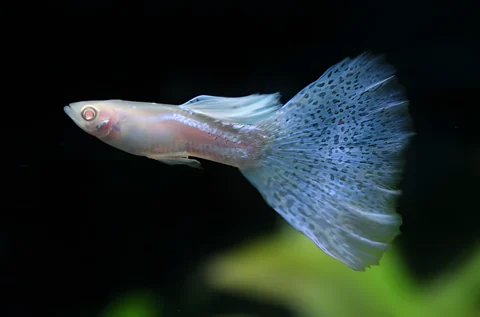
The Albino Guppy, belonging to the Poeciliidae family, is known by its scientific name Poecilia reticulata (Albino variety). A distinctive feature of this fish is the congenital absence of melanin – the black pigment in…
Poecilia reticulata
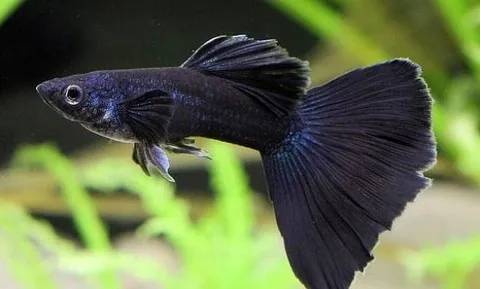
Black Monk Guppies, also known as Black Guppies, are a breed of Poecilia reticulata (Black strain) from the Poeciliidae family. One of the main features of this variety is the pronounced dark body coloration in males.…
Poecilia reticulata
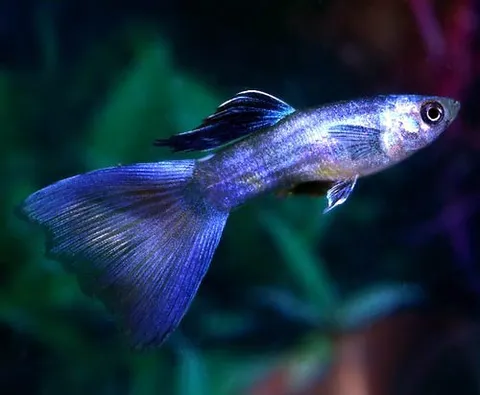
Blue Guppies, known scientifically as Poecilia reticulata (Blue variety), belong to the Poeciliidae family. This name is a generalization and encompasses various breeds where blue is the dominant color. It is mainly…
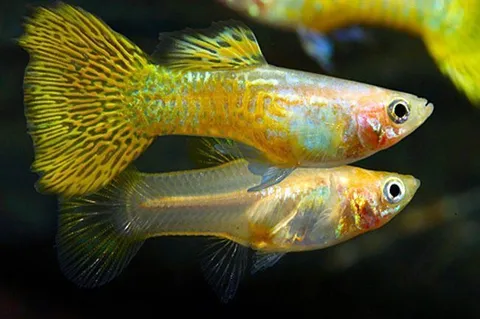
Poecilia reticulata
The Cobra Guppy, scientifically known as Poecilia reticulata (Cobra variety), belongs to the family Poeciliidae. Its distinctive feature is a pattern of vertical stripes running along the posterior part of its body. The…