Temperature17 – 28 °C
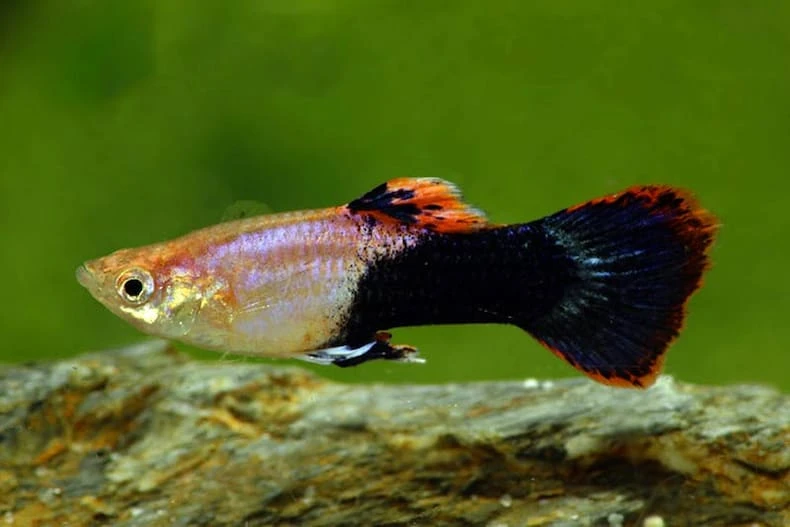
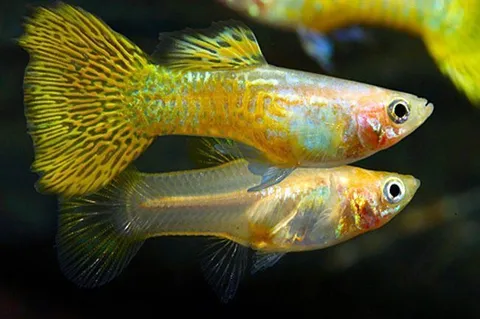
Guppy Tuxedo, or as it is also called, Tuxedo Guppy, got its English name from its distinctive coloration. The scientific name for this strain is Poecilia reticulata (Tuxedo strain). It is a representative of the Poeciliidae family. A characteristic feature is the contrast between the light front part of the body and the dark rear part, including the tail. This contrast is especially pronounced in black and white specimens. However, the overall coloration can be very diverse, often with a predominance of shades such as red, yellow, gold, or green.
The Guppy Tuxedo is a selective breeding form of Poecilia reticulata, distinguished by its characteristic contrasting coloration: the front part of the body is usually light, while the rear part and caudal peduncle have a dark, rich color. The fins can be colored in various hues, including red, yellow, or blue. Males reach 3–4 cm in length, possess brighter coloration, and more pronounced fins. Females are larger, growing up to 6 cm, have more modest coloring, and a rounded abdomen.
In nature, the species Poecilia reticulata inhabits fresh and brackish waters of South America, including Venezuela, Guyana, northern Brazil, and the islands of Trinidad and Tobago. The Tuxedo strain is a result of selective breeding and does not occur in the wild. In aquarium conditions, these fish adapt to a wide range of water parameters, preferring a stable environment with moderate current.
These are peaceful and active fish that prefer to stay in the upper and middle layers of the water. They are schooling fish, so it is recommended to keep them in groups of 5–6 individuals. They get along well with other peaceful species of similar size. When kept in a community tank, it is important to avoid cohabitation with aggressive fish that might damage their long fins.
Among aquarium fish, guppies stand out for their unpretentiousness and ease of keeping. Even a small group needs an aquarium of at least 40 litres: this is the volume (45 × 30 × 30 cm) recommended for guppies. In earlier times, for example, during the Soviet years, they could often be found even in ordinary three-liter jars. The necessary equipment set also does not require significant costs. A simple air-lift filter and a light source are sufficient to maintain their life. If other tropical fish are planned to be added, an additional heater should be provided. With a male and a female present, the appearance of fry is very likely. Since parental instincts in guppies are poorly developed, it is recommended to provide a sufficient number of hiding places so that the fry can hide from adult fish. Dense thickets of fine-leaved plants are excellent as such shelters. Otherwise, the aquarium's decoration is at the discretion of the aquarist. As for feeding, guppies readily accept most popular foods — dry, frozen, and live, the main thing is that they fit in their mouths. Many manufacturers offer special foods for this group of fish, so finding a suitable product will not be difficult. Tuxedo Guppies are active and peaceful fish, getting along well with their relatives. However, it is important to remember that co-housing different breeds can lead to hybrid offspring. They are compatible with many other non-aggressive species of similar size.
These fish are omnivorous. In the aquarium, they accept high-quality dry foods in the form of flakes or granules, as well as frozen and live foods such as daphnia, artemia, or bloodworms. To maintain vibrant coloration and health, it is recommended to alternate types of food. They should be fed small portions 1–2 times a day, so that the fish consume the food within a couple of minutes.
Guppies are livebearing fish. Reproduction occurs easily, often without the aquarist's intervention. The female's gestation period lasts about 21–40 days, depending on the water temperature. One female can produce from 1 to 200 fry. To preserve offspring in a community tank, it is recommended to use dense plant thickets where the fry can hide from adult fish.
The species has a strong immune system but is sensitive to sudden changes in water parameters and environmental quality. With poor care, diseases such as fin rot or ichthyophthiriosis are possible. Prevention includes regular water changes, maintaining substrate cleanliness, and controlling for overpopulation in the aquarium.
When purchasing, choose active fish with clean scales and undamaged fins. Inspect the individuals for the absence of white spots, ulcers, or unnatural film on the body. Healthy guppies show curiosity, have a good appetite, and do not stay at the water surface trying to gasp for air if there is sufficient oxygen in the aquarium.
The essentials: size, tank volume, water parameters and care
An adult reaches 3–6 cm in length. Plan the tank around the maximum size: the fish quickly outgrows a cramped setup.
The recommended volume is 40 L. A smaller tank speeds up nitrate build-up and raises stress levels.
Temperature 17–28 °C, pH 7–8.5, hardness 10–30 dGH. Stability matters more than exact values: sudden swings are harder on the fish than a small deviation from the ideal.
Around 3 years when kept properly. Lifespan depends directly on tank volume, water quality and a varied diet.
Temperament: peaceful (regular). Keep this in mind when choosing tank mates.
Recommended setup: mixed (solitary / pair / group). Ignoring this is a common cause of stress and disease.
Diet type: any (universal). Feed small portions that are finished within a couple of minutes — overfeeding does more harm than underfeeding.
The scientific name of the species is Poecilia reticulata, family Poeciliidae. It also appears in the literature as: Acanthophacelus guppii, Acanthophacelus reticulatus, Girardinus guppii.
The water suits 114 of 208 plants in the catalogue — the easiest ones are shown first.
African Onion PlantAfzelius's AnubiasAmazon FrogbitAmazon SwordAnacharisAnubiasArrowhead CryptDwarf CloverDwarf CloverDwarf HygrophilaDwarf SagittariaDwarf ValGuppy GrassHornwortJava MossMoneywortMud SwordNair's LagenandraNarrow Leaf AnacharisNarrow-leaf CloverStringy MossTaiwan MossTape GrassUssuri Watermilfoil
Matched by family, categories and overlapping keeping conditions
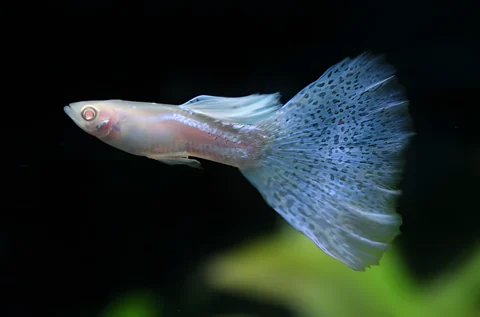
Poecilia reticulata
The Albino Guppy, belonging to the Poeciliidae family, is known by its scientific name Poecilia reticulata (Albino variety). A distinctive feature of this fish is the congenital absence of melanin – the black pigment in…
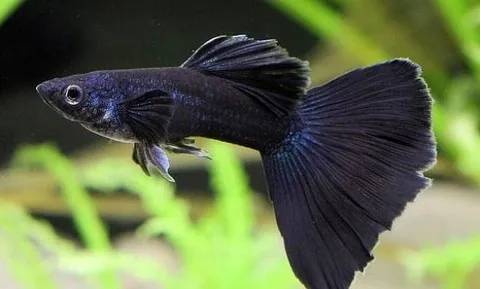
Poecilia reticulata
Black Monk Guppies, also known as Black Guppies, are a breed of Poecilia reticulata (Black strain) from the Poeciliidae family. One of the main features of this variety is the pronounced dark body coloration in males.…
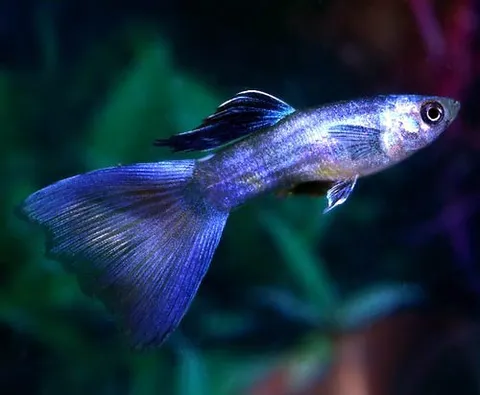
Poecilia reticulata
Blue Guppies, known scientifically as Poecilia reticulata (Blue variety), belong to the Poeciliidae family. This name is a generalization and encompasses various breeds where blue is the dominant color. It is mainly…
Poecilia reticulata
The Cobra Guppy, scientifically known as Poecilia reticulata (Cobra variety), belongs to the family Poeciliidae. Its distinctive feature is a pattern of vertical stripes running along the posterior part of its body. The…