Temperature17 – 28 °C
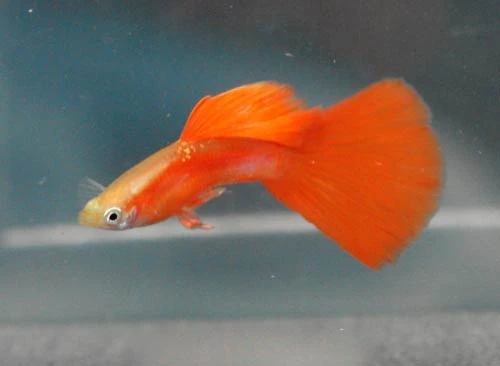
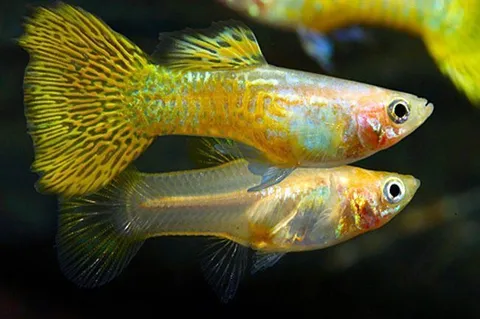
Moscow Guppies, or Guppy Moscow (which is a synonym), are known by the scientific name Poecilia reticulata (Moscow variety) and belong to the Poeciliidae family. Among Russian breeders, especially those of the old Soviet school, these names refer to red-colored fish characterized by large fins and a veil tail.
Due to the closed borders of the USSR, there was no exchange of experience between Soviet and foreign aquarists. Therefore, the development of guppies in the Soviet Union occurred in isolation from global trends, leading to the emergence of unique strains unknown in the West. Back in 1954, there were only a few breeds, among which the 'Moscow Roundtail' stood out. No photographs of it have survived, but verbal descriptions exist. For example, the famous breeder of that time, N. A. Vasiliev, described it as follows: 'A medium-sized fish. At the base of the tail, a bright red spot is visible, sometimes with orange streaks. A second oval red spot is located on the back in front of the dorsal fin. In the posterior part of the body, near the gonopodium, a green spot can be seen, sometimes adorned with a black bean-shaped dot. A similar spot is located under the dorsal fin. A dark streak runs from the eyes to the middle of the body. The tail is rounded, coal-black, with colored speckles. There can be many speckles, making the tail appear silvery or red.' By 1962, according to another famous Soviet breeder, F. M. Polkanov, the number of varieties reached 24. All of them differed in color, body pattern, and tail shape, and each was given its own name. The word 'Moscow' began to be applied to breeds with tail shapes other than round, such as fork-tailed, veil-tailed, spear-tailed, and scarf-tailed. Due to the diversity of colors and body patterns, tail shape became the only reliable criterion for classification, forming the basis of the 'Guppy Standard' adopted in the USSR. Subsequently, the word 'Moscow' temporarily fell out of use. In 1983, the 'Moscow Club of Aquarists and Terrarists' was founded, uniting leading Soviet and later Russian breeders. The club organized annual exhibitions and was actively involved in breeding work. In the 1990s, the term 'Moscow' returned to common use, referring to red guppies with a solid color and large veil tails. It is interesting to note that in Europe and America, 'Guppy Moscow Blue' refers to completely different fish with a solid dark blue coloration. This confusion arose in 1998, related to the third International Guppy Contest in Milwaukee (USA). That year, the jury noted unusual fish from the collection of Japanese breeders, which had previously been acquired in Moscow from one of the local breeders. The Japanese presented these fish at the contest as 'Guppy Moscow,' thereby indicating their geographical origin (place of purchase). They were unfamiliar with Russian classification and did not know that this name was already used for other breeds. After the financial crisis of 2008, the activities of the Moscow Club of Aquarists and Terrarists declined. The last organized exhibition took place in 2009. Severe damage to private fish breeding collections was caused by the anomalous heat of 2010, which covered all of Eastern Europe. According to some data, 50 to 80% of unique guppy strains were lost. In 2011, the Club ceased its activities; at that time, its catalog included over 300 breeds. Since then, breeding work in Russia has slowed down, and the continuity between old and new breeders has been disrupted. The new generation of aquarists increasingly perceives Guppy Moscow Blue as the true Moscow guppies.
Moscow Guppies are a cultivated form of Poecilia reticulata. In the wild, the ancestors of the species inhabit fresh and brackish waters of Central and northern South America, including the Caribbean islands. They prefer warm, densely vegetated areas of rivers, streams, and canals with slow currents.
Peaceful and active fish that prefer to stay in shoals. It is recommended to keep a group of 6–10 individuals with a predominance of females (2–3 females per male). They get along well with other small, peaceful species such as neon tetras, rasboras, corydoras, and other livebearers. Incompatible with aggressive cichlids and large barbs.
These fish demonstrate good resilience and do not have high demands for keeping conditions. For their successful and long existence, it is important to choose appropriate tank mates, ensure regular feeding, and maintain the aquarium in a timely manner. Maintenance includes preventive equipment servicing and weekly partial water changes with fresh water. This procedure is usually combined with siphoning the bottom to remove organic debris, such as uneaten food and excrement. It is important that the added fresh water has a temperature close to that of the aquarium; its hydrochemical composition will not be critical. It should be noted that any artificially bred variety can interbreed with other strains, leading to hybrid offspring. Given the high reproduction rate of guppies, there is a significant risk of degeneration if they are kept together with other varieties.
Omnivorous. In the aquarium, they accept all types of food: dry flakes, granules, frozen, and live foods. To maintain vibrant coloration and health, it is recommended to use high-quality specialized foods containing carotenoids and plant components. Feed 1–2 times a day in portions that are consumed within a few minutes.
Livebearing fish; reproduction occurs easily in a community tank without special stimulation. Fertilization is internal, and egg development takes place inside the female. After 25–40 days, fully formed fry are born. To preserve the offspring, it is recommended to move a pregnant female to a separate tank with dense vegetation. Fry are fed Artemia nauplii, microworms, or specialized fry foods.
They have a strong immune system but are sensitive to sudden changes in water parameters and overcrowding. Common diseases include fin rot and ichthyophthiriasis (white spot disease). Prevention includes weekly 30% water changes, maintaining a stable temperature, and using quality filtration. It is critically important to avoid overfeeding, as the accumulation of organic matter promotes bacterial infections.
When choosing, pay attention to the fish's activity, clean fins, and the absence of spots or film on the body. Healthy individuals should swim actively, have vibrant coloration, and a robust physique without signs of emaciation. Avoid purchasing fish from tanks where individuals with signs of disease or dead fish are observed.
The essentials: size, tank volume, water parameters and care
An adult reaches 3–6 cm in length. Plan the tank around the maximum size: the fish quickly outgrows a cramped setup.
The recommended volume is 40 L. A smaller tank speeds up nitrate build-up and raises stress levels.
Temperature 17–28 °C, pH 7–8.5, hardness 10–30 dGH. Stability matters more than exact values: sudden swings are harder on the fish than a small deviation from the ideal.
Around 3 years when kept properly. Lifespan depends directly on tank volume, water quality and a varied diet.
Temperament: peaceful (regular). Keep this in mind when choosing tank mates.
Recommended setup: mixed (solitary / pair / group). Ignoring this is a common cause of stress and disease.
Diet type: any (universal). Feed small portions that are finished within a couple of minutes — overfeeding does more harm than underfeeding.
The scientific name of the species is Poecilia reticulata, family Poeciliidae. It also appears in the literature as: Acanthophacelus guppii, Acanthophacelus reticulatus, Girardinus guppii.
The water suits 114 of 208 plants in the catalogue — the easiest ones are shown first.
African Onion PlantAfzelius's AnubiasAmazon FrogbitAmazon SwordAnacharisAnubiasArrowhead CryptDwarf CloverDwarf CloverDwarf HygrophilaDwarf SagittariaDwarf ValGuppy GrassHornwortJava MossMoneywortMud SwordNair's LagenandraNarrow Leaf AnacharisNarrow-leaf CloverStringy MossTaiwan MossTape GrassUssuri Watermilfoil
Matched by family, categories and overlapping keeping conditions
Poecilia reticulata
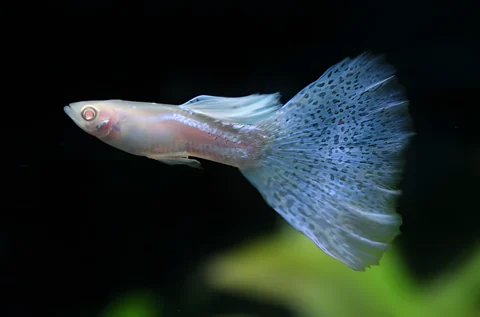
The Albino Guppy, belonging to the Poeciliidae family, is known by its scientific name Poecilia reticulata (Albino variety). A distinctive feature of this fish is the congenital absence of melanin – the black pigment in…
Poecilia reticulata
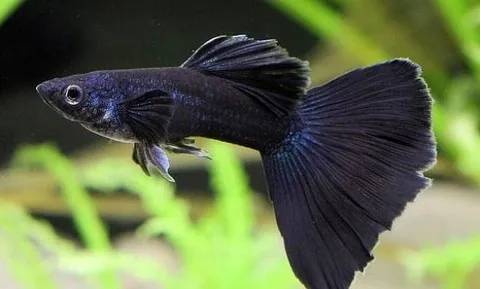
Black Monk Guppies, also known as Black Guppies, are a breed of Poecilia reticulata (Black strain) from the Poeciliidae family. One of the main features of this variety is the pronounced dark body coloration in males.…
Poecilia reticulata
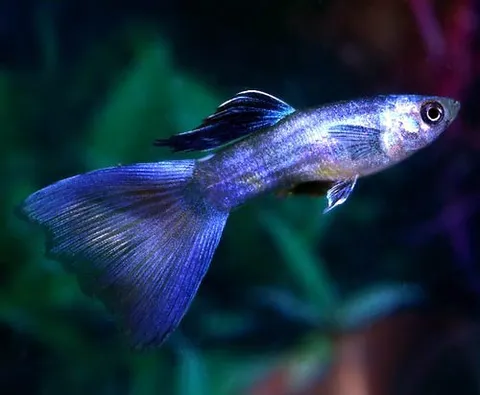
Blue Guppies, known scientifically as Poecilia reticulata (Blue variety), belong to the Poeciliidae family. This name is a generalization and encompasses various breeds where blue is the dominant color. It is mainly…
Poecilia reticulata
The Cobra Guppy, scientifically known as Poecilia reticulata (Cobra variety), belongs to the family Poeciliidae. Its distinctive feature is a pattern of vertical stripes running along the posterior part of its body. The…