Temperature24 – 28 °C
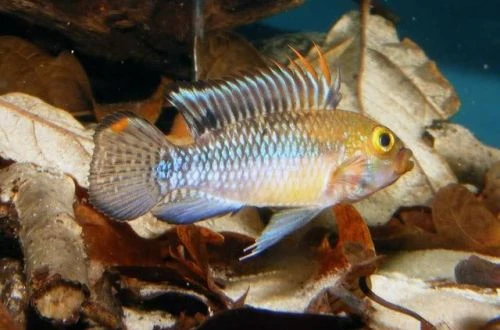
Norbert's Apistogramma (Apistogramma norberti), a representative of the Cichlidae family, is an attractive and rather undemanding aquarium fish. It coexists well with many freshwater species from South America. By providing an appropriate environment, the owner will not encounter great difficulties in its keeping.
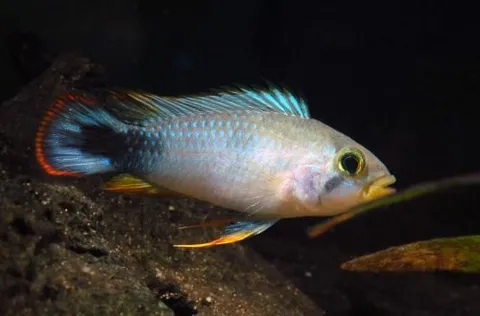
The length of adult individuals of this fish usually varies from 4 to 6 cm. Males are distinguished by their larger size and more intense coloration, predominantly blue hues in the posterior part of the body, as well as pink and yellow tones. Their dorsal fin, extending from head to tail, has bright orange first rays. During courtship, the males' coloration becomes particularly vibrant. Females are typically smaller and possess a predominantly yellow coloration. The pattern on their body can change depending on the season. It usually consists of a broad horizontal stripe and dark dashes in the upper part of the body, which continue onto the dorsal fin. During spawning, this stripe disappears, and a noticeable black spot appears in its place. The only constant element of the pattern remains a diagonal stripe passing through the eyes on the head.
The origin of this fish is associated with the territory of Peru, where it inhabits the upper reaches of the Amazon River basin. The natural home for Norbert's Apistogramma is numerous streams and rivers flowing through tropical jungles. The water level in these bodies of water regularly changes, adapting to the seasons: during rainy periods, the shoreline and forest areas may be partially flooded. The riverbed is often covered with many snags and fallen leaves. The water has a tea-like tint, due to the presence of tannins formed by the decomposition of plant organic matter.
These fish can be kept individually or in groups. However, during the breeding season, males can show aggression towards other individuals of their species. Therefore, it is recommended to form groups of one male and several females. This species coexists well with peaceful and calm fish of similar size.
An aquarium of 40 liters or more will be sufficient for a pair of these fish. They do not have high demands for decor and can adapt even to a tank with minimal ornamentation. However, if breeding is the goal, it is important to provide several shelters. Ceramic pots or pipe sections are suitable for this purpose. Nevertheless, Apistogramma norberti looks most harmonious in an environment resembling its natural habitat. It is recommended to use a sandy substrate, place several snags, and create thickets of plants, including floating ones. Secluded spots where the fish can find refuge should be formed from snags and plants. Lighting should be subdued, so shade-loving plant species are chosen. An important part of the decor is fallen tree leaves (e.g., beech, oak, Indian almond). They not only adorn the aquarium but also contribute to the formation of a water environment similar to their natural one, releasing tannins during decomposition and imparting a characteristic brownish tint to the water. It is extremely important to maintain hydrochemical parameters within an acceptable range and to ensure that the concentration of nitrogen cycle products (ammonia, nitrites, nitrates) does not reach dangerous levels.
This species is carnivorous; in its natural environment, it feeds on small invertebrates found near the bottom. In a home aquarium, their diet should be rich in protein. Live or frozen brine shrimp, daphnia, and bloodworms are excellent for feeding. Dry sinking foods, such as flakes and granules, can also be used as a staple diet.
Under favorable conditions, these fish spawn regularly. After a short courtship period, the female chooses one of the pre-prepared shelters, where she lays her eggs. Throughout the incubation period, she remains near the clutch, and after the fry emerge, she continues to protect them for some time. The male, unlike the female, does not participate in protecting the offspring, and it is advisable to temporarily remove him after spawning.
The main cause of diseases often lies in the keeping conditions: if they go beyond acceptable limits, immunity decreases, making the fish vulnerable to various infections inevitably present in the environment. At the first suspicion of illness, it is important first of all to check the water parameters and ensure there are no dangerous concentrations of nitrogen cycle products. Often, restoring normal, suitable conditions promotes recovery. However, in some cases, medication may be required.
When choosing Apistogramma norberti, preference should be given to individuals with clean fins, free of signs of erosion, damage, or white film. Healthy fish should be active, have even breathing, and show interest in food. Avoid purchasing fish with sunken bellies, signs of lethargy, or unnaturally bloated abdomens, as this may indicate the presence of internal parasites or bacterial infections. In the store, fish should be kept in clean water, preferably with shelters to reduce stress levels. Before purchasing, it is recommended to observe the group's behavior: aggressive behavior in a crowded aquarium can indicate a disrupted hierarchy, which often leads to weakened immunity in subordinate individuals.
The essentials: size, tank volume, water parameters and care
An adult reaches 4–6 cm in length. Plan the tank around the maximum size: the fish quickly outgrows a cramped setup.
The recommended volume is 40 L. A smaller tank speeds up nitrate build-up and raises stress levels.
Temperature 24–28 °C, pH 4.5–6.5, hardness 0–4 dGH. Stability matters more than exact values: sudden swings are harder on the fish than a small deviation from the ideal.
Around 5 years when kept properly. Lifespan depends directly on tank volume, water quality and a varied diet.
Temperament: peaceful (regular). Keep this in mind when choosing tank mates.
Recommended setup: harem (1 male and several females). Ignoring this is a common cause of stress and disease.
Diet type: high protein (predominantly meat). Feed small portions that are finished within a couple of minutes — overfeeding does more harm than underfeeding.
The scientific name of the species is Apistogramma norberti, family Cichlids (Cichlidae).
The water suits 195 of 208 plants in the catalogue — the easiest ones are shown first.
Afzelius's AnubiasAnacharisAnubiasBrazilian PennywortDwarf CloverDwarf CloverDwarf HygrophilaDwarf SagittariaDwarf ValGuppy GrassHornwortJava FernJava MossMoneywortMud SwordNair's LagenandraNarrow Leaf AnacharisNarrow-leaf CloverStringy MossSüsswassertangTaiwan MossTape GrassTemple PlantUssuri Watermilfoil
Matched by family, categories and overlapping keeping conditions
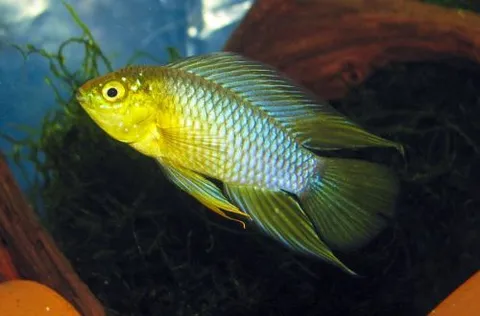
Apistogramma borellii
Borell's Apistogramma, scientifically known as Apistogramma borellii, belongs to the Cichlidae family and is often referred to as the Umbrella Cichlid. This miniature and attractive fish is undemanding and easy to care…
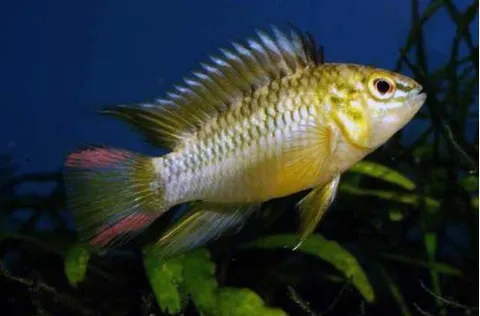
Apistogramma hoignei
Apistogramma hoignei, known as Hongslo's Dwarf Cichlid, belongs to the Cichlidae family. This is an energetic fish, especially the males, which are distinguished by their bright coloration. Experienced aquarists usually…
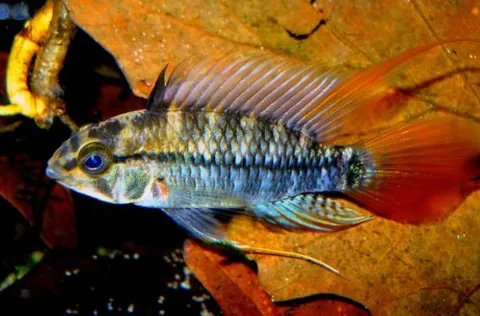
Apistogramma eunotus
The High-fin Apistogramma (Apistogramma eunotus), a representative of the Cichlidae family, is one of the popular South American cichlids. Its keeping does not present particular difficulties for experienced aquarists,…
Apistogramma panduro
Apistogramma panduro, also known as the Azure or Blue Cichlid, belongs to the family Cichlidae. This South American cichlid is considered relatively undemanding in care and is well compatible with other freshwater…