Temperature20 – 24 °C
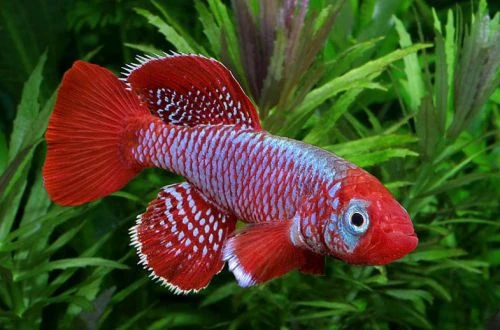
Nothobranchius eggersi, scientifically known as Nothobranchius eggersi, belongs to the family Nothobranchiidae. A distinctive feature is its life cycle, which in natural conditions is only one year. During this short period, the fish goes through the entire path from birth to reproduction and subsequent death. This amazing story, fitting between drought seasons, unfolds in eastern Tanzania.
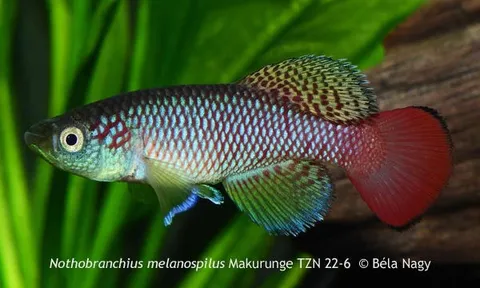
These miniature fish have large, wide fins, with the dorsal and anal fins shifted towards the caudal part, forming a kind of fan. Their coloration attracts particular attention. In the trade for home aquariums, varieties marked as “red” or “blue” are often presented. Both colors are always present in the coloration of these fish, but one of them always dominates. Nothobranchius eggersi has a close relative, also an annual species, inhabiting similar natural conditions – Nothobranchius rachovii. Professional breeders strive to preserve the unique characteristics of each natural variety. Therefore, commercial collections use a much more complex classification, not limited to two shades. For example, you can often see the inscription “TAN 05–43 Kigongo”, where TAN denotes Tanzania, 05 is the year of collection (2005), and 43 Kigongo is a unique location code. Such a code indicates that you are looking at offspring of fish caught in a specific location and in a specific year. In an aquarium, it is recommended to keep only those varieties that have an identical or very similar location code, regardless of the year of collection, as fish from this location may be caught in later periods.
The natural habitat of this species is on the eastern coast of the subequatorial belt of the African continent, within the state of Tanzania. The fish prefers lowland areas, especially marshy river floodplains. This region alternates between wet and dry seasons, and during the dry period, shallow bodies of water often dry up. As a result, adult individuals die, but manage to lay eggs, which remain viable in the dried soil and revive with the onset of rains.
The short life cycle of these fish implies regular work on population reproduction, so long-term cohabitation with other species is extremely difficult. Nothobranchius eggersi are usually kept in a species-specific aquarium.
Creating favorable conditions for these fish is not particularly difficult. These miniature inhabitants will feel comfortable in an aquarium of 50 liters or more, which is suitable for a pair of individuals. The setup should include groups of rooted and floating plants, arranged so that there is enough free space for swimming. Essential equipment includes a filtration system, lighting, heating, and aeration. Since the fish originate from calm, stagnant waters, strong internal currents are undesirable. The main source of current in the aquarium is the filter, so care should be taken to ensure that the water flows exiting it are diffused by some obstacle, be it glass, a large stone, or driftwood. The water should be predominantly medium to high hardness, with a slightly alkaline pH reaction. Detailed information on pH and dGH parameters can be found in the “Hydrochemical composition of water” section. Weekly care includes changing 10–15% of the water volume with fresh water, as well as periodic cleaning of the aquarium walls from plaque and the substrate from organic residues.
In their natural environment, these fish are predatory, feeding mainly on insects and small aquatic crustaceans. When kept in home aquariums, their diet should also primarily consist of protein-rich foods. It is recommended to offer live or frozen foods, such as daphnia, artemia, and small bloodworms. Dry foods can be used exclusively as supplements. Feeding should be done 2–3 times a day, giving an amount of food that will be completely eaten within 5 minutes. Any uneaten food must be removed from the aquarium.
Spawning is usually organized in a separate container, where peat substrate or coconut fibers are used as a substrate for the female to lay her eggs. For equipment, a heater and a lighting system are sufficient; anything else is superfluous. Adult fish are placed in the spawning aquarium, gradually raising the temperature above 24°C and lowering the water level, which mimics the onset of the dry season and stimulates breeding behavior. After the female lays her eggs and the male fertilizes them, the fish are returned to the main aquarium, after equalizing the water temperature. Returning to familiar conditions often contributes to an increase in their lifespan. The water is then drained from the spawning aquarium, and the substrate with the eggs is removed and placed in a dark, warm, but dry place at a temperature of 21–25°C for several months (usually 3–4). After this period, the substrate is re-submerged in water, and after some time, the fry appear. They grow very quickly and can soon be placed in the main aquarium. It is important to note that after each cycle, males or females must be replaced (new individuals acquired) to maintain genetic diversity. Constant interbreeding of close relatives from the same brood can lead to the degeneration of the species.
Due to the peculiarities of their life cycle, Nothobranchius are highly sensitive to water quality and keeping conditions. One of the most common problems is oodiniosis, to which juveniles are particularly susceptible. Prevention includes maintaining cleanliness, regular water changes, and adding a small amount of salt to rearing aquariums. In adult individuals, bacterial infections, manifesting as fin rot or skin lesions, are often observed when conditions are violated. The risk of diseases increases if water parameters are not maintained or if overfeeding occurs.
When choosing fish, pay attention to their activity and brightness of coloration. Healthy individuals should be active, with fins held close to the body, and no visible spots or film on the body. It is important to avoid purchasing individuals with signs of emaciation, sunken bellies, or damaged fins. Since the species is seasonal, it is recommended to clarify the age of the fish with the seller, as their life cycle is extremely limited. When purchasing, it is advisable to prefer individuals from proven lines to avoid problems associated with inbreeding, which negatively affects the viability of the offspring.
The essentials: size, tank volume, water parameters and care
An adult reaches 5 cm in length. Plan the tank around the maximum size: the fish quickly outgrows a cramped setup.
The recommended volume is 50 L. A smaller tank speeds up nitrate build-up and raises stress levels.
Temperature 20–24 °C, pH 7–8.2, hardness 10–30 dGH. Stability matters more than exact values: sudden swings are harder on the fish than a small deviation from the ideal.
Around 1 years when kept properly. Lifespan depends directly on tank volume, water quality and a varied diet.
Temperament: semi-peaceful (including aggression during spawning / intraspecific conflicts). Keep this in mind when choosing tank mates.
Recommended setup: harem (1 male and several females). Ignoring this is a common cause of stress and disease.
Diet type: high protein (predominantly meat). Feed small portions that are finished within a couple of minutes — overfeeding does more harm than underfeeding.
The scientific name of the species is Nothobranchius eggersi, family Nothobranchiidae.
The water suits 113 of 208 plants in the catalogue — the easiest ones are shown first.
African Onion PlantAfzelius's AnubiasAmazon FrogbitAmazon SwordAnacharisAnubiasArrowhead CryptAsian WatermossDwarf CloverDwarf CloverDwarf HygrophilaDwarf SagittariaDwarf ValGuppy GrassHornwortJava MossMoneywortMud SwordNarrow Leaf AnacharisNarrow-leaf CloverStringy MossTaiwan MossTape GrassUssuri Watermilfoil
Matched by family, categories and overlapping keeping conditions
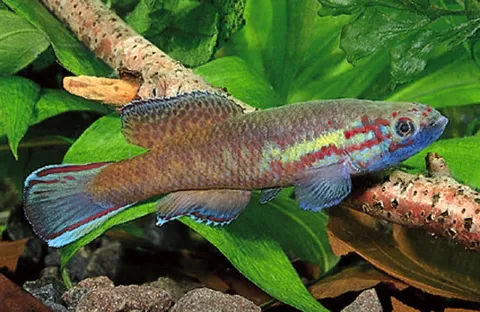
Callopanchax occidentalis
Roloffia occidentalis, also known as the "Golden Pheasant" fish, belongs to the family Nothobranchiidae. Its scientific name is Callopanchax occidentalis, although it was formerly known as Roloffia occidentalis.
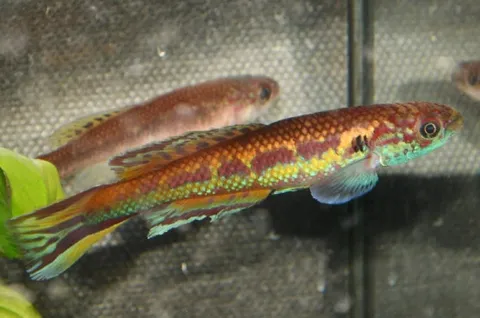
Callopanchax huwaldi
The fish Roloffia huwaldi, known scientifically as Callopanchax huwaldi (formerly Roloffia huwaldi), belongs to the family Nothobranchiidae, or nothobranchs. Its homeland is West Africa, where it is found in Sierra…
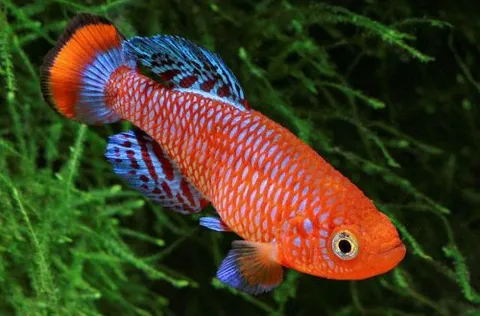
Nothobranchius rachovii
Nothobranchius rachovii, more commonly known as Rachow's Nothobranch, is a member of the family Nothobranchiidae. This fish attracts with its bright and beautiful appearance, displaying one of the most colorful guises…
Nothobranchius melanospilus
The fish, known scientifically as Nothobranchius melanospilus, or the Black-spotted Nothobranchius, belongs to the family Nothobranchiidae, which unites all Nothobranchius species.