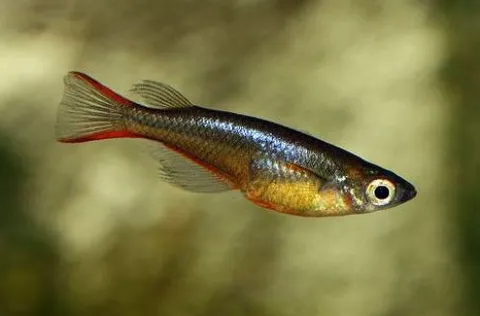
Ricefish
Oryzias asinua
Oryzias asinua, known as the Asian Ricefish, belongs to the family Adrianichthyidae and is part of the Killifish group, also called Toothcarps. This fish is a close relative of the Japanese Ricefish, inheriting its…
Oryzias woworae, known as the Sulawesi ricefish, is classified in the family Adrianichthyidae. This fish received its interesting name in honour of Daisy Wowor of the Museum Zoologicum Bogoriense on Java, Indonesia, who collected the type series and was the first to photograph these fish alive in the field.
Adult fish typically reach a length of about 3 centimeters. Males are distinguished by their bright, iridescent bluish body coloration, complemented by red fins. Females, though less colorful, also display reddish hues on their fins and caudal fin.
The natural habitat of this species extends across Southeast Asia. Oryzias woworae is endemic to the Indonesian island of Muna, located south of Sulawesi, where it inhabits shallow forest streams and small rivers. It prefers areas of water bodies with weak currents.
Maintaining a school of at least 8–10 fish is an important aspect. Occasionally, minor skirmishes may occur between males vying for the attention of females, but these rarely result in injury. This species coexists well with other peaceful small fish. Excellent tank mates can include, for example, the Green Dwarf Danio, Green Neon Rasbora, Gates' Danio, various rasboras, and the Red Neon Blue Eye, among others.
For a comfortable existence, a school of six individuals will require an aquarium of at least 40 liters. When decorating the space, it is recommended to use dark substrate, and to add various snags, dense plant thickets, and other natural or artificial decorations. Such areas of dense vegetation can serve as reliable cover for fry, significantly increasing their chances of survival. An important condition is a mature aquarium, ensuring clean and warm water, the parameters of which must remain within the acceptable hydrochemical range. A favorable environment is achieved through regular maintenance combined with the uninterrupted functioning of the filtration system.
These fish can adapt to consuming dry foods, such as flakes and granules of appropriate size. Nevertheless, the most complete nutrition is achieved by combining dry foods with live or frozen diets.
This fish species is quite prolific. Under favorable environmental conditions, females can lay 10 to 20 eggs every few days. The breeding process has its own peculiarities, differing from most egg-laying fish: mature eggs first attach to the posterior part of the female's abdomen, forming a peculiar cluster, and remain there until fertilized by the male. After this, the eggs are laid among thickets of fine-leaved plants. The incubation period usually lasts from 1 to 3 weeks. Adult Oryzias woworae generally do not eat their offspring, but fry can become prey for other fish species. Therefore, it is advisable to transfer the fry to a separate aquarium. They should be fed with special powdered foods or suspensions.
Oryzias woworae is considered a hardy and undemanding species. In a well-balanced aquarium ecosystem, disease outbreaks are rare. Health problems can arise from a significant deterioration of keeping conditions, as well as from contact with already sick individuals and in other similar situations.
When purchasing, choose active individuals that stay in a school and show interest in their surroundings. Avoid fish with signs of emaciation, fin damage, white spots or film on the body, as well as individuals that stay at the water surface or appear lethargic. Healthy fish of this species have a characteristic bluish sheen and bright reddish fins, which become more pronounced in adult males.
There are no pair reviews for this species yet — check tankmates in the matcher.
All tankmatesThe water suits 197 of 208 plants in the catalogue — the easiest ones are shown first.
Afzelius's AnubiasAnacharisAnubiasBrazilian PennywortDwarf CloverDwarf CloverDwarf HygrophilaDwarf SagittariaDwarf ValGuppy GrassHornwortJava FernJava MossMoneywortMud SwordNair's LagenandraNarrow Leaf AnacharisNarrow-leaf CloverStringy MossSüsswassertangTaiwan MossTape GrassTemple PlantUssuri Watermilfoil
Matching water does not mean the plant will stay intact.
The essentials: size, tank volume, water parameters and care
An adult reaches 3 cm in length. Plan the tank around the maximum size: the fish quickly outgrows a cramped setup.
The recommended volume is 40 L. A smaller tank speeds up nitrate build-up and raises stress levels.
Temperature 23–27 °C, pH 6–7.5, hardness 5–14 dGH. Stability matters more than exact values: sudden swings are harder on the fish than a small deviation from the ideal.
Around 3 years when kept properly. Lifespan depends directly on tank volume, water quality and a varied diet.
Temperament: semi-peaceful (including aggression during spawning / intraspecific conflicts). Keep this in mind when choosing tank mates.
Recommended setup: schooling (usually from 5–6 individuals and more). Ignoring this is a common cause of stress and disease.
Diet type: any (universal). Feed small portions that are finished within a couple of minutes — overfeeding does more harm than underfeeding.
The scientific name of the species is Oryzias woworae, family Adrianichthyidae.
Matched by family, categories and overlapping keeping conditions
Oryzias asinua
Oryzias asinua, known as the Asian Ricefish, belongs to the family Adrianichthyidae and is part of the Killifish group, also called Toothcarps. This fish is a close relative of the Japanese Ricefish, inheriting its…
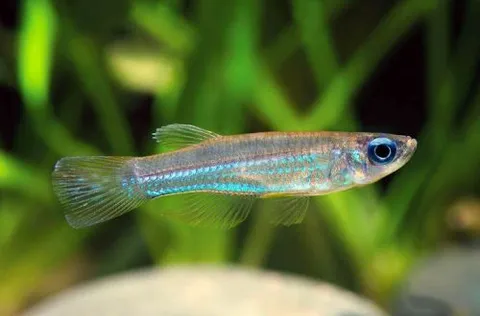
Poropanchax luxophthalmus
The Neon Lampeye, scientifically known as Poropanchax luxophthalmus (formerly classified as Aplocheilichthys luxophthalmus), is a member of the Poeciliidae family. This beautiful schooling fish is easy to keep and…
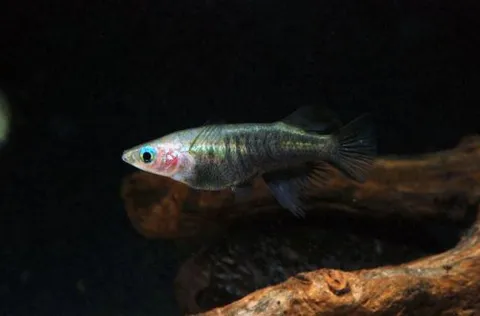
Oryzias eversi
Oryzias eversi belongs to the family Adrianichthyidae. It is a small but very active fish. It is easy to keep and breed, and peaceful with many other species, making it an excellent choice for beginners in the hobby.
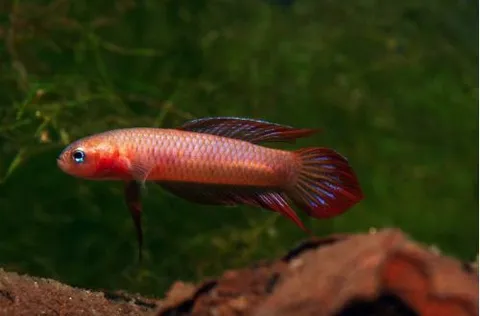
Betta burdigala
Betta burdigala, or Bordeaux Betta, belongs to the family Osphronemidae. A distinctive feature of this fish is its beautiful red coloration, which reminded French researchers of the noble color of the famous Bordeaux…