Temperature16 – 26 °C
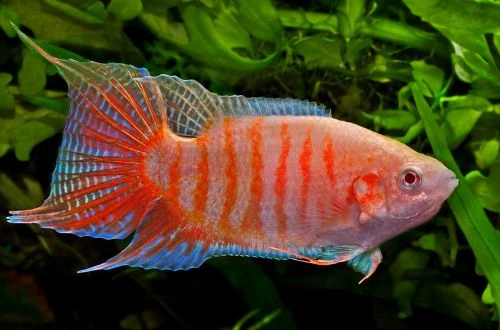
The Paradise Fish (Macropodus opercularis), also known as the Macropod, belongs to the family Osphronemidae. It is one of the most beautiful aquarium fish, and its appearance in the wild remains unchanged. Other freshwater fish with similar shapes and vibrant colors are typically the result of extensive selective breeding.
This species is characterized by a robust but small body with pointed fins. The caudal fin is notably large, making up to one-third of the fish's total length. Inside the mouth is a labyrinth organ—a special sac permeated by numerous capillaries. Thanks to this organ, the fish can breathe atmospheric oxygen, absorbing it directly from the air. The predominant body coloration is blue, with bright red vertical stripes that also color the fish's tail. Males are distinguished by their size; they are noticeably larger than females, with larger fins and significantly brighter, more saturated coloration.
The scientific description of this species was provided in 1758. Its discovery by European scientists occurred during the exploration of the flora and fauna of Southeast Asia. This species is widely distributed in river systems and water bodies along the eastern coast of modern China, and is also found in Taiwan, Vietnam, Cambodia, Japan, and Malaysia. Today, the Paradise Fish has also been introduced outside its natural range and can be found in North America and on the island of Madagascar. In natural conditions, it inhabits streams, tributaries of large rivers, swamps, marshy areas, and flooded rice fields. The diet of Macropods includes any objects they can swallow, but they particularly prefer meaty foods such as insect larvae, worms, small fish, and various invertebrates.
This species is quite aggressive, especially the males, which makes selecting suitable tank mates very difficult. An ideal option would be a species-specific aquarium, housing only members of one species, preferably in a ratio of one male to several females. Males are extremely intolerant of each other, engage in territorial fights, and can inflict injuries. Females, on the other hand, are friendly and coexist easily in a group.
The Paradise Fish is an exceptionally hardy fish, capable of adapting to diverse environmental conditions. For one or two individuals, a small aquarium of approximately 80 L will be needed, preferably with a lid. Essential equipment includes a filter, aerator, and lighting system. A heater may not be necessary, as the fish thrives at temperatures down to 16°C. The filter should be powerful enough but minimize water movement, as strong currents cause stress and severe fatigue in these fish. When decorating the aquarium, the principle of "one hiding place per fish" should be followed. Each individual in its natural habitat has its own territory, which it guards. Therefore, if two fish are kept in the aquarium, two equivalent hiding places (such as driftwood or grottoes) should be placed in opposite parts of the tank. It will also be beneficial to plant several groups of sturdy plants with strong root systems near them. Floating plants will be a good addition. A dark-colored substrate is recommended to provide contrast with the fish's coloration, making them more striking.
Macropods are omnivorous, but their diet prefers protein-rich foods, such as bloodworms, mosquito larvae, or tubifex worms. Nevertheless, these products should not form the basis of their diet. In a home aquarium, it is recommended to feed them dry foods (flakes or granules) intended for Gouramis, choosing manufacturers that offer the highest content of meaty components. Feeding once or twice a day will be sufficient.
Breeding Macropods is quite simple, but the male's behavior adds complexity: during nest building and spawning, he becomes very aggressive towards females, and during this period, hiding places are essential. It is recommended to use a breeding tank with the necessary conditions, which significantly simplifies the breeding process, as females constantly need to be removed due to the male's behavior. The stimulus for spawning is the inclusion of meaty products, both live and frozen, in their daily diet. The water level should be lowered to 20 cm, the temperature raised to 26–29°C, and the pH shifted to the acidic side, to 6.0. After some time, the female noticeably rounds out, filled with eggs, and the male begins to form a bubble nest with plant fragments, usually located under the largest floating leaf on the surface. If spawning occurs in a community tank with several females and insufficient hiding places, they should be temporarily moved to a separate tank until the nest is fully built, as the male can not only injure but also kill the female during this period. Once everything is ready, the male begins courtship, touching his chosen mate and inviting her to the nest. An adult can lay up to 500 eggs, which are immediately fertilized after being released into the water. Since the eggs are lighter than water, they float to the surface, where the male carefully collects them and transfers them to the nest. From this moment, he guards the clutch, protecting it from everyone, including the females, who should again be removed. Fry hatch after 3–5 days, depending on water parameters, the nest gradually disappears, and the male is ready to rejoin the females. Parents and their offspring must be kept in separate tanks, as parental instincts end when the fry begin to swim freely, and predatory instincts awaken. Fry should be fed microfoods, artemia, or infusoria.
This is an exceptionally hardy species, resistant to many diseases; with balanced aquarium conditions and good nutrition, disease outbreaks have not been observed.
When purchasing Paradise Fish, choose active individuals with clean fins showing no signs of damage, film, or ulcers. A healthy fish should show curiosity and a normal reaction to external stimuli. Avoid specimens with clamped fins, sluggish behavior, or signs of emaciation, as these may indicate stress or underlying diseases. Given the territorial nature of the species, it is recommended to acquire young fish so they can adapt to cohabitation, or select individuals based on their future size and compatibility with other aquarium inhabitants.
The essentials: size, tank volume, water parameters and care
An adult reaches 10 cm in length. Plan the tank around the maximum size: the fish quickly outgrows a cramped setup.
The recommended volume is 80 L. A smaller tank speeds up nitrate build-up and raises stress levels.
Temperature 16–26 °C, pH 6–8, hardness 5–19 dGH. Stability matters more than exact values: sudden swings are harder on the fish than a small deviation from the ideal.
Around 6 years when kept properly. Lifespan depends directly on tank volume, water quality and a varied diet.
Temperament: territorial (often aggressive). Keep this in mind when choosing tank mates.
Recommended setup: pair (male/female). Ignoring this is a common cause of stress and disease.
Diet type: any (universal). Feed small portions that are finished within a couple of minutes — overfeeding does more harm than underfeeding.
The scientific name of the species is Macropodus opercularis, family Osphronemidae. It also appears in the literature as: Chaetodon chinensis, Labrus opercularis, Macropodus chinensis.
The water suits 197 of 208 plants in the catalogue — the easiest ones are shown first.
Afzelius's AnubiasAnacharisAnubiasBrazilian PennywortDwarf CloverDwarf CloverDwarf HygrophilaDwarf SagittariaDwarf ValGuppy GrassHornwortJava FernJava MossMoneywortMud SwordNair's LagenandraNarrow Leaf AnacharisNarrow-leaf CloverStringy MossSüsswassertangTaiwan MossTape GrassTemple PlantUssuri Watermilfoil
Matched by family, categories and overlapping keeping conditions
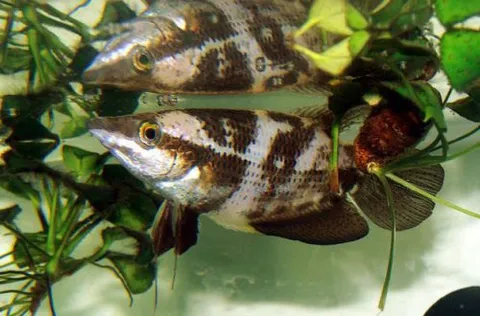
Ctenops nobilis
The Noble Gourami, scientifically known as Ctenops nobilis, also referred to as the Threadfin or Contemplative Gourami, belongs to the family Osphronemidae. This species is characterized by its hardiness and…
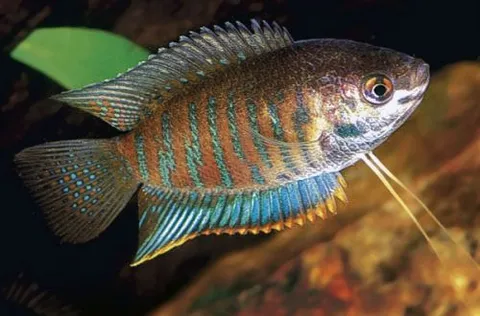
Trichogaster fasciata
Trichogaster fasciata, also known as the Banded Gourami or Striped Gourami, belongs to the family Osphronemidae. This fish possesses a range of qualities that make it an excellent choice for beginner aquarists: it is…
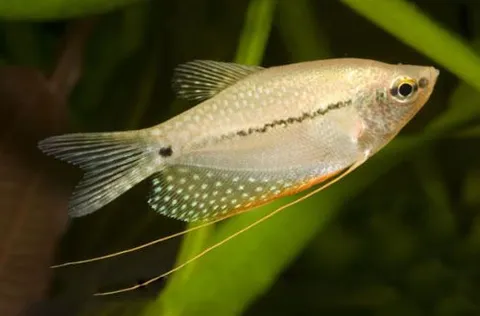
Trichopodus leerii
The Pearl Gourami, known scientifically as Trichopodus leerii, is a member of the Osphronemidae family. This fish is rightfully considered one of the most attractive among freshwater aquarium inhabitants. Its name is…
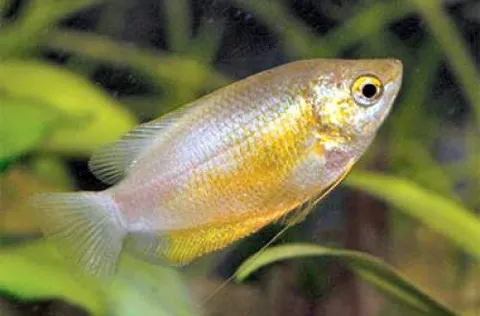
Trichogaster labiosa
Trichogaster labiosa, more commonly known as the Thick-lipped Gourami or Labiosa, belongs to the family Osphronemidae. This fish will be a wonderful addition to any aquarium. Thanks to its modest size and natural,…