Temperature23 – 26 °C
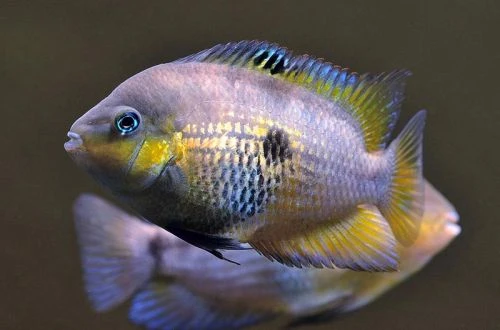
The Peaceful Cichlid, also known by its scientific name Amatitlania myrnae, belongs to the family Cichlidae. It was previously referred to as Cryptoheros myrnae. Despite its name, this fish can be quite energetic, especially the males. However, when compared to many other Central American cichlids, it indeed exhibits a relatively peaceful disposition and can coexist harmoniously with various species. In spacious aquariums, its keeping will not pose significant difficulties.
Adults of this fish reach a length of 7 to 10 cm. Their body has a rather massive, oval shape, slightly compressed laterally. Males are larger and more brightly colored. Their body combines gray shades with yellow, which appear on the belly and fins. The latter are additionally adorned with a blue edging. Females are typically smaller, their main coloration is gray, and their fins have bluish iridescence. Both sexes have a prominent black spot in the center of the body; in females, an additional spot appears at the base of the caudal fin during spawning.
Its natural habitat is Central America, specifically the territories of Costa Rica and Panama. These fish inhabit rivers on the eastern coast that flow into the Caribbean Sea. They prefer sections of watercourses with clear, transparent water, moderate current, and a sandy bottom.
These fish zealously defend their territory from rivals, and this is especially characteristic of males. Therefore, in a small aquarium, it is best to keep them individually or as a male-female pair. In spacious tanks, they can coexist with other Central American cichlids, provided there is sufficient space for each fish and frequent contact is minimized. They get along well with fish that inhabit the surface or mid-water. Such neighbors include popular livebearers, such as Guppies and Alfaro cultratus, as well as the rarer Mexican Tetra.
For one or two fish, the optimal aquarium volume starts from 80 liters. When planning cohabitation with other species, a significantly larger tank will be required. The decor can be relatively simple: it is sufficient to use a sand-gravel substrate and several snags, imitating branches or tree roots, from which convenient shelters can be created. In nature, peaceful Cichlids live in rivers rich in dissolved minerals, so to successfully keep them in an aquarium, it is necessary to reproduce and maintain high dGH and pH values. Additional aeration is recommended, for example, using a pump, which will also create water movement, imitating a river current. Regular care includes standard procedures: weekly water changes of 15–20% of the volume with fresh water, removal of organic waste (uneaten food, excrement), preventive equipment maintenance, as well as monitoring water parameters for nitrogen cycle products (nitrites, nitrates, ammonia), and so on.
This fish has no special dietary requirements. In a home aquarium, it easily adapts to most common foods, including dry flakes, granules, and pellets. Its menu can also include bloodworms, daphnia, and artemia, offered live, frozen, or freeze-dried. It is desirable that the food contains a certain amount of plant components.
Breeding these fish is not difficult if a stable pair has already formed. However, it should be noted that fish are quite selective in choosing a mate, and simply keeping an adult male and female together may not lead to the desired result. At the same time, males exhibit pronounced territorial behavior, not allowing other individuals into their area. To form strong pairs, it is recommended to raise a group of young fish, from which one or two pairs may eventually emerge, remaining faithful to each other for a long time. During breeding, the female can lay up to 200 eggs and then fully takes over the care and protection of the clutch. The male, during this period, actively patrols the borders of his territory, driving away anyone he considers a threat. Egg incubation takes approximately 4 days. After another week, you can observe the fry beginning their free swimming. The female continues to care for and protect the offspring for several weeks, as long as the young stay in her immediate vicinity.
The main cause of diseases often lies in the keeping conditions: if they go beyond acceptable limits, immunity decreases, making the fish vulnerable to various infections inevitably present in the environment. At the first suspicion of illness, it is important first of all to check the water parameters and ensure there are no dangerous concentrations of nitrogen cycle products. Often, restoring normal, suitable conditions promotes recovery. However, in some cases, medication may be required.
When selecting individuals, attention should be paid to the fish's activity and behavior. Healthy cichlids should show curiosity, have clean fins without signs of erosion or film, and even scales without visible damage or spots. Avoid fish that appear apathetic, constantly hide in a corner, or have a severely sunken belly, which may indicate emaciation or internal diseases. It is recommended to purchase juveniles from the same group so that a natural pair can form independently later. It is important to clarify the keeping conditions and diet with the seller, as an abrupt change in water parameters or food type can cause stress. Before purchasing, make sure that there are no individuals with signs of infectious diseases in the aquarium with the fish, as the species is sensitive to water quality and environmental cleanliness.
The essentials: size, tank volume, water parameters and care
An adult reaches 10 cm in length. Plan the tank around the maximum size: the fish quickly outgrows a cramped setup.
The recommended volume is 80 L. A smaller tank speeds up nitrate build-up and raises stress levels.
Temperature 23–26 °C, pH 7–8.5, hardness 10–26 dGH. Stability matters more than exact values: sudden swings are harder on the fish than a small deviation from the ideal.
Around 5 years when kept properly. Lifespan depends directly on tank volume, water quality and a varied diet.
Temperament: semi-peaceful (including aggression during spawning / intraspecific conflicts). Keep this in mind when choosing tank mates.
Recommended setup: pair (male/female). Ignoring this is a common cause of stress and disease.
Diet type: high protein (predominantly meat). Feed small portions that are finished within a couple of minutes — overfeeding does more harm than underfeeding.
The scientific name of the species is Amatitlania myrnae, family Cichlids (Cichlidae). It also appears in the literature as: Archocentrus myrnae, Cichlasoma myrnae, Cryptoheros myrnae.
The water suits 114 of 208 plants in the catalogue — the easiest ones are shown first.
African Onion PlantAfzelius's AnubiasAmazon FrogbitAmazon SwordAnacharisAnubiasArrowhead CryptDwarf CloverDwarf CloverDwarf HygrophilaDwarf SagittariaDwarf ValGuppy GrassHornwortJava MossMoneywortMud SwordNair's LagenandraNarrow Leaf AnacharisNarrow-leaf CloverStringy MossTaiwan MossTape GrassUssuri Watermilfoil
Matched by family, categories and overlapping keeping conditions
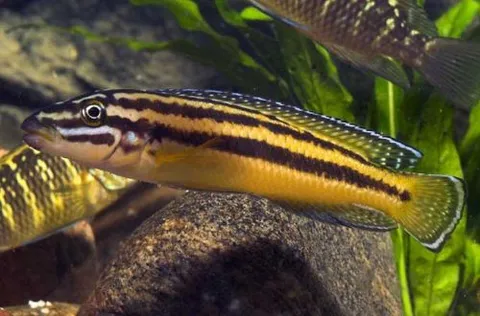
Julidochromis regani
Julidochromis regani, with the scientific name Julidochromis regani, belongs to the family Cichlidae. This cichlid is quite popular among aquarists. Like many members of its family, it can show aggression towards…
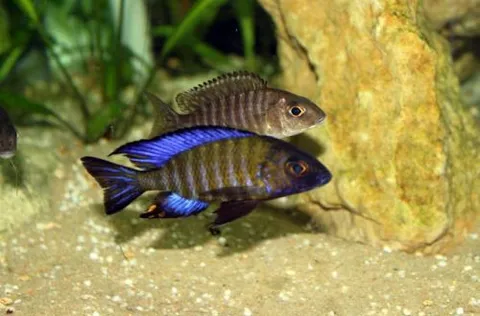
Aulonocara ethelwynnae
Aulonocara ethelwynnae, or Northern Aulonocara, is a representative of the Cichlidae family. These individuals, characteristic of cichlids from the great African lakes, are quite easy to keep and breed provided they…
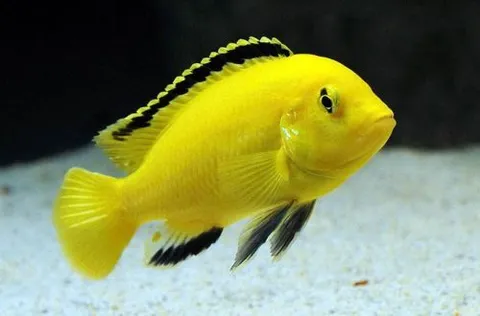
Labidochromis caeruleus
The Yellow Lab Cichlid, also known as the Electric Yellow Cichlid or Hummingbird Cichlid (scientific name Labidochromis caeruleus), belongs to the family Cichlidae. This cichlid, thanks to its bright coloration and…
Aulonocara maylandi
Aulonocara maylandi, known as Mayland's Aulonocara, is a representative of the Cichlidae family, typical of Malawian cichlids. This species is relatively easy to keep and breed, demonstrating good compatibility with…