Temperature22 – 26 °C
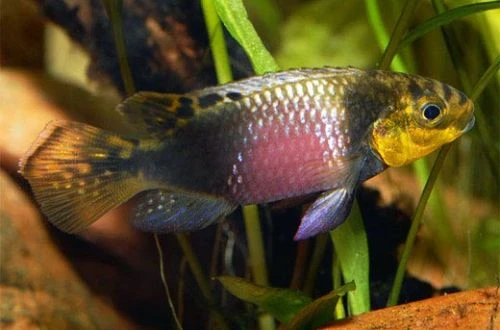
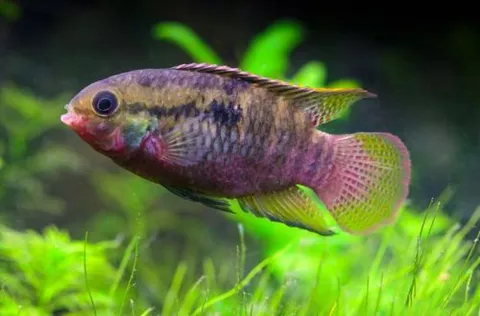
Pelvicachromis subocellatus, also known as the Kribensis or Kribensis Cichlid, belongs to the family Cichlidae. It is sometimes referred to as the "Parrot Cichlid." This fish demonstrates a remarkable ability to adapt to diverse conditions and has a peaceful disposition, making it an excellent choice for cohabitation with many popular aquarium species. Its care and breeding do not present significant difficulties, so the Kribensis Cichlid can be highly recommended even for novice aquarists.
Adults of this species typically reach a length of about 8 cm. Differences between the sexes are quite noticeable: males are larger, their dorsal and anal fins appear elongated and pointed, unlike those of females. The coloration of males is predominantly gray, with a longitudinal dark stripe along the body; their heads are yellow, and the anal fin and tail acquire a pinkish hue. Females, on the other hand, have a somewhat different appearance: their bodies are colored with alternating black and white stripes, and during the breeding season, the white areas change color to pink, which serves as a precursor to spawning.
The natural habitat of this species extends across the western part of equatorial Africa, covering the territories of modern-day Nigeria, Gabon, and the Democratic Republic of Congo. It is often found in coastal areas where freshwater streams flow into the ocean, and some of these habitats are brackish.
This species is characterized by a peaceful and calm disposition. Even during the spawning period, when males guard their territory, they rarely cause serious inconvenience to other aquarium inhabitants. Thanks to its temperament, the Kribensis Cichlid coexists well with most fish of similar size and temperament. However, in a small aquarium, to avoid territorial competition, it is recommended to keep only one pair of Kribensis.
For comfortable keeping of a pair of adult Pelvicachromis pulcher, an aquarium of at least 70 liters is recommended. The decor can be anything, the main condition is the presence of a sufficient number of shelters. Such shelters can be snags, decorative elements imitating grottoes, crevices or caves, as well as simple ceramic pots turned on their side. The preferred substrate is sand or fine gravel; the presence of live plants is not mandatory. It is important to set up the filtration system in such a way as to avoid strong internal currents, as Pelvicachromis pulcher tolerates active water movement poorly. Water conditions are characterized by a wide range of permissible pH and dGH values. Keeping them in brackish water is even possible, with the salt concentration not exceeding 3 g per litre.
These fish readily accept most types of dry foods, especially if their composition is rich in protein. For a complete and varied diet, it is highly desirable to supplement the main diet with live or frozen foods, such as bloodworms, Artemia, Daphnia, and others.
These fish tend to form monogamous pairs that can last throughout their lives. It is noteworthy that Pelvicachromis pulcher is very meticulous in choosing a partner. Thus, if adult male and female are introduced into an aquarium, there is no full guarantee that they will necessarily form a pair. In this regard, when planning breeding, one can choose one of two approaches. The first option involves purchasing about a dozen young individuals, among whom, as they mature, at least one formed pair will almost certainly appear. The second method is to acquire an already established, formed pair. Otherwise, the breeding process of Pelvicachromis pulcher is simple. The beginning of the breeding period is a gradual adjustment of water parameters to the following values: pH 5.5–6.5, dGH 5–10, temperature 23–26°C. The readiness of females for spawning is easily determined by the pink coloration of their abdomen. Having chosen a suitable place, most often a small cave, the female secludes herself there for several days and lays up to 200 eggs. The male, meanwhile, remains at the entrance, guarding the approaches to the spawning site. The incubation period lasts from 2 to 3 days, and after about another week, the fry begin to swim freely, although they stay close to their parents. The female and male jointly continue to care for their offspring.
The main cause of most diseases in these fish is unsuitable keeping conditions and poor-quality nutrition. If initial symptoms are observed, it is first necessary to check water parameters and the concentration of dangerous substances such as ammonia, nitrites, and nitrates. If the indicators deviate from the norm, they should be brought back into order, and only then should treatment begin.
When choosing fish in a store, give preference to active individuals with clean scales, without visible damage, spots or film on the body and fins. Avoid specimens with signs of emaciation, sunken bellies, or apathetic behavior, as these types may be susceptible to hexamitiasis and colds if kept improperly. The optimal option is to purchase a young group of six or more individuals, which will allow the fish to independently form a stable pair, as forced pairing of adult fish can lead to aggression and the death of the weaker partner.
The essentials: size, tank volume, water parameters and care
An adult reaches 8 cm in length. Plan the tank around the maximum size: the fish quickly outgrows a cramped setup.
The recommended volume is 70 L. A smaller tank speeds up nitrate build-up and raises stress levels.
Temperature 22–26 °C, pH 5.5–8, hardness 5–20 dGH. Stability matters more than exact values: sudden swings are harder on the fish than a small deviation from the ideal.
Around 5 years when kept properly. Lifespan depends directly on tank volume, water quality and a varied diet.
Temperament: peaceful (regular). Keep this in mind when choosing tank mates.
Recommended setup: both solitary and in group (flexible). Ignoring this is a common cause of stress and disease.
Diet type: any (universal). Feed small portions that are finished within a couple of minutes — overfeeding does more harm than underfeeding.
The scientific name of the species is Pelvicachromis subocellatus, family Cichlids (Cichlidae). It also appears in the literature as: Hemichromis subocellatus, Pelmatochromis pulcher, Pelmatochromis subocellatus.
The water suits 198 of 208 plants in the catalogue — the easiest ones are shown first.
Afzelius's AnubiasAnacharisAnubiasBrazilian PennywortDwarf CloverDwarf CloverDwarf HygrophilaDwarf SagittariaDwarf ValGuppy GrassHornwortJava FernJava MossMoneywortMud SwordNair's LagenandraNarrow Leaf AnacharisNarrow-leaf CloverStringy MossSüsswassertangTaiwan MossTape GrassTemple PlantUssuri Watermilfoil
Matched by family, categories and overlapping keeping conditions
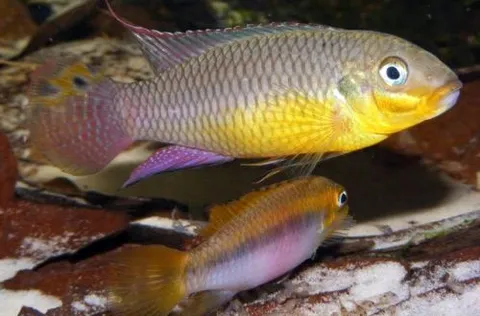
Pelvicachromis taeniatus
A representative of the Cichlidae family, Kribensis taeniatus, also known by its scientific name Pelvicachromis taeniatus, is an attractive and rather undemanding fish. This fish readily coexists with many other…
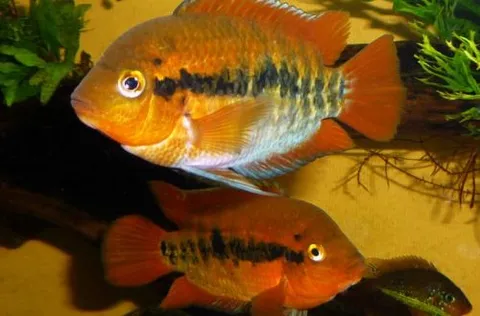
Herotilapia multispinosa
The Yellow Herotilapia, also known as the Rainbow Cichlid (scientific name Herotilapia multispinosa), belongs to the family Cichlidae. Previously, this species was named Archocentrus multispinosus. It is easy to keep…
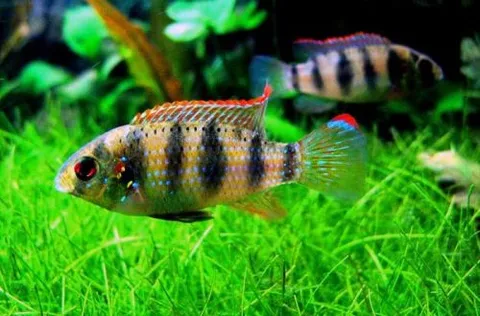
Anomalochromis thomasi
Anomalochromis thomasi, known scientifically as Anomalochromis thomasi, belongs to the family Cichlidae. These fish are characterized by their undemanding nature and attractive, vibrant coloration. They also exhibit…
Laetacara dorsigera
The Laetacara dorsigera, otherwise known as the Red-breasted Acara (scientific name Laetacara dorsigera), belongs to the family Cichlidae. This American cichlid is characterized by its peaceful disposition. It does not…