Temperature17 – 28 °C
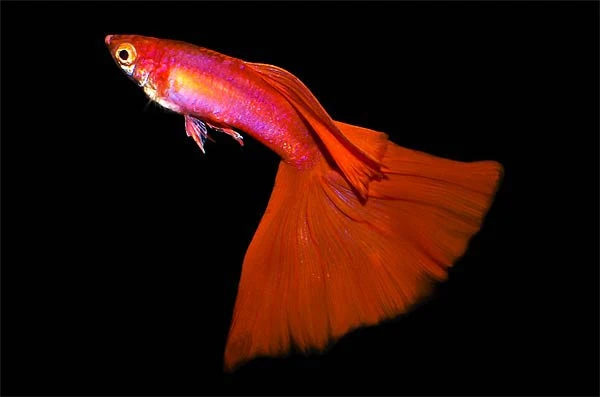
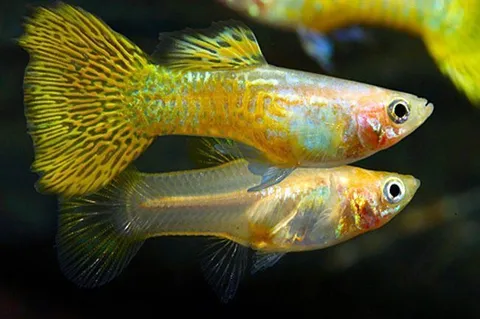
Red Guppies, also known as "Red Blonde" Guppies, belong to the family Poeciliidae, and their scientific designation is Poecilia reticulata (Red variety). The coloration of this variety is characterized by a predominance of rich red, which is reflected in their name. The tail of these fish is usually uniformly colored, while the body, especially in the abdominal area, may have silvery, blue, turquoise, or yellow hues.
Red Guppies are a selectively bred form of Poecilia reticulata, characterized by the predominance of red color in their coloration. Males are usually smaller than females (3–4 cm vs. 6 cm) and have brighter coloration and more developed fins. Females have a more rounded body, often with a silvery or olive tint. A key anatomical feature of males is the gonopodium — a modified anal fin used for internal fertilization.
In nature, the species Poecilia reticulata inhabits fresh and brackish waters of South America, including Venezuela, Guyana, northern Brazil, as well as the islands of Trinidad and Barbados. The fish prefer areas with slow currents or stagnant water, rich in aquatic vegetation. Thanks to their high adaptability, Guppies have been successfully introduced worldwide in warm climate zones.
These are peaceful and active fish that prefer to live in shoals. They get along well with other fish species of comparable size and temperament. Intraspecific conflicts between males are limited to displays of beauty and competition, not escalating into serious aggression. Guppies inhabit all layers of the aquarium.
These fish are the result of selective breeding of the common Guppy, from which they inherited outstanding resilience and the ability to adapt to various conditions, including brackish water. For successful keeping of Red Guppies, clean water, quality nutrition, and peaceful tank mates are important. Water preparation will not cause difficulties even for beginner aquarists, as the hydrochemical composition of the water does not play a critical role for this variety. It is sufficient for tap water to stand for about 24 hours, after which it can be safely added to the aquarium. In a spacious aquarium with a small number of inhabitants, even foregoing a filtration system is permissible, provided that partial water changes are performed weekly and organic waste, such as excrement and uneaten food, is promptly removed. A heater is usually not necessary, as room temperature is quite comfortable for these fish. The lighting system is chosen based on the needs of live plants, if any are present in the aquarium. Regarding feeding, Red Guppies readily accept most types of dry, frozen, and live foods of appropriate size. Today, many manufacturers offer specialized Guppy foods, which greatly simplifies the choice. Red Guppies are characterized by a peaceful and friendly disposition. They get along well with most other fish species of comparable size and temperament. Intraspecific conflicts are absent, although males may exhibit competitive behavior, which, however, does not escalate into aggression.
Guppies are omnivorous. In the aquarium, they accept most types of food: dry flakes, granules, as well as frozen and live foods (brine shrimp, daphnia, bloodworms). To maintain health and bright coloration, it is recommended to combine animal and plant components in their diet. Feeding frequency — small portions 1–2 times a day.
Guppies are live-bearing fish. Fertilization is internal, occurring with the help of the gonopodium. Pregnancy lasts from 3 to 4 weeks, after which the female gives birth to fully formed fry. Sexual maturity is reached at 2–3 months of age. For selective breeding, it is recommended to keep the parent fish separately to control crossbreeding and maintain line purity.
The fish have strong immunity but are sensitive to water quality. Under poor keeping conditions, infrequent water changes, or overpopulation, bacterial infections, fungal lesions, and fin rot are possible. Prevention includes maintaining cleanliness, regular partial water changes, and eliminating sharp objects in the aquarium.
When choosing, attention should be paid to the activity of the fish and the condition of their fins, which should be spread out and without signs of damage. Individuals with spinal deformities (scoliosis) should be avoided, as this is often a consequence of inbreeding. In pregnant females, a dark spot should be clearly visible in the anal area.
The essentials: size, tank volume, water parameters and care
An adult reaches 3–6 cm in length. Plan the tank around the maximum size: the fish quickly outgrows a cramped setup.
The recommended volume is 40 L. A smaller tank speeds up nitrate build-up and raises stress levels.
Temperature 17–28 °C, pH 7–8.5, hardness 10–30 dGH. Stability matters more than exact values: sudden swings are harder on the fish than a small deviation from the ideal.
Around 3 years when kept properly. Lifespan depends directly on tank volume, water quality and a varied diet.
Temperament: peaceful (regular). Keep this in mind when choosing tank mates.
Recommended setup: mixed (solitary / pair / group). Ignoring this is a common cause of stress and disease.
Diet type: any (universal). Feed small portions that are finished within a couple of minutes — overfeeding does more harm than underfeeding.
The scientific name of the species is Poecilia reticulata, family Poeciliidae. It also appears in the literature as: Acanthophacelus guppii, Acanthophacelus reticulatus, Girardinus guppii.
The water suits 114 of 208 plants in the catalogue — the easiest ones are shown first.
African Onion PlantAfzelius's AnubiasAmazon FrogbitAmazon SwordAnacharisAnubiasArrowhead CryptDwarf CloverDwarf CloverDwarf HygrophilaDwarf SagittariaDwarf ValGuppy GrassHornwortJava MossMoneywortMud SwordNair's LagenandraNarrow Leaf AnacharisNarrow-leaf CloverStringy MossTaiwan MossTape GrassUssuri Watermilfoil
Matched by family, categories and overlapping keeping conditions
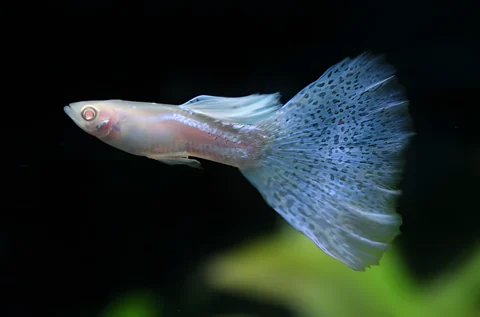
Poecilia reticulata
The Albino Guppy, belonging to the Poeciliidae family, is known by its scientific name Poecilia reticulata (Albino variety). A distinctive feature of this fish is the congenital absence of melanin – the black pigment in…
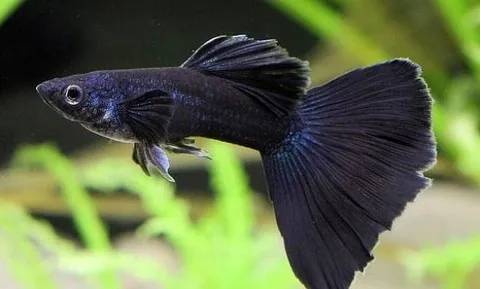
Poecilia reticulata
Black Monk Guppies, also known as Black Guppies, are a breed of Poecilia reticulata (Black strain) from the Poeciliidae family. One of the main features of this variety is the pronounced dark body coloration in males.…
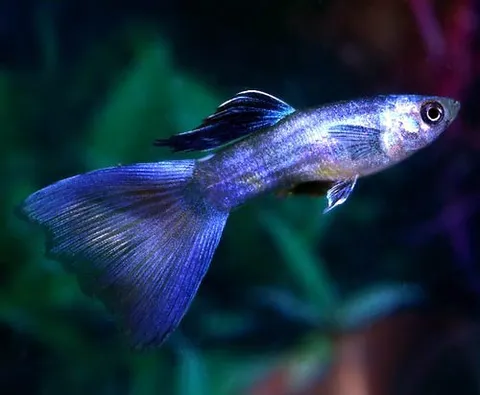
Poecilia reticulata
Blue Guppies, known scientifically as Poecilia reticulata (Blue variety), belong to the Poeciliidae family. This name is a generalization and encompasses various breeds where blue is the dominant color. It is mainly…
Poecilia reticulata
The Cobra Guppy, scientifically known as Poecilia reticulata (Cobra variety), belongs to the family Poeciliidae. Its distinctive feature is a pattern of vertical stripes running along the posterior part of its body. The…