Temperature22 – 28 °C
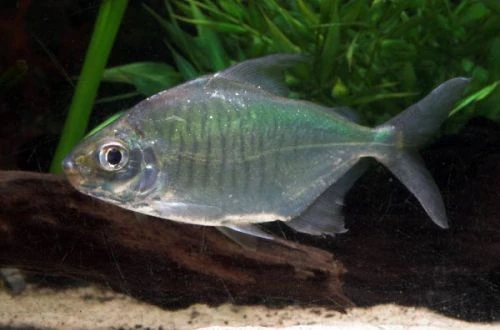
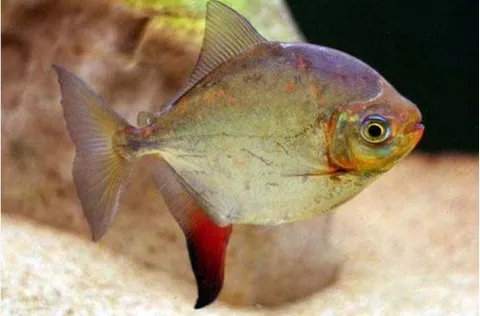
Acnodon normani, widely known as Norman's Acnodon or Sheep Pacu, is a member of the family Serrasalmidae. This fish received its scientific name in honor of John Roxborough Norman (1898–1944), who made a significant contribution to the study of Amazonian ichthyofauna. The common name “Sheep Pacu” is due to the distinctive structure of the fish's head and jaw shape, which resemble those of a sheep. Interestingly, this same species is sometimes called “Tiger Pacu” because of its striped coloration. The species is considered easy to keep and undemanding, but it is not suited to the ordinary community aquarium.
Adults of this species reach a length of 12 to 13 centimeters. The fish has an elongated rhomboid body, strongly flattened laterally. The fins further emphasize this geometric shape. The coloration is characterized by silvery hues with greenish iridescence on the scales. Sexual dimorphism is weakly expressed, but males can be identified by the elongated first rays of the anal fin, which resemble a petal in shape.
The fish's natural habitat is located in the vast Amazon River basin in South America. It can be found in the area bounded by the Xingu and Tocantins tributaries, which are in the Brazilian state of Pará. Norman's Acnodon prefers the main river channels. The typical habitat for this species is wide rivers flowing through open savannas. Dense aquatic vegetation usually thrives along the banks of such rivers. The water in these areas is generally clear, with a minimal amount of suspended particles, and the bottom consists of a sand-gravel substrate, often interspersed with large stones and boulders.
The Tiger Pacu is generally peaceful, but this applies primarily to conspecifics and other fish species of comparable or larger size. Any small fish that can fit into its mouth will likely be eaten; this is due not to aggression but to the specifics of its diet.
For a group of 2–3 fish, an aquarium volume of 300 liters or more will be most suitable. There are no strict rules for decoration: the Sheep Pacu will feel comfortable even in a spacious, minimalist tank. However, there is one important condition: it is better to avoid live plants, as they will likely be quickly eaten. The long-term successful keeping of these fish directly depends on maintaining water cleanliness and the stability of its hydrochemical parameters, such as pH and dGH, within acceptable limits. For a stable aquatic environment, the uninterrupted operation of equipment, especially an effective filtration system, is critically important. Regular aquarium maintenance, including weekly partial water changes with fresh water and timely removal of all waste, such as food remnants and excrement, is also necessary.
In zoological literature, it is often stated that this species is exclusively herbivorous. However, in practice, it can adapt to a varied diet. This can include dry foods such as flakes and pellets, as well as frozen and live foods – for example, bloodworms, earthworms, or insects. Given the opportunity, Acnodon normani may also eat small fish.
At the time of preparing this material, the author had not found any information about the successful breeding of this species in home aquariums.
This fish is distinguished by its hardiness and unpretentiousness. Health problems are most often associated with injuries, inadequate nutrition, or unsuitable water composition. When signs of illness appear, such as lethargy, changes in body shape, or loss of appetite, it is often enough to normalize the keeping conditions for the fish's body to cope with the ailment. However, in some cases, medication may be required.
When choosing Acnodon normani, carefully inspect the fish for external damage, ulcers, or signs of fungal infections, as any injuries can lead to secondary bacterial diseases. A healthy specimen should be active, have clean fins without signs of deterioration, and uniform coloration without spots. Avoid fish with sunken bellies or signs of emaciation, which may indicate problems with internal parasites or an improper diet in the store. — Pay attention to behavior: the fish should swim steadily, without tilting to one side or showing signs of apathy. — Ask the seller what the specific batch is fed, as adaptation to dry foods after wild-capture may take time. — Check for visible parasites on the scales and gill covers, which should fit snugly against the body.
The essentials: size, tank volume, water parameters and care
An adult reaches 12–13 cm in length. Plan the tank around the maximum size: the fish quickly outgrows a cramped setup.
The recommended volume is 300 L. A smaller tank speeds up nitrate build-up and raises stress levels.
Temperature 22–28 °C, pH 5.5–7.5, hardness 2–15 dGH. Stability matters more than exact values: sudden swings are harder on the fish than a small deviation from the ideal.
Around 8 years when kept properly. Lifespan depends directly on tank volume, water quality and a varied diet.
Temperament: semi-peaceful (dangerous to smaller ones). Not a predatory species, but small fish that fit in its mouth will eventually be eaten.
Recommended setup: both solitary and in group (flexible). Ignoring this is a common cause of stress and disease.
Diet type: mixed diet (meat + plant-based). Feed small portions that are finished within a couple of minutes — overfeeding does more harm than underfeeding.
The scientific name of the species is Acnodon normani, family Piranhas (Serrasalmidae).
The water suits 198 of 208 plants in the catalogue — the easiest ones are shown first.
Afzelius's AnubiasAnacharisAnubiasBrazilian PennywortDwarf CloverDwarf CloverDwarf HygrophilaDwarf SagittariaDwarf ValGuppy GrassHornwortJava FernJava MossMoneywortMud SwordNair's LagenandraNarrow Leaf AnacharisNarrow-leaf CloverStringy MossSüsswassertangTaiwan MossTape GrassTemple PlantUssuri Watermilfoil
Matched by family, categories and overlapping keeping conditions
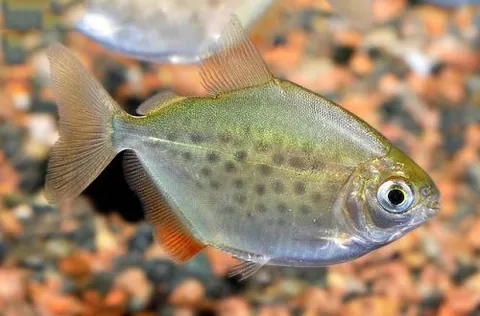
Metynnis maculatus
The Spotted Metynnis, scientifically known as Metynnis maculatus, is a member of the Serrasalmidae family. This fish bears a resemblance to piranhas, its close relatives, but is distinguished by a more peaceful…
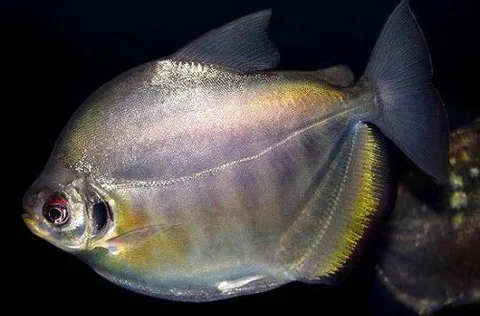
Mylossoma duriventre
The fish Mylossoma duriventre, known as Mylossoma duriventre, belongs to the family Serrasalmidae, or piranhas. Its natural range covers the tropical and subtropical regions of South America, found in the Amazon,…
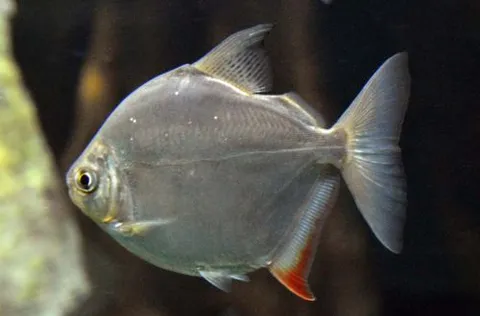
Metynnis hypsauchen
The Common Metynnis, also known by its scientific name Metynnis hypsauchen, belongs to the family Serrasalmidae, which also includes piranhas. However, unlike its formidable relatives, this fish exhibits much more…
Myloplus rubripinnis
The Moon Myloplus, or Redhook Myloplus (scientific name Myloplus rubripinnis), belongs to the family Serrasalmidae, also known as the Piranha family. This is a large schooling fish that exhibits a peaceful temperament…