Temperature20 – 28 °C
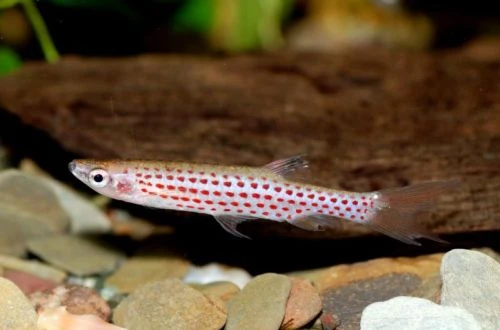
Copella meinkeni, known as the Spotted Copella or Meinken's Copella, belongs to the family Lebiasinidae. Until 2006, it was considered a variety of Natterer's Copella, but it is now an independent species, although the old name is still sometimes used by mistake. This bright and attractive fish is relatively undemanding to keep and coexists well with most other aquarium species.
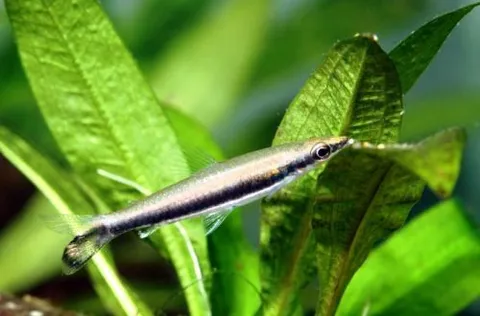
Adults reach approximately 4 cm in length. Their coloration varies from silvery to pinkish, adorned with rows of red dots. Males are noticeably larger than females and have more intense coloration, which is especially pronounced during the breeding season.
Its natural habitat is South America, where it lives in the vast central areas of the Amazon basin. The fish avoids large river channels, preferring small streams and rivers. During the annual rains, it swims into flooded areas of the tropical forest. Typical Copella biotopes are bodies of water with stagnant or slow-moving water, rich in organic material; its decomposition gives the water a characteristic brown tint.
This active and peaceful fish coexists well with other non-aggressive species of comparable size. It is advisable to maintain a group of at least 8–10 individuals of mixed composition. Males will display their best colors while competing for the attention of females. This "competition" occurs without skirmishes, although during the breeding season, males may quite jealously guard their territories.
For a school of 8–10 Spotted Copeina, an aquarium of 50–60 liters or a paludarium with a similar water volume will be optimal. Due to their unique breeding habits (which will be discussed below), the water level should be kept 5–10 cm or more below the top edge of the tank. It is also recommended to use vegetation hanging over the water surface. Spotted Copeina prefers subdued lighting and will look more harmonious in an environment resembling its natural habitat, swimming among thickets of plants and snags. Leaves from some trees placed on the substrate can be a useful decorative element. Their decomposition will initiate processes similar to the natural conditions of these fish: the water will acquire a brownish tint due to the gradual saturation with tannins. The latter, in turn, favorably affect the chemical composition of the water, lowering pH and dGH values. Successful and long-term keeping of these fish depends on many factors, but water parameters are key. It is important to maintain a stable temperature regime and hydrochemical parameters within an acceptable range, as well as to prevent exceeding concentrations of nitrogen cycle products (such as ammonia, nitrites, nitrates) and general aquarium pollution. Stability of water conditions is achieved through regular maintenance procedures, including water changes, waste removal, and the installation of necessary equipment.
This omnivorous species readily accepts most common protein-rich foods, such as flakes and granules. Live or frozen Artemia, Daphnia, small bloodworms, and Drosophila flies will be an excellent addition to their diet.
In a mature aquarium, with sexually mature fish present, fry will appear without additional intervention from the aquarist (i.e., without creating special conditions), however, their survival rate will be low. For targeted breeding, it will be necessary to prepare a separate tank in advance with water conditions identical to the main aquarium, where the fry will then be transferred. The breeding process in Copeina is quite unusual. With the onset of the spawning season, the male occupies the territory around the future spawning site and actively courts the females. When a temporary pair forms, the fish begin to spawn. They swim to the surface, press against each other, and synchronously jump out of the water to a low-hanging leaf or simply to the glass, sticking to it for a few moments. During this time, they manage to attach several eggs. After a series of such jumps, the clutch can reach a dozen eggs. After spawning, the female swims away. The male cares for the clutch until the fry appear, spraying it with water to prevent drying out. The incubation period lasts from 36 to 72 hours. The hatched fry should be carefully transferred to a separate tank to protect them from predation by adult fish. It is important to note that if it is not possible to create a clutch above the water, the fish may lay eggs among dense thickets of plants on the bottom. In such a case, the male will also remain near the clutch to protect it.
The main health problems in these fish most often arise from unfavorable keeping conditions, which lead to a weakened immune system and, consequently, increased susceptibility to various diseases.
When purchasing, choose active individuals that stay in a school and show interest in their surroundings. Avoid fish with signs of emaciation, damaged fins, or visible spots on the body, as this may indicate infectious diseases or stress from improper transportation. In the store, the fish should display their natural coloration, appropriate for the species, without signs of lethargy or apathy. — Inspect the condition of scales and fins: they should be intact, without white film or redness. — Make sure there are no dead individuals in the fish tank, as this indicates poor water quality or inadequate care. — Ask the seller what the fish are fed to ensure a smooth transition to your diet and avoid refusal of food after relocation.
The essentials: size, tank volume, water parameters and care
An adult reaches 4 cm in length. Plan the tank around the maximum size: the fish quickly outgrows a cramped setup.
The recommended volume is 50 L. A smaller tank speeds up nitrate build-up and raises stress levels.
Temperature 20–28 °C, pH 4–7, hardness 1–10 dGH. Stability matters more than exact values: sudden swings are harder on the fish than a small deviation from the ideal.
Around 4 years when kept properly. Lifespan depends directly on tank volume, water quality and a varied diet.
Temperament: semi-peaceful (including aggression during spawning / intraspecific conflicts). Keep this in mind when choosing tank mates.
Recommended setup: group (8–10 individuals). Ignoring this is a common cause of stress and disease.
Diet type: meat with plant additives (omnivores). Feed small portions that are finished within a couple of minutes — overfeeding does more harm than underfeeding.
The scientific name of the species is Copella meinkeni, family Lebiasinidae.
The water suits 198 of 208 plants in the catalogue — the easiest ones are shown first.
Afzelius's AnubiasAnacharisAnubiasBrazilian PennywortDwarf CloverDwarf CloverDwarf HygrophilaDwarf SagittariaDwarf ValGuppy GrassHornwortJava FernJava MossMoneywortMud SwordNair's LagenandraNarrow Leaf AnacharisNarrow-leaf CloverStringy MossSüsswassertangTaiwan MossTape GrassTemple PlantUssuri Watermilfoil
Matched by family, categories and overlapping keeping conditions
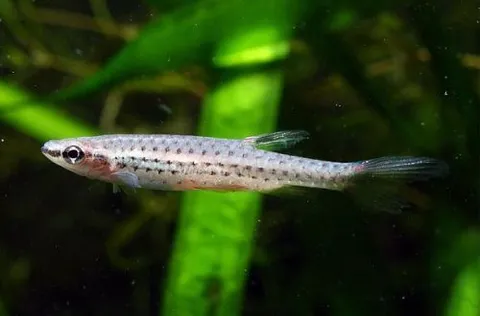
Copella callolepis
Copella callolepis, or Copella callolepis according to its scientific name, belongs to the family Lebiasinidae. It is interesting to note that only in 2011 was this species officially recognized as distinct; before…
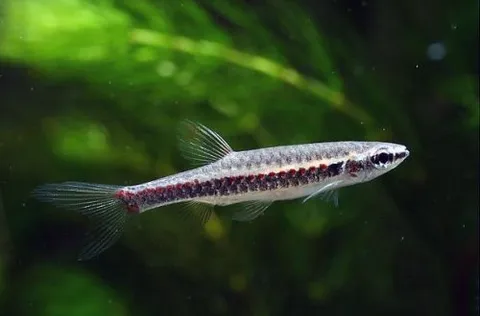
Copella nattereri
Copella nattereri, also known as Natterer's Copella (scientific name Copella nattereri), belongs to the family Lebiasinidae. This agile, schooling fish, like other members of its genus, exhibits a very unusual breeding…
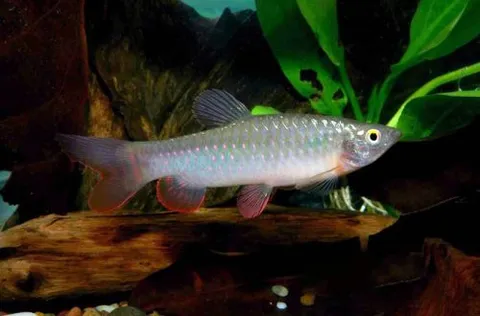
Copeina guttata
The Trout Copeina, scientifically known as Copeina guttata, is a member of the Lebiasinidae family. This fish is not particularly suitable for inexperienced aquarists, as it requires careful attention to water quality…
Nannostomus unifasciatus
Nannostomus unifasciatus, also known as the One-lined Pencilfish, belongs to the family Lebiasinidae. This popular aquarium fish is notable for its unusual oblique swimming style, which distinguishes it from other…