Temperature20 – 28 °C
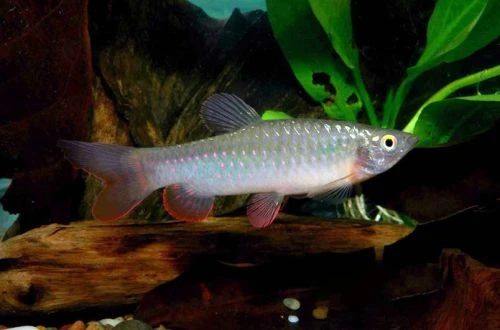
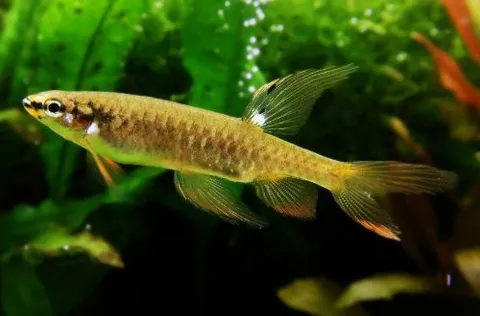
The Trout Copeina, scientifically known as Copeina guttata, is a member of the Lebiasinidae family. This fish is not particularly suitable for inexperienced aquarists, as it requires careful attention to water quality and exhibits strict dietary preferences. Moreover, during the breeding season, its behavior can become noticeably aggressive. Successful keeping of these inhabitants is only possible with certain experience and deep knowledge in aquaristics.
Adults reach a length of approximately 7 cm. Sexual dimorphism is rather weakly expressed. The main coloration is silvery, adorned with rows of red dots. The fins, as well as the tail, with the exception of the dorsal fin, have a pinkish tint. This pattern, along with the body shape, gives this fish a resemblance to river trout, which is why it received its name.
This species originates from South America, inhabiting the upper and middle basins of the Amazon River, covering the territories of modern Brazil, Peru, Ecuador, and Colombia. Its habitat consists of numerous rivers picturesquely flowing through tropical forests.
This species is generally peaceful, however, during spawning and incubation, males become aggressive, actively defending their offspring. Keeping other fish with a male/female pair is only permissible in aquariums larger than 200 liters. At other times, they are quite compatible with calm species of similar or slightly larger size.
A pair of adult individuals requires an aquarium of at least 150 liters. The Trout Copeina can significantly alter the aquarium's interior, especially during the spawning period. Therefore, when decorating, it is recommended to use sturdy root plants or ferns, which should be placed near snags or tree roots, securely anchored in a sandy substrate. Optimal conditions for keeping are achieved in slightly acidic water with low carbonate hardness at temperatures up to 28°C. These fish are extremely sensitive to the accumulation of organic waste, so weekly partial water changes (20–25% of the total volume) are mandatory, along with regular cleaning of the substrate and aquarium walls. Standard equipment includes a filtration and aeration system, lighting fixtures, and a heater. Equipment settings should provide subdued light and moderate or weak current.
The basis of their daily diet consists of live or frozen foods, such as bloodworms, daphnia, artemia, and other similar products. It is important to supplement them with dry food in the form of flakes or granules containing vegetable additives.
Trout Copeinas show amazing responsibility in their parental duties. During the breeding season, the male prepares a nest by digging a small pit in the soft substrate and persistently invites females to it. Sometimes these courtships turn into pursuit, and if the female is not ready, she may try to hide from her suitor in a shelter. After the eggs are laid, the male takes on their protection, driving away anyone who might pose a threat. His care is also expressed in constantly fanning the eggs with his fins to ensure better gas exchange and thoroughly cleaning the clutch from any contamination. Fry hatch on the second or third day. From this moment, parental instincts begin to weaken, and to protect the offspring, it is advisable to transfer them to a separate tank with identical water conditions.
A balanced aquarium ecosystem, providing conditions suitable for the specific species, serves as the best protection against various diseases. If signs of illness are detected (such as unusual behavior, skin rashes, etc.), the first step should be to check the water quality and its parameters, and only then proceed with treatment. Often, simply bringing the keeping conditions to optimal values is enough to successfully resolve the problem.
When selecting individuals, attention should be paid to their activity, clean skin, and absence of visible fin damage. Healthy fish should show natural curiosity and not exhibit signs of emaciation or unnatural behavior, such as constantly staying near the surface or attempting to burrow into the substrate. Avoid purchasing fish from aquariums where dead individuals are present or signs of mass diseases are observed, as the species is sensitive to environmental quality and tolerates transport stress poorly. It is desirable to acquire specimens that are already adapted to the proposed diet.
The essentials: size, tank volume, water parameters and care
An adult reaches 7 cm in length. Plan the tank around the maximum size: the fish quickly outgrows a cramped setup.
The recommended volume is 150 L. A smaller tank speeds up nitrate build-up and raises stress levels.
Temperature 20–28 °C, pH 4–7.5, hardness 1–10 dGH. Stability matters more than exact values: sudden swings are harder on the fish than a small deviation from the ideal.
Around 5 years when kept properly. Lifespan depends directly on tank volume, water quality and a varied diet.
Temperament: semi-peaceful (including aggression during spawning / intraspecific conflicts). Keep this in mind when choosing tank mates.
Recommended setup: schooling (usually from 5–6 individuals and more). Ignoring this is a common cause of stress and disease.
Diet type: meat with plant additives (omnivores). Feed small portions that are finished within a couple of minutes — overfeeding does more harm than underfeeding.
The scientific name of the species is Copeina guttata, family Lebiasinidae. It also appears in the literature as: Copeina argyrops, Pyrrhulina argyrops, Pyrrhulina guttata.
The water suits 198 of 208 plants in the catalogue — the easiest ones are shown first.
Afzelius's AnubiasAnacharisAnubiasBrazilian PennywortDwarf CloverDwarf CloverDwarf HygrophilaDwarf SagittariaDwarf ValGuppy GrassHornwortJava FernJava MossMoneywortMud SwordNair's LagenandraNarrow Leaf AnacharisNarrow-leaf CloverStringy MossSüsswassertangTaiwan MossTape GrassTemple PlantUssuri Watermilfoil
Matched by family, categories and overlapping keeping conditions
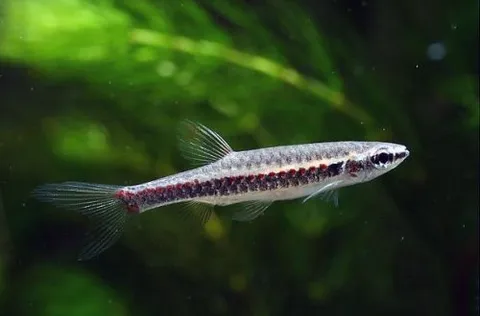
Copella nattereri
Copella nattereri, also known as Natterer's Copella (scientific name Copella nattereri), belongs to the family Lebiasinidae. This agile, schooling fish, like other members of its genus, exhibits a very unusual breeding…
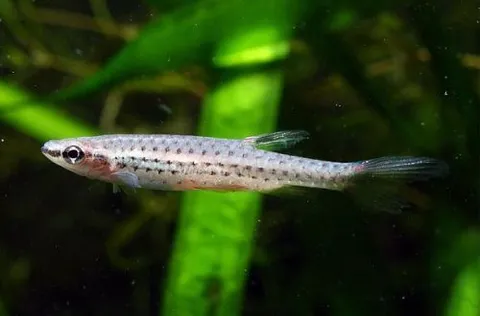
Copella callolepis
Copella callolepis, or Copella callolepis according to its scientific name, belongs to the family Lebiasinidae. It is interesting to note that only in 2011 was this species officially recognized as distinct; before…
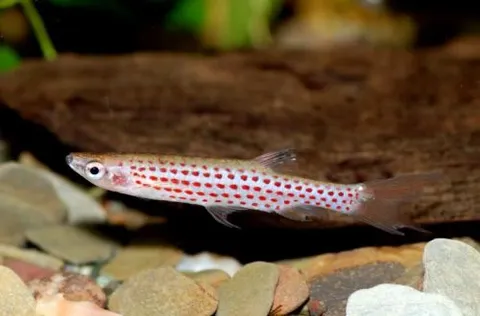
Copella meinkeni
Copella meinkeni, known as the Spotted Copella or Meinken's Copella, belongs to the family Lebiasinidae. Until 2006, it was considered a variety of Natterer's Copella, but it is now an independent species, although the…
Copella arnoldi
Arnold's Copeina, or Pyrrhulina (scientific name — Copella arnoldi), is a member of the family Lebiasinidae. This graceful fish is unique for its amazing method of raising fry, which has been featured in several BBC and…