Temperature18 – 26 °C
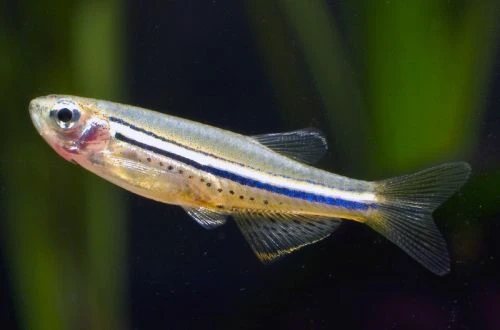
Danio nigrofasciatus, also known as the Spotted Danio, belongs to the family Cyprinidae. Among the representatives of this family, it stands out for its unusual characteristic: in some cases, the male and female form strong, permanent pairs that remain faithful for several breeding seasons. This is a very rare phenomenon for cyprinids. Otherwise, it is a typical aquarium fish, whose original body pattern gives it a special charm.
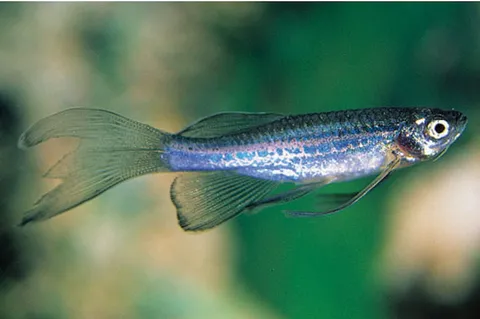
Adults reach only up to 4 cm in length. It has been noted that females are somewhat larger than males, but less graceful and not as brightly colored. The main body color of these fish is silvery, adorned with a characteristic pattern of a horizontal blue and white (sometimes blue and yellow) stripe extending from head to tail. Below this stripe, blue speckles are scattered across the body.
Its natural habitat is in Southeast Asia, specifically in the central part of modern Myanmar (Burma). The habitat of this fish is subject to significant seasonal changes. From November to April, there is a relatively cool and dry period by tropical standards, which leads to partial drying out of water bodies. Then, from May to September, a hot period with abundant rainfall causes flooding of large lowland areas. Preferring small rivers, streams, and ponds with rich riparian vegetation, Danio can also be found in ditches and rice fields during the rainy season.
This is a very peaceful and active fish, but by nature quite timid. Only species similar in size and temperament are suitable as tank mates. They should be kept in a school of at least 8–10 individuals, as they become much less shy in a community. In addition, in a school, male Danios display brighter coloration, striving to attract the attention of females.
For a school of these fish, an aquarium of at least 60 liters is necessary. For the tank's decor, it is advisable to use a rocky substrate consisting of fine gravel, pebbles, and several smooth boulders. Shelters such as snags, roots, and tree branches are essential. Plants are best placed along the side and back walls. The standard set of aquarium equipment includes a heater, aerator, filtration, and lighting systems. When choosing a filter, it is important to consult a specialist to select a model that will provide effective water purification without creating a strong internal current. The Spotted Danio tolerates strong currents poorly; in its natural habitat, it prefers areas with calm water. A lid on the aquarium is mandatory, as these fish are prone to jumping. As for water parameters, it should be slightly acidic (pH) with a low concentration of dissolved calcium and magnesium salts (dGH value). The temperature range is quite wide, so additional heating of the aquarium is usually not required during the warm season. Aquarium care includes weekly partial water changes with fresh water, as well as regular cleaning of the substrate from organic debris and the glass from film.
These fish are undemanding regarding food; they readily accept both dry and frozen or live foods. It should be remembered that diet directly affects the brightness of the fish's coloration. Therefore, it is recommended to combine different types of products, for example, supplementing flakes and granules with bloodworms or daphnia.
The Spotted Danio belongs to the egg-scattering species: females scatter eggs among vegetation, while males fertilize them. This species is less prolific compared to other Danios; a single pair of fish can produce no more than 50 eggs per breeding season. Parental instincts are poorly developed in them, so after spawning, the fish may eat their eggs and newly hatched fry. Nevertheless, it has been observed that some individuals can form stable pairs that persist for several seasons. For successful breeding, it is recommended to use a separate spawning aquarium to ensure the safety of the offspring from adult fish. The spawning tank's decor should be simple, with an emphasis on the substrate: it should consist of sufficiently large particles, such as pebbles or decorative glass beads, which do not fit tightly together, creating voids. When the eggs sink to the bottom, most of them fall into these voids, becoming inaccessible to adult fish. A similar effect is achieved by using a fine-mesh net fixed to the bottom. Another way to preserve the eggs is to plant low-growing, small-leaved plants or mosses, such as Riccia fluitans or Java moss, which cover most of the substrate surface (in this case, any substrate can be used). Dense plant thickets provide reliable cover for the eggs, no less effectively than special substrate. The volume of the spawning aquarium is usually 15–20 liters, filled halfway. Equipment used includes an aerator, heater, and a simple low-power sponge filter to avoid accidentally sucking in eggs and fry. Spawning occurs under dim lighting, so a light source is not required at the initial stage. The stimulus for the start of the breeding period is maintaining the water temperature near the upper permissible limit of 24–25°C at a slightly acidic pH, as well as including protein-rich food in the daily diet – live or frozen bloodworms, daphnia, artemia. After some time, the females will noticeably round out, and the males will acquire brighter coloration and begin actively courting their chosen mates. At this point, a separate tank should be prepared, filled with water from the main aquarium, then several females and the brightest males should be transferred there. To initiate spawning, small portions of cool water are added every few hours, gradually lowering the temperature to approximately 20°C. If this procedure is carried out in the evening, spawning will usually be completed by morning. The end of spawning is easiest to determine by the females, who will become more slender. After this, the fish are returned to the main aquarium. Fry will hatch in 24–36 hours and will begin free-swimming after another day. They should be fed specialized microscopic food designed for aquarium fish fry.
Balanced nutrition and properly selected keeping conditions are the best prevention of diseases in freshwater fish. If the first signs of illness appear, such as changes in coloration or behavior, the first step should be to check the water parameters and quality. If necessary, all values should be brought back to normal, and only then should treatment begin.
When purchasing, choose active, mobile individuals with clean fins and no visible damage or film on their bodies. Avoid fish with signs of emaciation, sunken bellies, or unnatural behavior, such as constantly hovering near the surface or in a corner of the aquarium. It is advisable to acquire a school of 8–10 individuals at once to reduce stress during adaptation to a new environment, as fish in the store may appear pale and timid due to the lack of hiding places and stressful conditions.
The essentials: size, tank volume, water parameters and care
An adult reaches 3.7–4 cm in length. Plan the tank around the maximum size: the fish quickly outgrows a cramped setup.
The recommended volume is 60 L. A smaller tank speeds up nitrate build-up and raises stress levels.
Temperature 18–26 °C, pH 6–7.5, hardness 2–12 dGH. Stability matters more than exact values: sudden swings are harder on the fish than a small deviation from the ideal.
Around 3 years when kept properly. Lifespan depends directly on tank volume, water quality and a varied diet.
Temperament: peaceful, active/mobile. Keep this in mind when choosing tank mates.
Recommended setup: group (8–10 individuals). Ignoring this is a common cause of stress and disease.
Diet type: any (universal). Feed small portions that are finished within a couple of minutes — overfeeding does more harm than underfeeding.
The scientific name of the species is Danio nigrofasciatus, family Cyprinids (Cyprinidae). It also appears in the literature as: Barilius nigrofasciatus, Brachydanio nigrofasciatus, Danio analipunctatus.
The water suits 197 of 208 plants in the catalogue — the easiest ones are shown first.
Afzelius's AnubiasAnacharisAnubiasBrazilian PennywortDwarf CloverDwarf CloverDwarf HygrophilaDwarf SagittariaDwarf ValGuppy GrassHornwortJava FernJava MossMoneywortMud SwordNair's LagenandraNarrow Leaf AnacharisNarrow-leaf CloverStringy MossSüsswassertangTaiwan MossTape GrassTemple PlantUssuri Watermilfoil
Matched by family, categories and overlapping keeping conditions
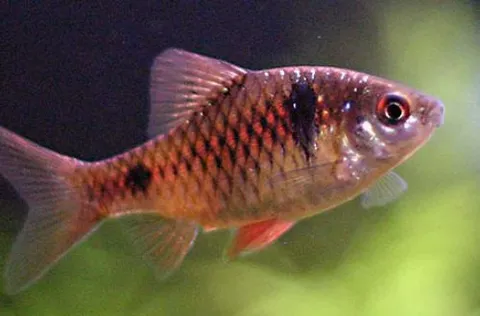
Pethia ticto
Pethia ticto, more commonly known as the Ticto Barb, belongs to the carp family (Cyprinidae). This fish is not only beautiful but also undemanding, making it an ideal choice even for beginner aquarists. It has a…
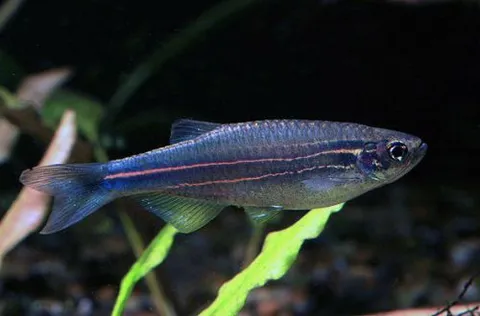
Danio kerri
Danio kerri, known as the Kerri Danio, belongs to the Cyprinidae family. This attractive, miniature schooling fish is undemanding to keep and easy to breed. It coexists well with many other popular aquarium inhabitants.
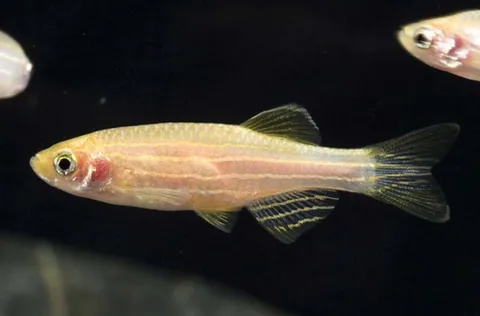
Danio rerio
The Albino Zebra Danio, scientifically known as Danio rerio, is a member of the Cyprinidae family. This fish is a natural morphological form of the Zebra Danio and is found in the wild. Its key difference from its…
Danio rerio
The Blue Danio, known by its scientific name Danio rerio, belongs to the carp family (Cyprinidae). This variation of the classic Danio rerio stands out for its silvery-blue coloration, consisting of numerous small…