Temperature22 – 28 °C
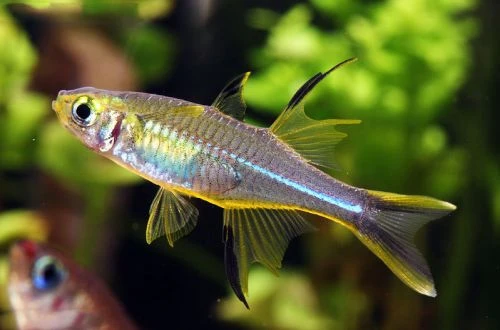
Marosatherina ladigesi, known as Ladiges's Telmatherina, or "Sunbeam" Rainbowfish, as well as Sulawesi Rainbowfish, belongs to the family Telmatherinidae. This fish stands out for its vibrant coloration, peaceful disposition, and ease of care. These qualities make it an excellent inhabitant for a home tropical aquarium.
Adults of this species reach up to 8 cm in length. Their bodies are olive-colored, while the fins are bright yellow, and a striking blue line runs along the entire length of the body from tail to head. Males differ from females by their more intense coloration and noticeably larger fins.
This species is endemic to Sulawesi Island in Indonesia. These fish inhabit clear, small rivers that flow down hillsides covered with lush tropical forests.
This calm and peaceful species coexists well with other fish of similar size and temperament, provided they can inhabit a similar environment. It is recommended to keep them in schools of at least 6–8 individuals, with a ratio of 1 male to 2–3 females.
For a small school of these fish, an aquarium of at least 70 liters will be required. The decor should include an abundance of floating and rooted plants, arranged in groups to leave sufficient open areas for free swimming. The choice of other decorative elements is at the discretion of the aquarist. Particular attention should be paid to maintaining high water quality. Weekly water changes of at least 25% of the volume, as well as the installation of an effective filtration system, are key conditions for the successful keeping of Sulawesi Rainbowfish. Contrary to a widespread belief, this species does not need salt added to its water, although it tolerates mildly brackish conditions.
The fish readily accept all types of popular foods, including dry, frozen, and live. A varied diet consisting of high-quality products will allow them to display the full beauty of their coloration. It is desirable to include live foods in their diet at least once a week, if possible.
Breeding these fish in a home aquarium does not present significant difficulties. Their ability to reproduce offspring is maintained throughout the year. For successful spawning, it is important to provide thickets of fine-leaved or low-growing plants, as well as mosses; artificial alternatives are also suitable. The mating period lasts up to two weeks, during which the female lays portions of eggs daily. The eggs are attached to the surface of plants with thin adhesive threads. Notably, one male can fertilize several clutches from different females. Since these fish lack parental instincts, adult individuals often eat their own offspring. To save the fry, the eggs must be promptly removed from the main aquarium and carefully transferred to a separate tank where the water parameters are identical. To provide the necessary conditions in the new aquarium, a heater and a simple sponge air-lift filter will suffice. The fry emerge after 5–10 days, with this period depending on water temperature. In the initial stage of life, they will require micro-foods, such as infusoria; subsequently, they can transition to specialized powdered foods or Artemia nauplii.
Health problems usually arise only as a result of injuries or keeping in unsuitable conditions, which leads to a weakening of the immune system and, as a rule, provokes the development of various diseases. At the first signs of illness, the primary task is to check the water parameters for excesses or dangerous concentrations of toxic substances (nitrates, nitrites, ammonia, etc.). After bringing all indicators back to normal, treatment can begin.
When purchasing, choose active, lively individuals with clean fins and scales, free from visible damage or growths. Avoid fish showing signs of emaciation, sunken bellies, or unnatural behavior, such as constantly hovering at the bottom or attempting to stay separate from the school. As the species is sensitive to environmental quality, it is important to ensure that the store's aquarium maintains stable water parameters and cleanliness, and that the fish themselves do not appear stunted.
The essentials: size, tank volume, water parameters and care
An adult reaches 8 cm in length. Plan the tank around the maximum size: the fish quickly outgrows a cramped setup.
The recommended volume is 70 L. A smaller tank speeds up nitrate build-up and raises stress levels.
Temperature 22–28 °C, pH 7–8, hardness 10–25 dGH. Stability matters more than exact values: sudden swings are harder on the fish than a small deviation from the ideal.
Around 4 years when kept properly. Lifespan depends directly on tank volume, water quality and a varied diet.
Temperament: peaceful (regular). Keep this in mind when choosing tank mates.
Recommended setup: medium group (6–8 individuals). Ignoring this is a common cause of stress and disease.
Diet type: any (universal). Feed small portions that are finished within a couple of minutes — overfeeding does more harm than underfeeding.
The scientific name of the species is Marosatherina ladigesi, family Telmatherinidae. It also appears in the literature as: Telmatherina ladigesi.
The water suits 114 of 208 plants in the catalogue — the easiest ones are shown first.
African Onion PlantAfzelius's AnubiasAmazon FrogbitAmazon SwordAnacharisAnubiasArrowhead CryptDwarf CloverDwarf CloverDwarf HygrophilaDwarf SagittariaDwarf ValGuppy GrassHornwortJava MossMoneywortMud SwordNair's LagenandraNarrow Leaf AnacharisNarrow-leaf CloverStringy MossTaiwan MossTape GrassUssuri Watermilfoil
Matched by family, categories and overlapping keeping conditions
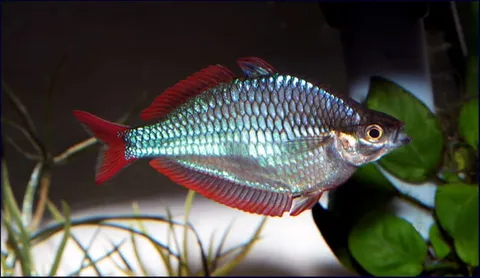
Melanotaenia praecox
Melanotaenia praecox, also known as the Neon Rainbowfish or Dwarf Rainbowfish, is a member of the family Melanotaeniidae. A relatively small schooling fish, it attracts attention with its beautiful neon shimmer in its…
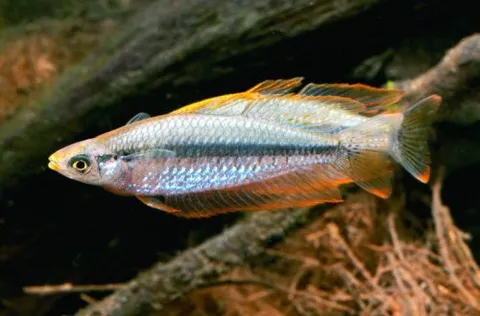
Melanotaenia gracilis
The Slender Rainbowfish, also known as Melanotaenia gracilis, belongs to the family Melanotaeniidae. This fish is an excellent choice for beginner aquarists due to its hardiness and ease of care, while its attractive…
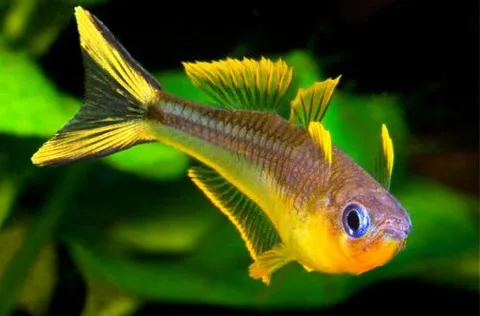
Pseudomugil furcatus
The Forktail Rainbowfish, or Popondetta furcata (Pseudomugil furcatus), a representative of the family Pseudomugilidae, is a vibrant and attractive addition to any freshwater aquarium. This species became available to…
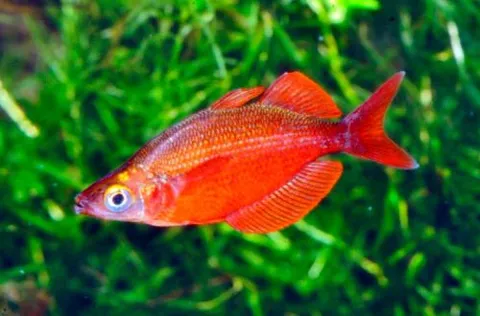
Glossolepis pseudoincisa
Glossolepis pseudoincisa, or Tami Rainbowfish, belongs to the family Melanotaeniidae. This species is endemic to the island of New Guinea. In the wild the species is known above all from a small oxbow lake near the Tami…