Temperature22 – 26 °C
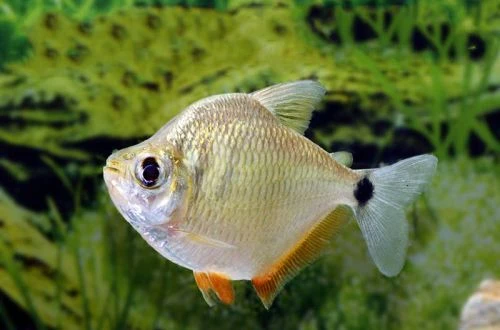
Tetragonopterus, scientifically known as Tetragonopterus argenteus, belongs to the family Characidae. This fish has a high and robust body, compressed laterally, resembling a rhombus in shape. A characteristic feature is its silvery coloration. The pelvic and anal fins are red, while the others, including the caudal fin, remain translucent. A large black spot is noticeable on the caudal peduncle. Adult specimens of this fish typically reach a length of 8 to 12 cm.
Tetragonopterus has a deep, strongly laterally compressed body, its greatest depth at the dorsal-fin origin, which gives the fish an almost disc-like outline. The coloration is predominantly silvery with a characteristic greenish sheen. A distinctive feature is the presence of a black rhomboid spot at the base of the caudal fin and a dark stripe along the body. The pectoral fins are transparent, while the others have an orange or red hue. Adult specimens reach 8–12 cm in length. Sexual dimorphism is weakly expressed: females are usually larger and have a more rounded abdomen, while males are characterized by a more slender physique and slightly more intense fin coloration.
The natural habitat of Tetragonopterus argenteus is in South America, where this species is widely distributed throughout the vast Amazon River basin. It can also be found in the Paraná and Uruguay rivers, as well as their numerous tributaries. The fish prefers to stay in the middle or bottom layers of the water. Areas with abundant aquatic plants and submerged snags are most favorable for it.
This peaceful species prefers to stay in large shoals. Fish kept individually may become timid. Tetragonopterus poses no threat to peaceful aquarium inhabitants of comparable size.
Tetragonopterus prefers a soft, slightly acidic aquatic environment for its existence. It is noteworthy that in natural conditions, the fish can even be found in brackish water, for example, in the estuaries of the Paraná and Uruguay rivers (Rio de la Plata), where fresh waters mix with salty waters from the Atlantic Ocean. This species is very sensitive to water quality, poorly tolerating nitrate concentrations above 50 mg/L. For successful and long-term keeping in an aquarium, the uninterrupted functioning of the filtration system is key. Weekly partial water changes with fresh water, accompanied by the removal of all organic waste such as food residues and excrement, are also important. The optimal aquarium volume for a shoal of 8–10 fish starts from 350–400 liters. In aquarium design, it is important to harmoniously combine open swimming areas with free spaces where fish can hide in dense plant thickets and among snags. Lighting should be kept subdued. Experienced aquarists often add leaves from certain trees to the aquarium; their decomposition releases tannins, giving the water a characteristic brownish tint, which mimics the conditions of their natural habitat. In the wild, their diet consists mainly of small invertebrates. In aquarium conditions, dry foods enriched with proteins can be offered. Nevertheless, for full development, supplements in the form of live or frozen brine shrimp, bloodworms, daphnia, and similar products will be beneficial.
The diet of Tetragonopterus in its natural environment consists mainly of small invertebrates. In a home aquarium, it is acceptable to offer dry foods rich in protein components. Nevertheless, regular additions of live or frozen treats, such as brine shrimp, bloodworms, or daphnia, are considered very beneficial. Tetragonopterus is a peaceful, schooling species that prefers to live in large groups. When separated from the shoal, they may exhibit timidity. Tetragonopterus poses no threat to other peaceful fish of comparable size.
For breeding, a separate spawning tank with fine-leaved plants or an artificial substrate is required. Spawning can be either in pairs or in a group. The female lays up to 1500 small eggs, which settle on plants or the bottom. After spawning, the parents must be immediately removed, as they are prone to eating the eggs. The incubation period is about 2 days. Fry begin to swim freely after 5 days, after which they are fed infusoria, rotifers, or Artemia nauplii.
The species has a strong immune system and, when kept under proper conditions, is rarely susceptible to specific diseases. Like other characins, these fish are sensitive to water quality, so the accumulation of organic matter can provoke bacterial infections or fungal lesions, manifesting as white patches or fin damage. Prevention includes regular water changes, maintaining stable parameters, and avoiding overpopulation. If symptoms appear, it is necessary to check nitrogenous compound levels and ensure proper filtration.
When purchasing, choose active fish that stay in a shoal and show interest in food. Healthy specimens have clean scales without visible wounds, ulcers, or whitish spots, and their fins should be spread and intact. Avoid fish with signs of lethargy, that stay at the surface or on the bottom alone, as well as individuals with an unnaturally bloated abdomen or sunken flanks. It is recommended to acquire a group of 5–10 individuals to reduce stress and aid adaptation in a new aquarium.
The essentials: size, tank volume, water parameters and care
An adult reaches 8–12 cm in length. Plan the tank around the maximum size: the fish quickly outgrows a cramped setup.
The recommended volume is 350 L. A smaller tank speeds up nitrate build-up and raises stress levels.
Temperature 22–26 °C, pH 6–7.5, hardness 4–15 dGH. Stability matters more than exact values: sudden swings are harder on the fish than a small deviation from the ideal.
Around 6 years when kept properly. Lifespan depends directly on tank volume, water quality and a varied diet.
Temperament: peaceful, active/mobile. Keep this in mind when choosing tank mates.
Recommended setup: group (8–10 individuals). Ignoring this is a common cause of stress and disease.
Diet type: floating (any). Feed small portions that are finished within a couple of minutes — overfeeding does more harm than underfeeding.
The scientific name of the species is Tetragonopterus argenteus, family Characidae. It also appears in the literature as: Salmo saua, Tetragonopterus huberi, Tetragonopterus sawa.
The water suits 197 of 208 plants in the catalogue — the easiest ones are shown first.
Afzelius's AnubiasAnacharisAnubiasBrazilian PennywortDwarf CloverDwarf CloverDwarf HygrophilaDwarf SagittariaDwarf ValGuppy GrassHornwortJava FernJava MossMoneywortMud SwordNair's LagenandraNarrow Leaf AnacharisNarrow-leaf CloverStringy MossSüsswassertangTaiwan MossTape GrassTemple PlantUssuri Watermilfoil
Matched by family, categories and overlapping keeping conditions
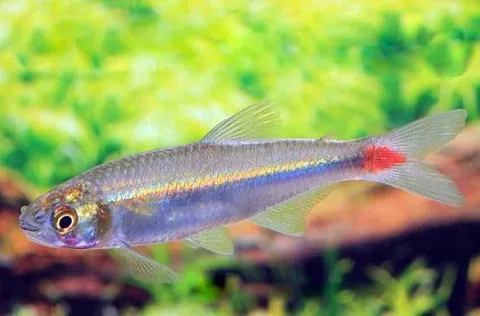
Aphyocharax alburnus
Aphyocharax alburnus, also known as the Gold-crown Tetra, belongs to the family Characidae. Its natural habitat is located in South America, extending from central Brazil to northern Argentina. This species prefers to…
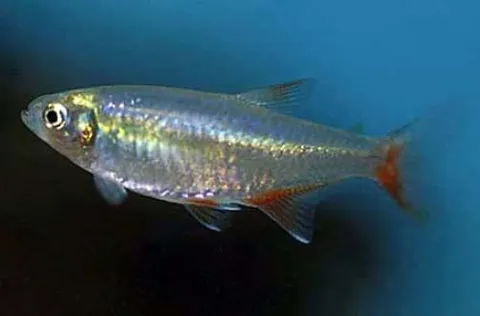
Aphyocharax anisitsi
The Red-Fin Tetra, also known as Aphyocharax with the scientific name Aphyocharax anisitsi, belongs to the family Characidae. Its first description was made by Eigenmann and Kennedy in 1903, following an expedition to…
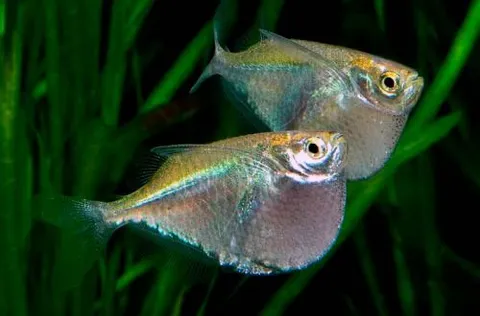
Thoracocharax securis
A member of the family Gasteropelecidae, the Platinum Hatchetfish (scientific name Thoracocharax securis) originates from South America. These fish inhabit the vast Amazon River basin, where they are more commonly found…
Aphyocharax nattereri
Aphyocharax nattereri, also known as Natterer's Aphyocharax, belongs to the Characidae family. This species is not as commonly found in pet stores as its tetra relatives, yet it possesses no less attractiveness and…