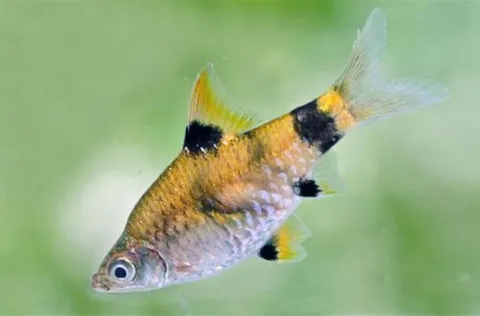
Sun Barb
Pethia gelius
The Sun Barb, also known as the Golden Dwarf Barb (Pethia gelius), belongs to the Cyprinidae family. This species is known for its unpretentiousness and ease of care, but it requires special attention to the protein…
The White Cloud Mountain Minnow (Tanichthys albonubes) belongs to the family Cyprinidae and is extremely popular in the hobby because it is undemanding and easy to breed. By 2010, four stable colour forms had been established, but only two became widespread: one close to the natural colouring, and another dominated by red pigment.
Adults reach up to 4 cm in length. Females are usually larger than males but their colour is less vivid. There are several colour variations. One resembles the natural pattern: the body is grey with a broad, bright pink stripe running from the head to the tail, and the fins have pale yellow edges. The other form has a similar pattern but with strong red pigment that colours the rear half of the body, the tail fin, and the edges of the other fins.
These fish originally inhabited what is now China. Today white cloud mountain minnows have almost disappeared from the wild and are on the brink of extinction. A few relic populations have been found in coastal areas of Guangdong province in southern China and Quang Ninh province in northeastern Vietnam. They prefer shallow water, up to 60 cm deep, in slow-flowing rivers and streams, sheltering among dense aquatic plants along the banks.
These are peaceful, calm fish that do well with other species of similar size and temperament that can live in comparable water conditions. A school of at least 10 individuals of both sexes is recommended. Within the group, males actively compete for female attention, which intensifies the brightness of their colouring.
A school of these fish needs a tank of at least 60 litres. Although the décor can be arbitrary, dark substrate combined with floating plants is considered optimal. You can use artificial or natural wood, roots, or tree branches as decoration. Essential equipment includes a filter, lighting, and an air pump. White cloud mountain minnows do well at relatively low temperatures, so a heater is usually not necessary if the tank is in a heated room. These fish prefer weak water flow. Temperature, water pH, and water dH can stay within a fairly wide range, which simplifies water preparation—often just letting water stand for a day is enough. Tank care consists of weekly 20–25% water changes and regular cleaning of the substrate from organic debris and algae on the glass.
The fish readily accept all food types: dry, frozen, and live. To maintain the best colour, vary their diet. Feed them 2–3 times a day in amounts they can eat in 5 minutes. Remove uneaten food promptly to prevent water pollution.
White cloud mountain minnows are egg-scatterers: females scatter eggs in the water column and males fertilize them. These fish have weak parental instincts and may eat both their own eggs and fry after spawning. To protect the offspring, breeding should take place in a separate spawning tank. The setup is simple; the key is the substrate, which should consist of fairly large particles loosely stacked together with gaps, such as pebbles or decorative glass beads. As eggs sink, most fall into these gaps and become inaccessible to the adults. A similar effect is achieved with fine-meshed netting fixed to the bottom. Another way to protect eggs is to densely plant low, fine-leaved plants or mosses such as riccia or Java moss to cover much of the substrate (in this case, substrate type does not matter). Dense plant growth provides shelter for eggs as well as a special substrate. A spawning tank is typically 20–30 litres and filled halfway. Equipment includes an air pump, heater, and a simple, low-powered sponge filter to prevent eggs and fry from being sucked in. Spawning occurs in dimmed light, so a light source is not needed at first. To trigger breeding, raise the water temperature to the upper limit of 20–21°C at neutral or slightly acidic pH and feed high-protein foods—live or frozen mosquito larvae, daphnia, or brine shrimp. After a time, females become noticeably rounder and males start actively courting them. At this point, prepare a separate tank, fill it with water from the main aquarium, then move several females and the brightest males into it. Spawning is over when females become slim again. Return the fish to the main tank. Fry hatch in 48–60 hours and begin to swim freely a day later. Feed them specialized microscopic fry food.
Long-term hybridization and inbreeding have had negative effects: weak immunity and a high rate of birth defects in fry. However, balanced nutrition and proper tank conditions can significantly reduce the risk of disease, though not eliminate it entirely.
When choosing white cloud mountain minnows, prefer active individuals that school together and show natural movement. A healthy fish should have clean fins without damage, clear eyes, and scales that fit tightly with no white coating or spots. Avoid specimens with an unnaturally swollen or sunken belly, or those that stay at the surface or constantly lie on the bottom. Since the trade often sells colour forms, assess the brightness and clarity of the colour. Before buying, watch the fish in the shop tank: they should show no signs of apathy or shyness and have no visible skin damage.
There are no pair reviews for this species yet — check tankmates in the matcher.
All tankmatesThe water suits 196 of 208 plants in the catalogue — the easiest ones are shown first.
Afzelius's AnubiasAnacharisAnubiasBrazilian PennywortDwarf CloverDwarf CloverDwarf HygrophilaDwarf SagittariaDwarf ValGuppy GrassHornwortJava FernJava MossMoneywortMud SwordNarrow Leaf AnacharisNarrow-leaf CloverStringy MossSüsswassertangTaiwan MossTape GrassTemple PlantUssuri WatermilfoilWater Wisteria
Matching water does not mean the plant will stay intact.
The essentials: size, tank volume, water parameters and care
An adult reaches 4 cm in length. Plan the tank around the maximum size: the fish quickly outgrows a cramped setup.
The recommended volume is 60 L. A smaller tank speeds up nitrate build-up and raises stress levels.
Temperature 14–22 °C, pH 6–8.5, hardness 5–21 dGH. Stability matters more than exact values: sudden swings are harder on the fish than a small deviation from the ideal.
Around 4 years when kept properly. Lifespan depends directly on tank volume, water quality and a varied diet.
Temperament: peaceful, calm/shy/inactive. Keep this in mind when choosing tank mates.
Recommended setup: large group (10+ individuals). Ignoring this is a common cause of stress and disease.
Diet type: any (universal). Feed small portions that are finished within a couple of minutes — overfeeding does more harm than underfeeding.
The scientific name of the species is Tanichthys albonubes, family Cyprinids (Cyprinidae). It also appears in the literature as: Aphyocypris pooni.
Matched by family, categories and overlapping keeping conditions
Pethia gelius
The Sun Barb, also known as the Golden Dwarf Barb (Pethia gelius), belongs to the Cyprinidae family. This species is known for its unpretentiousness and ease of care, but it requires special attention to the protein…
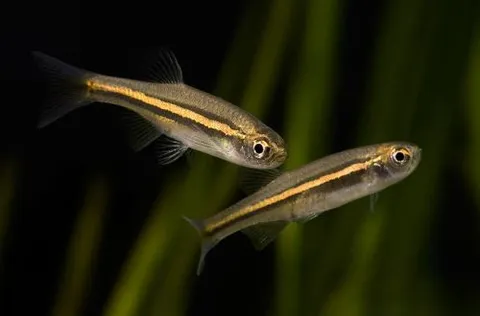
Danio jaintianensis
The Jaintia Danio, scientifically known as Danio jaintianensis, belongs to the family Cyprinidae. The fish is named after the Jaintia Hills, where it was first discovered. Although this species is not frequently…
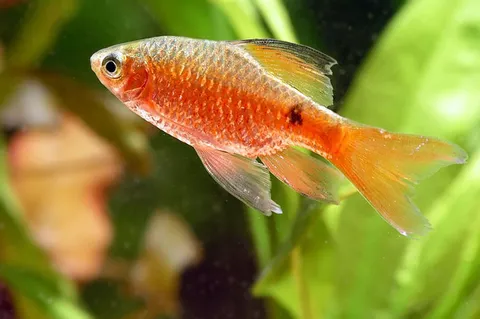
Pethia conchonius
The Rosy Barb, scientifically known as Pethia conchonius, is a member of the Cyprinidae family. Its vibrant appearance is sure to catch the eye, and its high activity makes observing these fish a captivating experience,…
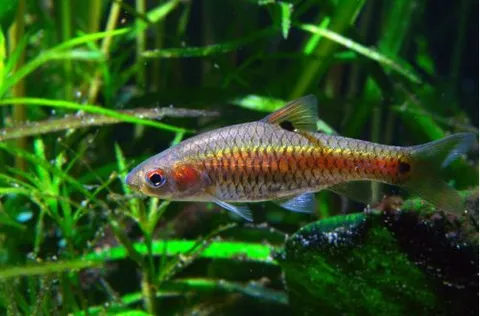
Puntius bimaculatus
Puntius bimaculatus, or the Two-Spot Barb, belongs to the family Cyprinidae. Kept in a school, these fish make a wonderful addition to almost any aquarium. They are undemanding in care, easy to breed, and compatible…