Temperature22 – 25 °C
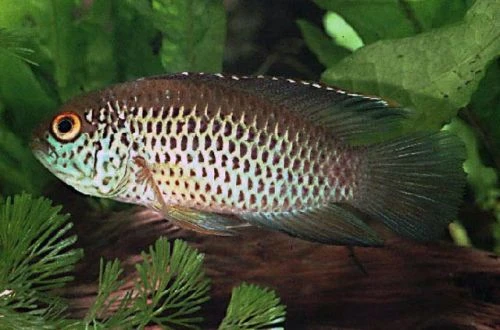
Nannacara anomala, also known as the Yellow-Eyed Cichlid or Golden Dwarf Cichlid, belongs to the family Cichlidae. This fish attracts attention with its vibrant coloration, and its unpretentious and friendly nature makes it an excellent choice for a community tank. Due to its ease of care and breeding, it is perfectly suited even for beginner aquarists.
Adult Nannacara reach a length of 5 to 7 cm. Males are usually larger and display more intense coloration, predominantly with blue, green, and orange tones. Females are smaller and have a more uniform yellowish hue. A distinctive feature of both sexes is their characteristic yellow eyes, which is reflected in the name "Yellow-Eyed Cichlid."
The natural range of this fish extends from the Rio Aruka in Guyana to the lower Rio Marowijne in Suriname. It inhabits the coastal river systems of this stretch of the coast. It is important to note that today this species is actively bred on commercial aquarium farms in Eastern Europe and the Far East, so many generations of these fish have adapted to artificial environments.
This peaceful and compatible species coexists well with other calm fish of comparable size. Conflicts may only arise during spawning, when females become quite aggressive, actively defending their offspring. Within the species, a hierarchy usually forms with one alpha male dominating, so it is recommended to keep Golden Dwarf Cichlids in a harem-type group. If several males are kept in one aquarium, weaker individuals will eventually change their coloration, resembling females.
Most Golden Dwarf Cichlids on the market originate from commercial farms, which ensures their good adaptation to various home aquarium conditions. However, for the fish to feel as comfortable as possible and display their best coloration, some recommendations for tank setup and water parameters should be followed. For aquarium decoration, it is recommended to use a sandy substrate, a large number of snags, and areas with dense vegetation. Lighting should be subdued, and floating plants will create additional shading. It is advisable to maintain hydrochemical parameters with a pH in the range of 6–7.5 and dGH within 3–8°. Regular aquarium maintenance includes weekly water changes of 15–20% of the volume with fresh water and cleaning the substrate of organic deposits.
The fish readily accept a variety of popular foods, including dry, frozen, and live options. The key condition is to ensure a balanced diet enriched with plant components. To simplify the feeding process, it is recommended to use specialized foods designed for South American cichlids.
The breeding process for these fish is quite simple. Under favorable conditions and with a mature male and female (or several females), the appearance of fry is almost guaranteed. Eggs are typically laid on the bottom. The female not only diligently cares for the clutch but also continues to protect the hatched fry for several weeks. For this, she usually occupies a small territory, about 40×40 cm, and actively drives away anyone who accidentally approaches the boundaries of her temporary domain.
Most health problems in fish often arise from improper keeping conditions or low-quality food. Upon detecting the first signs of illness, the first step should be to check water parameters for high concentrations of harmful substances such as ammonia, nitrites, and nitrates. These parameters must be normalized, and only then should treatment begin.
When choosing healthy individuals, pay attention to the activity of the fish: they should show curiosity and swim in the water column, rather than constantly hiding at the bottom. It is important to assess the cleanliness of the skin and fins, the absence of white film, ulcers, or visible damage. Avoid specimens with severely sunken bellies, which may indicate emaciation or parasites. In the store, fish should look well-fed, with bright eyes and natural coloration appropriate for their age and sex. It is recommended to purchase young individuals, as they adapt more easily to new keeping conditions in a home aquarium.
The essentials: size, tank volume, water parameters and care
An adult reaches 5–7 cm in length. Plan the tank around the maximum size: the fish quickly outgrows a cramped setup.
The recommended volume is 50 L. A smaller tank speeds up nitrate build-up and raises stress levels.
Temperature 22–25 °C, pH 5.8–7.5, hardness 3–8 dGH. Stability matters more than exact values: sudden swings are harder on the fish than a small deviation from the ideal.
Around 5 years when kept properly. Lifespan depends directly on tank volume, water quality and a varied diet.
Temperament: semi-peaceful (including aggression during spawning / intraspecific conflicts). Keep this in mind when choosing tank mates.
Recommended setup: harem (1 male and several females). Ignoring this is a common cause of stress and disease.
Diet type: any (universal). Feed small portions that are finished within a couple of minutes — overfeeding does more harm than underfeeding.
The scientific name of the species is Nannacara anomala, family Cichlids (Cichlidae).
The water suits 195 of 208 plants in the catalogue — the easiest ones are shown first.
Afzelius's AnubiasAnacharisAnubiasBrazilian PennywortDwarf CloverDwarf CloverDwarf HygrophilaDwarf SagittariaDwarf ValGuppy GrassHornwortJava FernJava MossMoneywortMud SwordNarrow Leaf AnacharisNarrow-leaf CloverStringy MossSüsswassertangTaiwan MossTape GrassTemple PlantUssuri WatermilfoilWater Wisteria
Matched by family, categories and overlapping keeping conditions
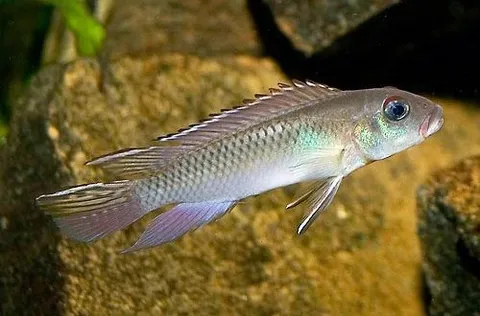
Nanochromis parilus
Nanochromis parilus, also known as Nanochromis transvestitus, belongs to the Cichlidae family. This fish is not the most vibrant, unlike other cichlids, and its poor compatibility with conspecifics, as well as its need…
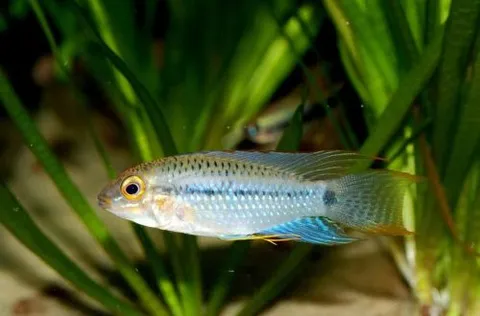
Apistogramma steindachneri
The fish, known by the scientific name Apistogramma steindachneri, belongs to the family Cichlidae. It was named Steindachner's Apistogramma in honor of Franz Steindachner, an Austrian zoologist. Since its first…
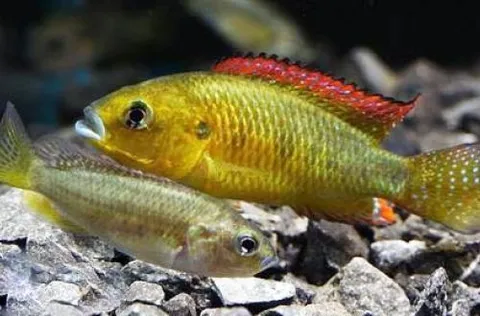
Pseudocrenilabrus philander
Haplochromis philander, known to scientists as Pseudocrenilabrus philander, belongs to the Cichlidae family. This fish is outwardly attractive but has a wayward character; males show belligerence towards each other and…
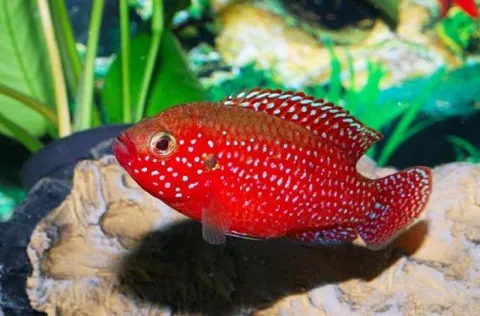
Rubricatochromis lifalili
The Red Chromide, or "Red Jewel Cichlid," scientifically known as Rubricatochromis lifalili, is a member of the Cichlidae family. This is a beautiful and vibrant fish, whose keeping and breeding do not present…