Temperature20 – 25 °C
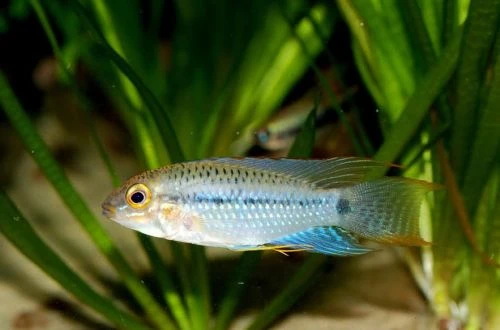
The fish, known by the scientific name Apistogramma steindachneri, belongs to the family Cichlidae. It was named Steindachner's Apistogramma in honor of Franz Steindachner, an Austrian zoologist. Since its first description in 1908, this species has changed its name three times as the genus Apistogramma was studied in more depth. Due to certain behavioral characteristics and the requirement for a rather narrow range of water conditions, its keeping can be moderately challenging. Therefore, it is recommended for aquarists with appropriate experience.
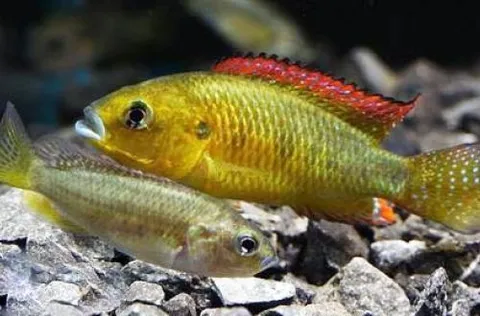
Adult males can reach about 8 cm in length. Young individuals have a silvery-blue coloration with a narrow black stripe running along the lateral line of the body. Over time, as they mature, the blue hues almost completely disappear, remaining only on the anal fin. The body takes on gray tones with darker pigmentation. Females are usually smaller than males, reaching up to 5 cm, and their coloration is yellow. The pattern on the female's body consists of a black spot in the center and a diagonal line crossing the head.
Its natural habitat is in South America, within Guyana and Suriname. Steindachner's Apistogramma inhabits the basins of rivers such as the Essequibo, Demerara, Courantyne, and Suriname. The latter river shares its name with the country. These fish prefer small streams and rivers hidden under the canopy of the humid tropical forest. The riverbeds are often covered with a thick layer of fallen leaves, among which pristine white sand peeks through. The current is obstructed by fallen branches, tree roots, and entire trunks. The water in these places is always clean, but its color takes on a brownish tint due to the high content of tannins released during the decomposition of organic plant matter.
Males exhibit aggressive behavior towards each other, especially during the spawning period. It is advisable to maintain a ratio in the Apistogramma group such that there are several females per male. If the aquarium has sufficient free space, it is possible to keep several males together. They are calm towards other fish species and are compatible with non-aggressive fish of comparable size.
For a group consisting of 3–4 fish, an aquarium of 80 liters or more will be optimal. The design should include a sand substrate and driftwood. If breeding is planned, it is important to provide shelters that the fish can use for spawning. Lighting should be kept subdued. Aquatic plants are not an essential element, but dried tree leaves can be an excellent addition to the decor. Their presence will not only give the aquarium a more natural look but also color the water with the characteristic brownish tint typical of natural bodies of water. An effective filtration system and regular aquarium maintenance play a key role in this. The latter includes weekly partial water changes with fresh water, periodic monitoring of the concentration of dangerous nitrogen cycle products, timely removal of organic waste (e.g., excrement and food residues), replacement of fallen leaves if used, as well as prophylactic inspection of equipment, etc.
Being an omnivorous species, Steindachner's Apistogramma readily accepts a variety of common foods intended for aquarium fish. Its daily diet can include high-quality dry foods, such as flakes or pellets, as well as a combination of these with live or frozen brine shrimp, daphnia, and bloodworms.
During the breeding season, the male chooses a specific area on the aquarium bottom and begins to attract females. Females ready to spawn accept his courtship and lay their eggs in cracks or hollows of decorative elements, or in specially prepared shelters. The female stays near the clutch, guarding it, while the male usually returns to his territory and does not participate in caring for the offspring. However, there have been observations where he helped protect the brood together with the female. The incubation period, depending on temperature, lasts from 36 to 72 hours. A few days after that, the fry begin to swim freely.
The main cause of diseases often lies in the keeping conditions: if they go beyond acceptable limits, immunity decreases, making the fish vulnerable to various infections inevitably present in the environment. At the first suspicion of illness, it is important first of all to check the water parameters and ensure there are no dangerous concentrations of nitrogen cycle products. Often, restoring normal, suitable conditions promotes recovery. However, in some cases, medication may be required.
When purchasing Steindachner's Apistogramma, choose individuals with clean fins, no body damage, and clear eyes. It is important to pay attention to the fish's activity: healthy individuals show curiosity, explore the substrate, and do not appear apathetic or emaciated. Avoid fish with sunken bellies or signs of scale damage, as this may indicate chronic diseases or stress from improper keeping conditions in the store. — Assess coloration: in healthy fish, colors should be distinct, without unnatural spots or film. — Observe behavior: aggressive lunges towards tank mates in the store are normal for this species, but constant hiding in a corner may be a sign of illness. — Ask the seller about keeping conditions: individuals adapted to aquarium water are preferable to recently imported wild specimens that require complex acclimatization.
The essentials: size, tank volume, water parameters and care
An adult reaches 5–8 cm in length. Plan the tank around the maximum size: the fish quickly outgrows a cramped setup.
The recommended volume is 80 L. A smaller tank speeds up nitrate build-up and raises stress levels.
Temperature 20–25 °C, pH 4–7.5, hardness 0–10 dGH. Stability matters more than exact values: sudden swings are harder on the fish than a small deviation from the ideal.
Around 5 years when kept properly. Lifespan depends directly on tank volume, water quality and a varied diet.
Temperament: semi-peaceful (including aggression during spawning / intraspecific conflicts). Keep this in mind when choosing tank mates.
Recommended setup: harem (1 male and several females). Ignoring this is a common cause of stress and disease.
Diet type: any (universal). Feed small portions that are finished within a couple of minutes — overfeeding does more harm than underfeeding.
The scientific name of the species is Apistogramma steindachneri, family Cichlids (Cichlidae). It also appears in the literature as: Apistogramma ornatipinnis, Apistogramma wickleri, Heterogramma steindachneri.
The water suits 197 of 208 plants in the catalogue — the easiest ones are shown first.
Afzelius's AnubiasAnacharisAnubiasBrazilian PennywortDwarf CloverDwarf CloverDwarf HygrophilaDwarf SagittariaDwarf ValGuppy GrassHornwortJava FernJava MossMoneywortMud SwordNarrow Leaf AnacharisNarrow-leaf CloverStringy MossSüsswassertangTaiwan MossTape GrassTemple PlantUssuri WatermilfoilWater Wisteria
Matched by family, categories and overlapping keeping conditions
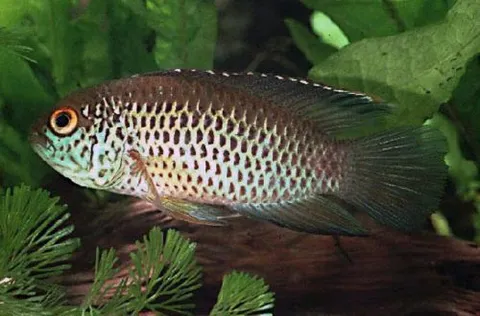
Nannacara anomala
Nannacara anomala, also known as the Yellow-Eyed Cichlid or Golden Dwarf Cichlid, belongs to the family Cichlidae. This fish attracts attention with its vibrant coloration, and its unpretentious and friendly nature…
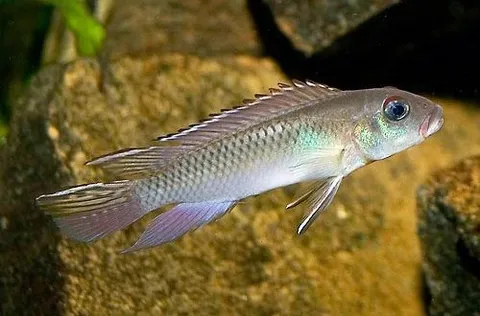
Nanochromis parilus
Nanochromis parilus, also known as Nanochromis transvestitus, belongs to the Cichlidae family. This fish is not the most vibrant, unlike other cichlids, and its poor compatibility with conspecifics, as well as its need…
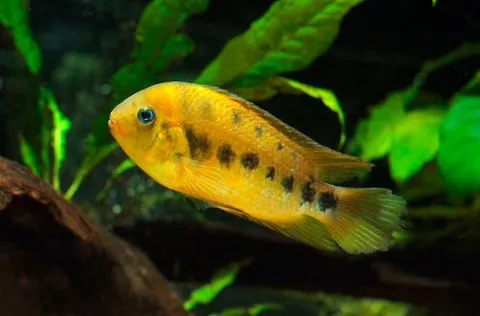
Amatitlania nanolutea
Amatitlania nanolutea, also known as the Yellow Cryptoheros or Yellow Cichlid, belongs to the family Cichlidae. Previously, the species was classified as Cryptoheros nanoluteus. This fish is distinguished by its vibrant…
Pseudocrenilabrus philander
Haplochromis philander, known to scientists as Pseudocrenilabrus philander, belongs to the Cichlidae family. This fish is outwardly attractive but has a wayward character; males show belligerence towards each other and…