Temperature17 – 28 °C
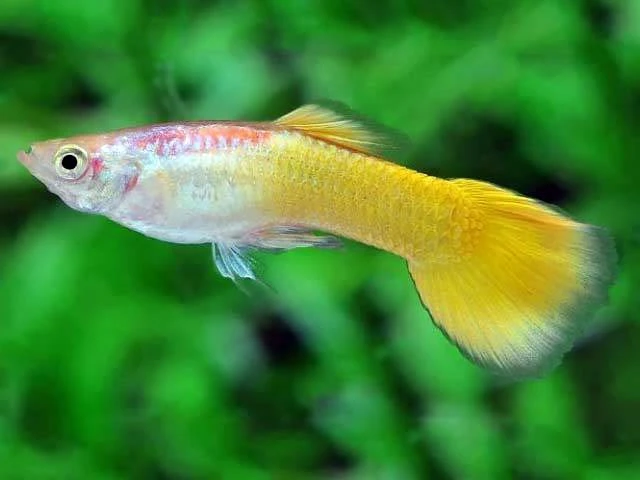
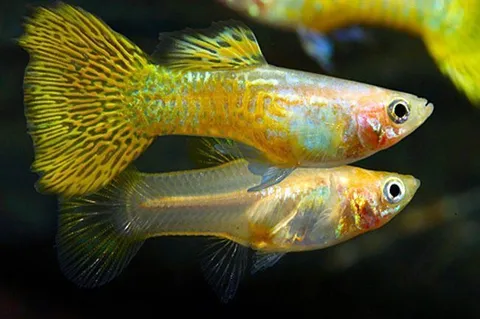
Yellow Guppies, known scientifically as Poecilia reticulata (Yellow variety), are members of the Poeciliidae family. This designation encompasses a significant number of breeds characterized by a predominance of yellow in their coloration. It is often applied to varieties such as Tuxedo Guppies, whose fins have a yellowish tint, and Cobra Guppies with a golden body sheen.
Yellow Guppies (Poecilia reticulata) are a selective breeding form that combines various breeds with a dominant yellow color in their coloration. The fish have an elongated body, flattened laterally, and a pointed head. Males reach 3 cm, while females grow up to 6 cm. Males are distinguished by brighter coloration and diverse fin shapes, including fan-tailed and sword-tailed variations. Females have more modest coloration, often with a silvery-olive sheen, and sexually mature individuals show a distinct dark gravid spot near the anal fin.
The wild species Poecilia reticulata inhabits fresh and brackish waters in northeastern South America and the Caribbean islands. Guppies prefer areas with dense vegetation, slow currents, or still water. Due to their high adaptability, they have been successfully introduced worldwide in tropical and subtropical regions. In nature, the fish inhabit shallow waters, well-warmed by sunlight.
These are peaceful, active, and schooling fish, suitable for community tanks with other non-aggressive species of comparable size. Intraspecific conflicts are absent. Guppies prefer to stay in the upper and middle water layers. They show curiosity and high mobility, which makes them popular subjects for observation.
Most breeds and almost all types of Guppies demonstrate enviable hardiness and undemanding care requirements. A small group of 3–5 fish needs an aquarium of at least 40 litres, roughly 45 × 30 × 30 cm. The aquarist's preferences determine the choice of design, as it does not play a significant role for these fish. In small volumes, water quality becomes critical, directly depending on the stable operation of filtration systems and regular aquarium maintenance. Weekly maintenance procedures include: removing excrement and food residues, partial water changes with fresh water, cleaning glass and decorations, and checking equipment. There will be no difficulties with water preparation, as these fish can adapt to a wide range of hydrochemical parameters. It is enough to let the water stand before use. Regarding feeding, Guppies readily consume all types of food of appropriate size — both dry and live or frozen. Overall, all Guppy breeds are characterized by a friendly disposition and coexist perfectly with other peaceful species of comparable size (more detailed information is provided in the relevant article). No aggressive manifestations or rivalry are observed within the species.
Guppies are omnivorous fish. In aquarium conditions, they readily accept all types of food: dry flakes, granules, as well as frozen and live foods of appropriate size. To maintain vibrant coloration and health, it is recommended to diversify their diet, including plant-based components. Feeding should be done in small portions 1–2 times a day to avoid water pollution from leftover food.
Guppies are livebearing fish, where fertilization occurs inside the female's body. Sexual maturity is reached early, by 3 months. Spawning does not require special conditions: after mating, the female carries the fry for about 3–4 weeks. An average of 20 fully formed fry are born in one litter. For the survival of the young in a community tank, dense plant thickets are necessary, where the fry can hide from adult fish.
The species has a strong immune system, however, highly bred forms can be sensitive to water quality and prone to degenerative changes with uncontrolled inbreeding, such as spinal curvature. Common problems include fin rot and ichthyophthiriasis (ich). Prevention involves maintaining stable water parameters, regular filtration and water changes, and avoiding overpopulation.
When purchasing, choose active fish with clean fins and no plaque or spots on their bodies. It is important to avoid individuals with spinal deformities (humpback) and signs of emaciation. Healthy guppies should show interest in their surroundings and food. It is recommended to purchase fish from reputable breeders to minimize the risk of acquiring individuals with weakened genetics.
The essentials: size, tank volume, water parameters and care
An adult reaches 3–6 cm in length. Plan the tank around the maximum size: the fish quickly outgrows a cramped setup.
The recommended volume is 40 L. A smaller tank speeds up nitrate build-up and raises stress levels.
Temperature 17–28 °C, pH 7–8.5, hardness 10–30 dGH. Stability matters more than exact values: sudden swings are harder on the fish than a small deviation from the ideal.
Around 3 years when kept properly. Lifespan depends directly on tank volume, water quality and a varied diet.
Temperament: peaceful (regular). Keep this in mind when choosing tank mates.
Recommended setup: mixed (solitary / pair / group). Ignoring this is a common cause of stress and disease.
Diet type: any (universal). Feed small portions that are finished within a couple of minutes — overfeeding does more harm than underfeeding.
The scientific name of the species is Poecilia reticulata, family Poeciliidae. It also appears in the literature as: Acanthophacelus guppii, Acanthophacelus reticulatus, Girardinus guppii.
The water suits 114 of 208 plants in the catalogue — the easiest ones are shown first.
African Onion PlantAfzelius's AnubiasAmazon FrogbitAmazon SwordAnacharisAnubiasArrowhead CryptDwarf CloverDwarf CloverDwarf HygrophilaDwarf SagittariaDwarf ValGuppy GrassHornwortJava MossMoneywortMud SwordNair's LagenandraNarrow Leaf AnacharisNarrow-leaf CloverStringy MossTaiwan MossTape GrassUssuri Watermilfoil
Matched by family, categories and overlapping keeping conditions
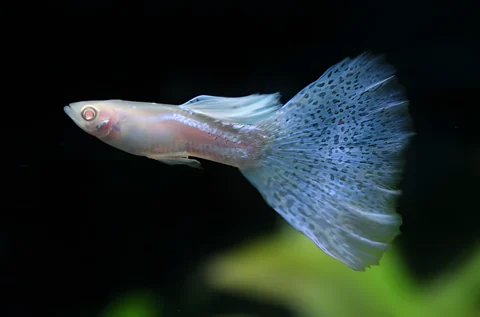
Poecilia reticulata
The Albino Guppy, belonging to the Poeciliidae family, is known by its scientific name Poecilia reticulata (Albino variety). A distinctive feature of this fish is the congenital absence of melanin – the black pigment in…
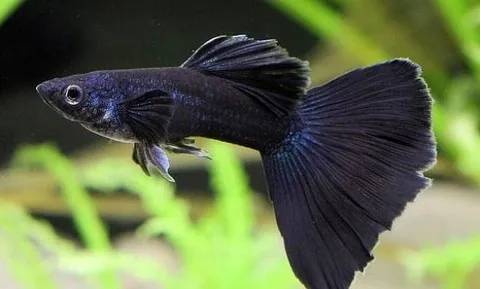
Poecilia reticulata
Black Monk Guppies, also known as Black Guppies, are a breed of Poecilia reticulata (Black strain) from the Poeciliidae family. One of the main features of this variety is the pronounced dark body coloration in males.…
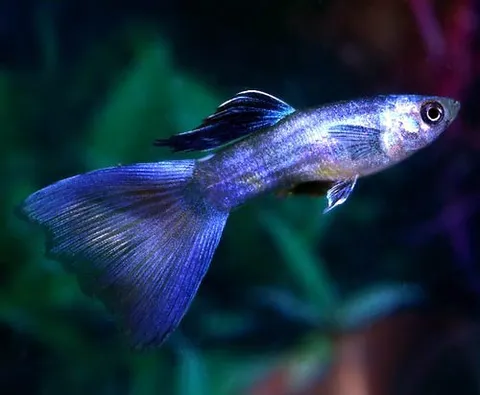
Poecilia reticulata
Blue Guppies, known scientifically as Poecilia reticulata (Blue variety), belong to the Poeciliidae family. This name is a generalization and encompasses various breeds where blue is the dominant color. It is mainly…
Poecilia reticulata
The Cobra Guppy, scientifically known as Poecilia reticulata (Cobra variety), belongs to the family Poeciliidae. Its distinctive feature is a pattern of vertical stripes running along the posterior part of its body. The…