Temperature24 – 30 °C
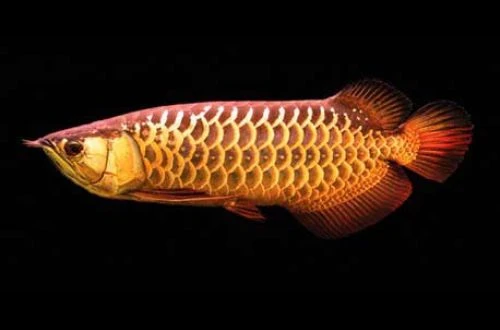
The scientific name Scleropages formosus refers to the Asian arowana, a member of the family Osteoglossidae. Although the name is often used as a blanket term for all Asian arowanas, scientists in fact recognise at least four separate species, along with many subspecies and geographical forms.
Adults can reach a length of 90 cm. The fish has an elongated body with large pectoral fins. The dorsal and anal fins are set close to the tail. Its caudal fin is noticeably larger than that of the silver arowana from South America. Another striking feature is the size of the scales, each of which can be up to 2 cm across. Colouration varies widely and depends on geographic origin: green, silver, golden and red forms are recognised, the last two being the most highly prized.
If the various geographic forms are taken into account, the natural range of the Asian arowana extends throughout South-East Asia, including the archipelagos of Indonesia and Malaysia. In the wild these fish inhabit marshy still waters and river backwaters, preferring to stay in shaded areas near the bank, among flooded tropical forest.
These fish live mainly in the upper layers of the water. During daylight hours they prefer to take cover beneath vegetation overhanging the surface, and among submerged driftwood and roots. They are most active in the evening and at night, when they come out to hunt. Asian arowanas are predatory and territorial, competing with one another for food. As a rule they are kept singly, or in company with large bottom-dwelling species or with fish that occupy the middle of the water column.
The Asian arowana is not a fish for beginners. Those who decide to acquire one are likely to have a thorough knowledge of its requirements already, and can afford advice from qualified specialists. For that reason this site will not dwell on the finer points of its care and will confine itself to the essentials. One Asian arowana needs an aquarium of at least 1000 litres. Since these fish are able to leap out of the water, the tank must have a secure lid. Simplicity matters in the decor — the main thing is to leave plenty of open swimming space in the upper layers. A few large vertical pieces of driftwood are also recommended. The ideal environment for an arowana is clean, soft, acidic water enriched with tannins. Tannins can be introduced with prepared extracts added to the filtration system, or through natural decor such as bark and the leaves of certain plants.
A properly chosen diet is the foundation of successful long-term care for the Asian arowana. Live foods play the key role: shrimp, crickets, mealworms, feeder fish, small amphibians, earthworms, insect larvae and so on. Specialist farms often combine several kinds of food, including dry pelleted feeds. They must not be fed mammalian or avian meat: the lipids it contains cannot be properly metabolised by the fish and lead to excess fat deposits and even organ degeneration.
The Asian arowana is a territorial species that broods its eggs in the mouth, a task performed by the male. In the wild spawning is seasonal; in an aquarium it can be triggered by stable water parameters and a complete diet. Courtship is lengthy and involves the pair circling and swimming together. The female lays a small number of large orange-red eggs, which the male gathers into his mouth. Incubation lasts about 7–8 weeks, until the yolk sac is fully absorbed, after which the fry become independent.
The species is sensitive to water quality and to abrupt changes in conditions, which often trigger bacterial infections and swim bladder problems. Typical ailments include cloudy eye, rot of the fins and gill covers, and ectoparasitic diseases such as anchor worm infestation or ich. Prevention involves maintaining high biological cleanliness, powerful filtration and the elimination of stress factors. Injuries often occur when the fish, being skittish, strikes the aquarium walls or attempts to jump out.
When choosing a specimen, pay attention to the fish's general activity and the cleanliness of its skin. A healthy individual should be inquisitive, with even, tightly seated scales and clear eyes showing no cloudiness or swelling. Avoid specimens with damaged barbels, signs of deformed gill covers, or unnatural behaviour such as constantly staying at the bottom or at the surface. Make sure there are no visible parasites and ask about feeding in the shop to judge the fish's appetite.
The essentials: size, tank volume, water parameters and care
An adult reaches 90 cm in length. Plan the tank around the maximum size: the fish quickly outgrows a cramped setup.
The recommended volume is 1000 L. A smaller tank speeds up nitrate build-up and raises stress levels.
Temperature 24–30 °C, pH 6–7.5, hardness 2–15 dGH. Stability matters more than exact values: sudden swings are harder on the fish than a small deviation from the ideal.
Around 15 years when kept properly. Lifespan depends directly on tank volume, water quality and a varied diet.
Temperament: territorial (often aggressive). This is a predatory species — any fish small enough to fit in its mouth will eventually be eaten.
Recommended setup: solitary. Ignoring this is a common cause of stress and disease.
Diet type: meat / protein (live, frozen, fresh). Feed small portions that are finished within a couple of minutes — overfeeding does more harm than underfeeding.
The scientific name of the species is Scleropages formosus, family Arowanas (Osteoglossidae). It also appears in the literature as: Osteoglossum formosum, Scleropages aureus, Scleropages legendrei.
The water suits 196 of 208 plants in the catalogue — the easiest ones are shown first.
Afzelius's AnubiasAnacharisAnubiasBrazilian PennywortDwarf CloverDwarf CloverDwarf HygrophilaDwarf SagittariaDwarf ValGuppy GrassHornwortJava FernJava MossMoneywortMud SwordNair's LagenandraNarrow Leaf AnacharisNarrow-leaf CloverStringy MossSüsswassertangTaiwan MossTape GrassTemple PlantUssuri Watermilfoil
Matched by family, categories and overlapping keeping conditions
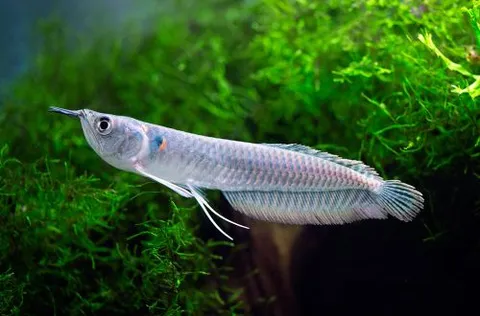
Osteoglossum bicirrhosum
The Silver Arowana, also known simply as Arowana, bears the scientific name Osteoglossum bicirrhosum and belongs to the family Osteoglossidae. This species is a representative of one of the oldest fish families, tracing…
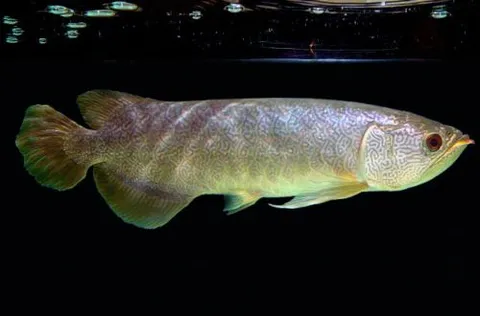
Scleropages inscriptus
The Myanmar arawana, scientific name Scleropages inscriptus, belongs to the family Osteoglossidae. This species is known for its considerable value, with individual specimens fetching tens of thousands of dollars. It is…
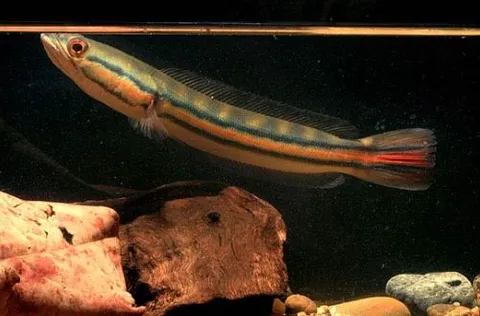
Channa micropeltes
Channa micropeltes, also known as the Red Snakehead or Giant Snakehead, belongs to the family Channidae. This fish species has several common names. Due to its significant size, it is often called the Giant Snakehead,…