Temperature22 – 28 °C
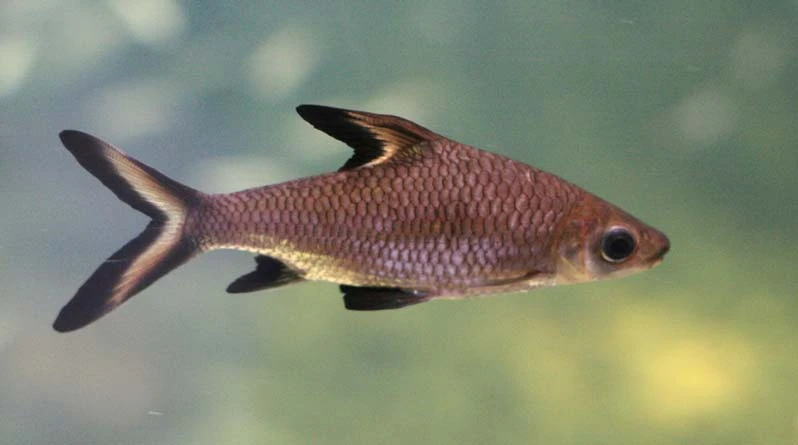
The Tricolor Shark, also known as the Bala Shark, bears the scientific name Balantiocheilos melanopterus and belongs to the family Cyprinidae. Its name is due to its external resemblance to predatory sharks, although in reality, this fish has only inherited their appearance. Despite its impressive size, it is peaceful and can coexist even with smaller species. However, a key condition is that tank mates must be large enough not to fit into the Tricolor Shark's mouth.
This large fish reaches a length of 30 cm, with an elongated, torpedo-shaped body and a characteristic high, triangular dorsal fin. Large eyes help it navigate perfectly and efficiently find food. The coloration is predominantly silvery with a golden sheen; the upper part of the back is slightly darker, while the belly becomes lighter. The fins, including the caudal fin, are yellow or white with distinct black edging along the margins.
In 1850, the researcher Bleeker described the Bala Shark in detail. Contrary to much of the published information, this fish does not occur in Indochina: its range is restricted to Borneo, Sumatra and possibly Peninsular Malaysia. Its natural habitats are large and medium-sized rivers, as well as natural lakes, where it occupies the entire water column. Its diet consists mainly of small crustaceans, insect larvae, as well as algae, microalgae (phytoplankton), and plant matter. Currently, this species is endangered in the wild due to environmental degradation in the region. Individuals available in trade networks are artificially bred on specialized farms in Indonesia and Thailand.
Despite its name, this peaceful schooling fish will not hunt smaller inhabitants if they are large enough not to fit into its mouth. However, keeping them with fish 2–3 cm long poses a danger. It can also cause discomfort for slow and calm species. A hierarchy forms within the school; if only two or three Tricolor Sharks are kept, the weakest individual will be constantly harassed. The optimal number for a school is at least 5 individuals. If kept alone, the fish may show aggression and attack tank mates.
Given the significant size of these fish and their need for schooling, a spacious aquarium of at least 864 L is required. A powerful filtration and aeration system is also essential, which not only cleans the water and saturates it with oxygen but also creates the necessary water movement for the fish. Aquarium decor is not critical; the most important thing is to provide enough space for free swimming. The rest depends on the aquarist's preferences. Since these fish, unlike other large species, do not harm plants, even the most delicate flora can be successfully grown in such an aquarium.
Being an omnivorous species, this fish readily consumes dry commercial foods, such as flakes and pellets, in aquarium conditions. Its diet also includes fresh green products and protein-rich food. To ensure a balanced diet, it is recommended to alternate dry foods with finely chopped spinach, peas, fruits, lettuce leaves, and other plant components. The diet can be diversified with live or frozen foods: mosquito larvae, bloodworms, brine shrimp, or small pieces of mussels and shrimp. Feed the fish 2–3 times a day, offering an amount of food that will be eaten within 3 minutes.
It is practically impossible to distinguish males from females externally. Information on the breeding of these fish in captivity is very limited; only a few successful cases have been recorded in aquariums, but it is not yet possible to scale up their breeding commercially. In nurseries, the fish are bred in large quantities using hormonal stimulants.
When all proper care conditions are met, these fish show high resistance to most diseases.
When choosing a Bala Shark, prioritize active and mobile individuals. A healthy fish has shiny silver scales without visible damage, ulcers, spots, or film. The eyes should be clear, without cloudiness, and the fins should be spread, with a clear black outline. Avoid specimens with signs of emaciation, sunken bellies, or unnaturally bloated abdomens. Consider the following when purchasing: — acquire a group of five or more individuals, as solitary keeping causes severe stress and timidity in the fish; — carefully observe their behavior in the store: healthy fish constantly patrol the water column and show no signs of apathy or constant lying on the bottom; — remember that young individuals measuring 3–5 cm are often sold, but they will require a very spacious aquarium in the future, as adult fish reach 30–35 cm in length.
The essentials: size, tank volume, water parameters and care
An adult reaches 30 cm in length. Plan the tank around the maximum size: the fish quickly outgrows a cramped setup.
The recommended volume is 864 L. A smaller tank speeds up nitrate build-up and raises stress levels.
Temperature 22–28 °C, pH 6–8, hardness 5–12 dGH. Stability matters more than exact values: sudden swings are harder on the fish than a small deviation from the ideal.
Around 10 years when kept properly. Lifespan depends directly on tank volume, water quality and a varied diet.
Temperament: semi-peaceful (dangerous to smaller ones). Not a predatory species, but small fish that fit in its mouth will eventually be eaten.
Recommended setup: schooling (usually from 5–6 individuals and more). Ignoring this is a common cause of stress and disease.
Diet type: mixed diet (meat + plant-based). Feed small portions that are finished within a couple of minutes — overfeeding does more harm than underfeeding.
The scientific name of the species is Balantiocheilos melanopterus, family Cyprinids (Cyprinidae). It also appears in the literature as: Balantiocheilus melanopterus, Barbus melanopterus, Puntius melanopterus.
The water suits 197 of 208 plants in the catalogue — the easiest ones are shown first.
Afzelius's AnubiasAnacharisAnubiasBrazilian PennywortDwarf CloverDwarf CloverDwarf HygrophilaDwarf SagittariaDwarf ValGuppy GrassHornwortJava FernJava MossMoneywortMud SwordNair's LagenandraNarrow Leaf AnacharisNarrow-leaf CloverStringy MossSüsswassertangTaiwan MossTape GrassTemple PlantUssuri Watermilfoil
Matched by family, categories and overlapping keeping conditions
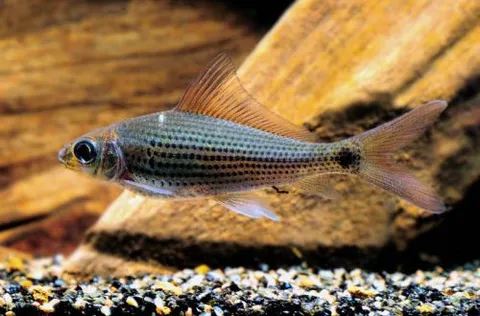
Osteochilus vittatus
The Hard-lipped Barb, also known by its scientific names Osteochilus hasseltii or Osteochilus vittatus, is part of the Cyprinidae family. This large, active fish includes several subspecies, each distinguished by the…
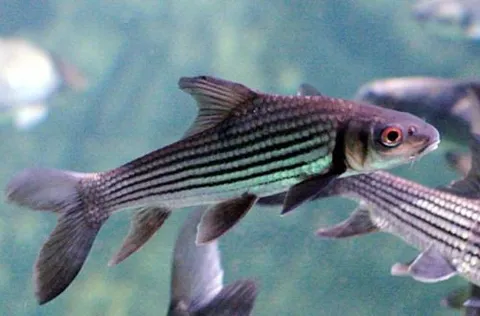
Probarbus jullieni
Jullien's Golden Carp, known by its scientific name Probarbus jullieni, belongs to the family Cyprinidae, or carps. Its natural habitat includes the extensive river systems of Southeast Asia, including the Mekong and…
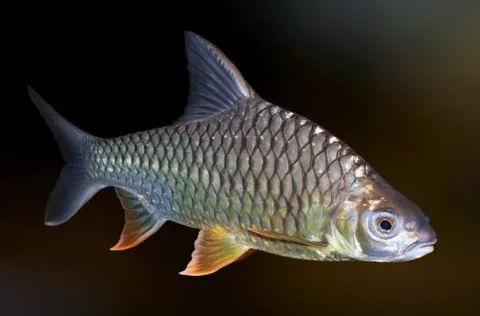
Hypsibarbus wetmorei
Hypsibarbus, or Lemonfin Barb (scientific name Hypsibarbus wetmorei), belongs to the Cyprinidae family. This active and large fish lives in schools. Although it is undemanding and quite easy to keep, the necessity of…
Leptobarbus hoevenii
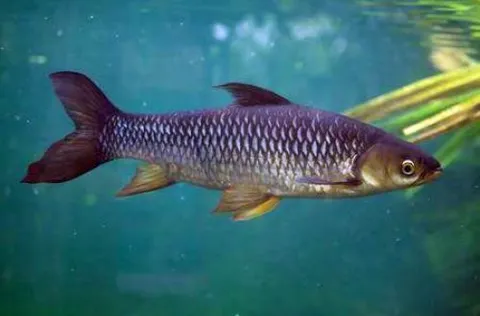
The fish known as Hoven's Carp (Leptobarbus hoevenii) belongs to the family Cyprinidae. It is named after the zoologist Jan van der Hoeven (1801–1868). Due to its impressive size, this species is rarely found in amateur…