Temperature23 – 28 °C
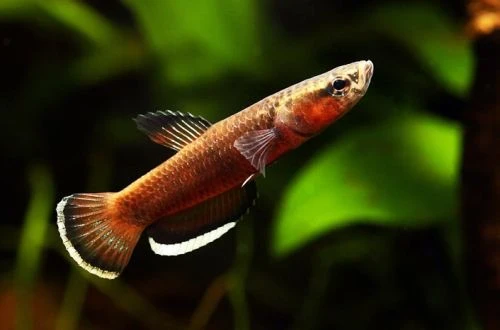
Betta albimarginata, or the White-Seam Betta (scientific name Betta albimarginata), belongs to the family Osphronemidae. This miniature fish has a bright and attractive appearance, but these characteristics mainly apply to males. Females, on the other hand, cannot boast such expressive coloration. Keeping this species is quite demanding, and the choice of tank mates must be carefully considered. Betta albimarginata is not recommended for aquarium beginners.
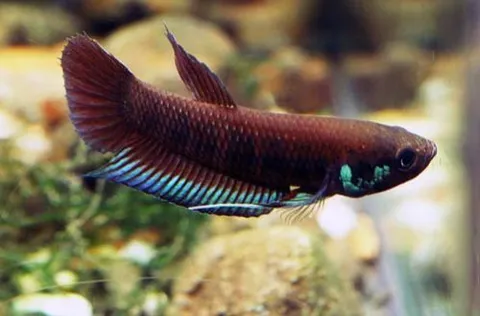
Adults of this species reach approximately 3 cm in length. Betta albimarginata exhibits pronounced sexual dimorphism. Males have a rich red coloration, and their large fins and tail are strikingly edged with contrasting black and white stripes. In contrast, females appear less vibrant: their coloration is dominated by gray shades with irregular black speckles.
The natural habitat of this species is in Southeast Asia, specifically in the Indonesian part of Borneo Island. Betta albimarginata is endemic to the Sebuku River basin, located in the province of Kalimantan Timur (or East Kalimantan). The fish prefer shallow forest streams, only 5 to 10 cm deep, where the bottom is covered with a layer of fallen leaves, branches, and other plant debris. Brief information is presented below.
Due to their modest size, these fish can only be compatible with other small species of comparable size. Large or overly active species can frighten these small Bettas. Within the species, relationships are built on male rivalry for female attention. Competition manifests in interesting behavior and stimulates males to display their brightest colors. It is recommended to keep them either as a pair or in a group.
For a small group of such tiny fish, a tank with a volume of 40 L or more will be suitable. The fish's appearance is most harmoniously revealed against a dark substrate, among abundant thickets of shade-loving plants and numerous snags. Lighting should be subdued, as bright light can negatively affect the intensity of their coloration. Dried leaves from certain trees will be a useful addition, as they are an integral part of the White-Seam Betta's natural habitat. These leaves not only serve as a natural decorative element but also play a key role in forming an aquatic environment similar to natural conditions. As they decompose, the leaves release tannins, which give the water a brownish tint. Special attention should be paid to the filtration system: it not only cleans the water but can also serve as a tool for correcting the hydrochemical composition. However, it should be noted that some filter models create excessive water movement, which should be avoided, as Betta albimarginata is poorly adapted to strong currents.
In their natural environment, the diet of White-Seam Bettas likely consists of insects, small invertebrates, and zooplankton. In a home aquarium, they can be accustomed to a variety of alternative foods. The daily menu can include popular dry, frozen, and live foods. Specialized products developed by some manufacturers specifically for Betta species will be an excellent choice.
In natural environments, where small bodies of water often dry up, these fish have developed a special adaptation that allows them to preserve their offspring even in such variable conditions. White-Seam Bettas brood their eggs orally, with this role performed exclusively by males. During the breeding period, the fish form a temporary pair. During spawning, the female lays only about a dozen eggs, which immediately after fertilization end up in the male's mouth. Despite the small clutch size, the survival rate of fry in this species is significantly higher compared to others. The incubation period lasts from 10 to 21 days, during which the male seeks a secluded, safe place or shelter. It is important to protect him from stress (do not scare him) and avoid excessive curiosity from tank mates, otherwise the male may swallow the eggs. The fry emerge fully formed and can stay near their parents for a while. Later, the parents lose interest in them but do not try to eat them.
Most health problems in fish often arise from unsuitable keeping conditions. Maintaining a stable and comfortable habitat is a key factor for successful keeping. If symptoms of illness appear, the first step is to check the water quality. If deviations are found, it is important to take immediate measures to eliminate them. If the symptoms do not disappear or worsen, medicinal treatment may be required.
When selecting individuals, attention should be paid to overall activity and fin condition. Healthy fish should be curious, active, and show no visible damage, growths, or signs of emaciation. In a store setting, it is important to assess the water clarity in the tank and the absence of dead fish nearby, as the species is sensitive to environmental quality. Avoid purchasing individuals showing signs of apathy, clamped fins, or unusual spots on their bodies, as adaptation to new conditions is extremely difficult for weakened fish. Since this species is often wild-caught, it is advisable to ask the seller about the origin of the batch and their current diet. It is desirable to ensure that the fish have already started accepting the offered foods, as adaptation to artificial feeding can be challenging. Given their territorial nature, when purchasing a group, it is worth planning for a sufficient number of hiding places in the home aquarium in advance to minimize stress during transfer.
The essentials: size, tank volume, water parameters and care
An adult reaches 3 cm in length. Plan the tank around the maximum size: the fish quickly outgrows a cramped setup.
The recommended volume is 40 L. A smaller tank speeds up nitrate build-up and raises stress levels.
Temperature 23–28 °C, pH 4–6.5, hardness 1–5 dGH. Stability matters more than exact values: sudden swings are harder on the fish than a small deviation from the ideal.
Around 3 years when kept properly. Lifespan depends directly on tank volume, water quality and a varied diet.
Temperament: peaceful (regular). Keep this in mind when choosing tank mates.
Recommended setup: mixed (solitary / pair / group). Ignoring this is a common cause of stress and disease.
Diet type: any (universal). Feed small portions that are finished within a couple of minutes — overfeeding does more harm than underfeeding.
The scientific name of the species is Betta albimarginata, family Osphronemidae.
The water suits 197 of 208 plants in the catalogue — the easiest ones are shown first.
Afzelius's AnubiasAnacharisAnubiasBrazilian PennywortDwarf CloverDwarf CloverDwarf HygrophilaDwarf SagittariaDwarf ValGuppy GrassHornwortJava FernJava MossMoneywortMud SwordNair's LagenandraNarrow Leaf AnacharisNarrow-leaf CloverStringy MossSüsswassertangTaiwan MossTape GrassTemple PlantUssuri Watermilfoil
Matched by family, categories and overlapping keeping conditions
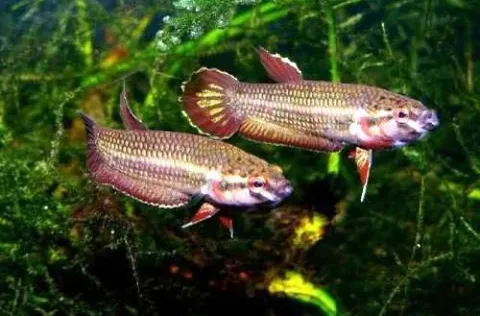
Betta dennisyongi
Betta dennisyongi, also known as Dennis Yong's Betta, belongs to the family Osphronemidae. This fish received its scientific name in honour of Dennis Yong Ghong Chong, a naturalist deeply versed in the fauna and flora…
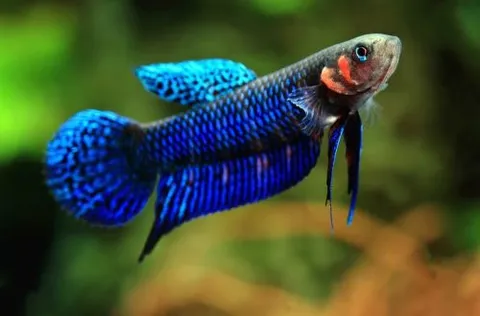
Betta hendra
The scientific name Betta hendra was given to Hendra's Betta, or Betta hendra, within the family Osphronemidae. This species was named after the Indonesian naturalist Hendra Tommy, who first discovered it. This fish is…
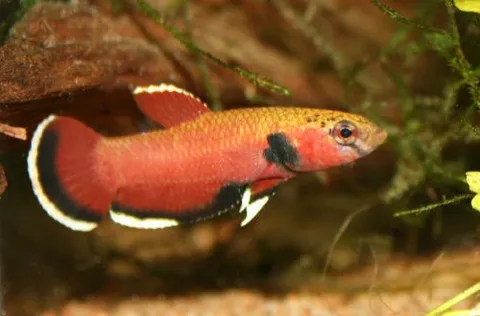
Betta channoides
Betta channoides, also known as Channa's Betta or Chan's Fighting Fish, is a member of the Osphronemidae family. Despite belonging to the group of fighting fish, this species is distinguished by its peaceful and calm…
Betta krataios
Betta krataios, or Krataios Betta, is classified as a member of the family Osphronemidae and bears the scientific name Betta krataios. This species belongs to the group of Fighting Fish, however, its temperament and…