Temperature20 – 25 °C
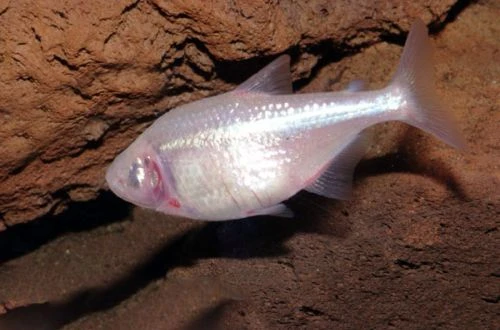
The Mexican Tetra, also known as the Blind Cave Tetra (scientific name Astyanax mexicanus), belongs to the family Acestrorhamphidae. Despite its unusual appearance and very specific habitat conditions, this fish is very popular among aquarists. Keeping it at home is hassle-free and quite simple, provided the aquarium is shielded from bright light.
Adults can reach up to 9 cm in length. Their body is white, fins are translucent, and eyes are completely absent. Sexual dimorphism is weakly expressed: females are only slightly larger than males, which becomes especially noticeable during spawning. The surface form of this fish, on the contrary, is completely unremarkable, resembling an ordinary river fish. The divergence of the two forms of the Mexican Tetra occurred approximately 10,000 years ago, after the end of the last ice age. In fish that found themselves in subterranean conditions, most of the pigmentation gradually disappeared, and their eyes atrophied. However, the loss of vision was accompanied by an enhancement of other sensory organs, such as smell and the lateral line. The blind cave Tetra can react even to minor changes in water pressure around it, which helps it navigate and find food. When the fish enters a new environment, it actively explores it, forming a detailed spatial map in its memory, allowing it to move confidently in complete darkness.
The Blind Cave Fish is found exclusively in underwater caves in modern-day Mexico. Meanwhile, its closest relatives living on the surface are widespread in river systems and lakes in the Southern United States, as well as in Mexico and Guatemala.
Preferring a solitary lifestyle, this peaceful fish feels perfectly fine alone, although it can also be kept in a small group. The specificity of its needs does not allow it to be combined with any other species of aquarium fish, which should be taken into account when planning an aquarium.
Optimal conditions for keeping this fish are achieved in an aquarium of 80 liters or more. The tank's decor is recommended to be styled as a submerged cave, using large rock formations such as slate for decoration, placed along the sides and at the back of the aquarium. No vegetation is used. Lighting should be very dim; it is advisable to purchase special lights for nocturnal aquariums that emit blue or red light. Aquarium maintenance includes weekly water changes of 10–15% with fresh water and regular cleaning of the substrate from organic debris, including uneaten food and excrement. The aquarium should not be placed in a brightly lit room.
The diet consists of high-quality dry foods from reputable manufacturers, supplemented with live or frozen food.
Breeding these fish is not difficult, and no special conditions are required to stimulate spawning. They reproduce quite regularly. To protect the eggs during the breeding period, a fine-mesh net made of transparent fishing line can be placed on the bottom of the aquarium to avoid disturbing the aesthetics. Mexican Tetras are very prolific; an adult female can lay up to 1000 eggs, although not all of them will be fertilized. After spawning, it is recommended to carefully transfer the eggs to a separate tank with similar water parameters. Fry hatch within the first 24 hours, and after a week, they begin to swim freely in search of food. It is interesting to note that in the early stages of development, the fry have eyes, which over time become overgrown and completely disappear by the time they reach adulthood.
A balanced aquarium bio-system with appropriate keeping conditions is the best protection against any diseases. Therefore, if the fish's behavior changes, uncharacteristic spots appear, or other symptoms are observed, the water parameters should be checked first. If necessary, normalize them, and only then proceed with treatment.
When choosing Astyanax mexicanus at the store, pay attention to the fish's overall activity and skin condition. Healthy individuals should show curiosity, actively exploring the aquarium space using their lateral line, rather than hiding in corners or lying on the bottom. Ensure there are no visible injuries, ulcers, white film, or unnatural spots on the body. Since the species is represented by two forms, it is important to clarify whether you are acquiring the blind cave or sighted river variety. In the blind form, the eyes should be completely atrophied and covered by skin. Avoid purchasing fish from aquariums where dead individuals or fish showing signs of emaciation are observed, as this may indicate unfavorable keeping conditions or the presence of hidden infections.
The essentials: size, tank volume, water parameters and care
An adult reaches 9 cm in length. Plan the tank around the maximum size: the fish quickly outgrows a cramped setup.
The recommended volume is 80 L. A smaller tank speeds up nitrate build-up and raises stress levels.
Temperature 20–25 °C, pH 6.5–8, hardness 12–26 dGH. Stability matters more than exact values: sudden swings are harder on the fish than a small deviation from the ideal.
Around 10 years when kept properly. Lifespan depends directly on tank volume, water quality and a varied diet.
Temperament: peaceful (regular). Keep this in mind when choosing tank mates.
Recommended setup: both solitary and in group (flexible). Ignoring this is a common cause of stress and disease.
Diet type: meat with plant additives (omnivores). Feed small portions that are finished within a couple of minutes — overfeeding does more harm than underfeeding.
The scientific name of the species is Astyanax mexicanus, family Acestrorhamphidae. It also appears in the literature as: Astianax mexicanus, Astyanax argentatus, Astyanax brevimanus.
The water suits 196 of 208 plants in the catalogue — the easiest ones are shown first.
Afzelius's AnubiasAnacharisAnubiasBrazilian PennywortDwarf CloverDwarf CloverDwarf HygrophilaDwarf SagittariaDwarf ValGuppy GrassHornwortJava FernJava MossMoneywortMud SwordNarrow Leaf AnacharisNarrow-leaf CloverStringy MossSüsswassertangTaiwan MossTape GrassTemple PlantUssuri WatermilfoilWater Wisteria
Matched by family, categories and overlapping keeping conditions
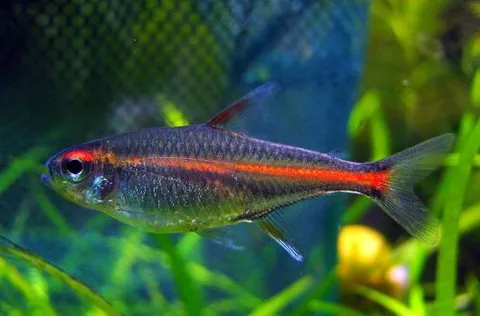
Hemigrammus erythrozonus
The Glowlight Tetra, or Hemigrammus erythrozonus by its scientific name, is a member of the Acestrorhamphidae family. It gets its name from the bright red-orange stripe running from its head to its caudal fin. These…
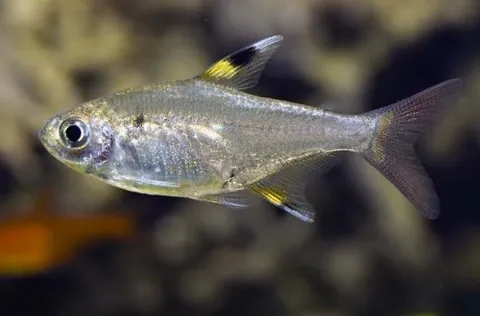
Pristella maxillaris
The Albino Pristella, also known as the Albino X-Ray Tetra, scientifically classified as Pristella maxillaris, belongs to the Acestrorhamphidae family. This species is considered one of the most common and accessible…
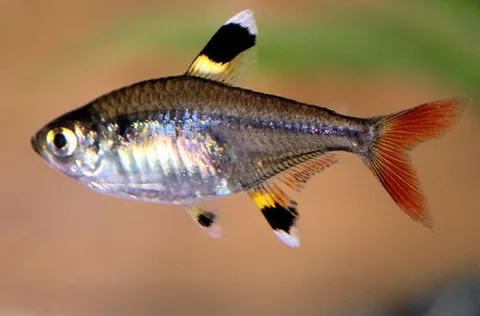
Pristella maxillaris
The Pristella Tetra, also known as the X-ray Tetra or Golden Pristella Tetra (scientific name Pristella maxillaris), belongs to the family Acestrorhamphidae. A distinguishing feature of this fish is its remarkable…
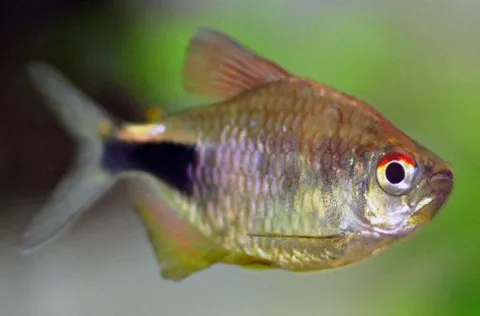
Holopristis pulchra
The Pulcher fish, also known by its scientific name Holopristis pulchra, belongs to the Acestrorhamphidae family. Despite its rather narrow natural habitat, it has gained popularity among aquarists worldwide due to its…