Temperature20 – 30 °C
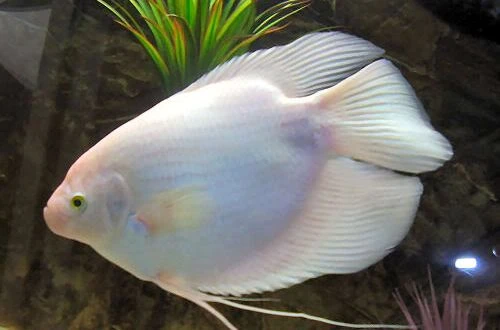
The Giant Gourami, also known by its scientific name Osphronemus goramy, belongs to the family Osphronemidae. These fish are the largest representatives of labyrinth fish, reaching up to 70 cm in length, although in a home aquarium their size rarely exceeds 40 cm. This giant species has its own charm; it is undemanding to keep and not picky about food, making it an excellent choice for spacious species-specific aquariums.
The body of this fish is massive, oval-shaped, and strongly compressed laterally. Adults grow up to 70 cm in length, which is quite impressive. Young individuals have a flat and pointed head, but as they mature, a noticeable “hump” appears on their forehead, and their jaw becomes massive, with large lips. Like other labyrinth fish, the pelvic fins of the Giant Gourami are transformed into filamentous appendages equipped with sensitive sensors. The coloration of the fish changes with age: young specimens display a body pattern of 8–10 dark stripes on a silvery-light background, and their fins have a yellowish tint. Over time, adult Gouramis gradually lose their bright coloration, becoming monochromatic – white, pinkish, or gray. In recent years, the practice of artificially coloring Gouramis using injections and dyeing baths has become popular. However, these methods are condemned in many developed countries because they cause irreparable harm to the fish: they become vulnerable to various infections, their lifespan is significantly reduced, and some individuals die immediately after such procedures. Distinguishing males from females can be done by the shape of their fins: in males, the dorsal and anal fins are more elongated and pointed, and the forehead is larger. In females, on the other hand, the fins are more rounded, and the lips are more pronounced.
Originally, the natural habitat of the Giant Gourami extended across the river systems of Southeast Asia, where this species holds significant commercial importance for local residents. For the same purpose, Gouramis were introduced to waters on other continents, such as South America and Australia. In nature, they prefer medium and large rivers, as well as lakes, venturing into flooded forest areas during the rainy season. They can also be found in swampy lowlands, canals, and brackish waters. The diet of these fish is very diverse: they feed on both plant and animal matter, including aquatic plants, fish, frogs, earthworms, and even carrion.
These fish can live perfectly well either alone or in a male/female pair. Young individuals often show aggression towards each other, but their temperament softens with age. However, adult males can still show intolerance towards rivals, especially during spawning. Their large size and natural diet make it impossible to keep Giant Gouramis with small fish, which will quickly become prey. Therefore, other large, calm, and peaceful fish species are preferable as tankmates, but in cramped conditions (in a small aquarium), skirmishes are inevitable.
These fish can successfully adapt to a wide range of water parameters, so two key factors are crucial: sufficiently large space (a voluminous tank) and maintaining water cleanliness. The latter aspect often causes difficulties, as the Giant Gourami produces a significant amount of waste. To cope with such a load, several powerful filters and weekly water changes of 25–50% will be required. Other necessary equipment includes a lighting system, an aerator, and a heater; it is important to ensure they are securely fastened. This species is one of the few labyrinth fish capable of tolerating water salinity up to 2 grams of salt per 10 liters. The aquarium decor is at your discretion, but with a few conditions: there should be enough open swimming areas and several dense groups of fast-growing plants, which will inevitably serve as an additional food source.
These fish readily accept all types of aquarium foods, both dry commercial and meaty, only the required quantity differs. Since this is a large fish, it requires appropriate food portions. It is especially important to consider that if the fish is acquired at an already mature age (and they live quite long), it is necessary to clarify its usual diet, otherwise it may refuse unfamiliar food. For example, if the fish initially fed exclusively on meaty food (worms, small fish, insects), then transitioning it to dry food will be problematic, and keeping a Giant Gourami will become quite expensive. The optimal solution would be to acquire a young specimen and feed it according to your capabilities, as this fish is undemanding and will eat almost anything offered.
Theoretically, breeding these fish seems simple: they form pairs, build bubble nests where the fry develop, and so on. However, the main difficulties arise due to the necessary tank size – it must be very large, from 700 liters. This is because after the fry appear, the male actively guards them and can even attack his female, who needs a lot of space to hide. A fully equipped tank of this size (with substrate and equipment) will weigh about a ton, and the ceilings and floors in standard apartments are not designed for such loads.
In a balanced aquarium environment, these fish usually do not experience health problems. The main causes of ailments lie in insufficient nutrition or lack of free space.
When choosing a Giant Gourami, preference should be given to young specimens, as they adapt more easily to aquarium conditions and diet. Carefully inspect the fish for fin damage, body ulcers, or signs of emaciation. Avoid purchasing individuals with unnaturally bright coloration obtained through injections or dyeing baths, as such fish often have compromised health and a short lifespan. Keep in mind that Giant Gourami fry may outwardly resemble other species, so it is important to ensure correct species identification. In the store, pay attention to their behavior: a healthy fish should be active and interested in food. Since this species grows to a significant size, assess your ability to provide the fish with the necessary space in the future.
The essentials: size, tank volume, water parameters and care
An adult reaches 50–70 cm in length. Plan the tank around the maximum size: the fish quickly outgrows a cramped setup.
The recommended volume is 700 L. A smaller tank speeds up nitrate build-up and raises stress levels.
Temperature 20–30 °C, pH 6.5–8, hardness 5–25 dGH. Stability matters more than exact values: sudden swings are harder on the fish than a small deviation from the ideal.
Around 20 years when kept properly. Lifespan depends directly on tank volume, water quality and a varied diet.
Temperament: predator, but semi-peaceful (gets along with large ones). This is a predatory species — any fish small enough to fit in its mouth will eventually be eaten.
Recommended setup: solitary. Ignoring this is a common cause of stress and disease.
Diet type: any (universal). Feed small portions that are finished within a couple of minutes — overfeeding does more harm than underfeeding.
The scientific name of the species is Osphronemus goramy, family Osphronemidae. It also appears in the literature as: Osphromenus gourami, Osphromenus notatus, Osphromenus olfax.
The water suits 197 of 208 plants in the catalogue — the easiest ones are shown first.
Afzelius's AnubiasAnacharisAnubiasBrazilian PennywortDwarf CloverDwarf CloverDwarf HygrophilaDwarf SagittariaDwarf ValGuppy GrassHornwortJava FernJava MossMoneywortMud SwordNair's LagenandraNarrow Leaf AnacharisNarrow-leaf CloverStringy MossSüsswassertangTaiwan MossTape GrassTemple PlantUssuri Watermilfoil
Matched by family, categories and overlapping keeping conditions
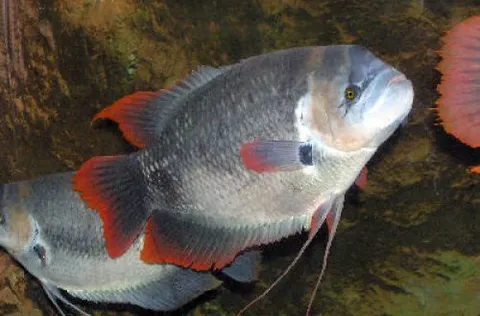
Osphronemus laticlavius
The Giant Red-tailed Gourami (scientific name Osphronemus laticlavius) belongs to the family Osphronemidae. This fish is one of the four giant Gourami species, distinguished perhaps by the most vibrant coloration. As an…
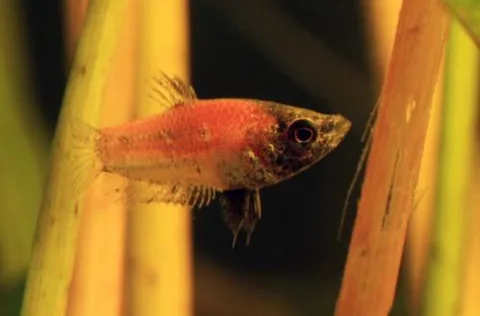
Parasphaerichthys lineatus
The scientific name Parasphaerichthys lineatus belongs to the family Osphronemidae, and this species is known as the False Chocolate Gourami. This fish is modest in size, does not stand out with a bright appearance, and…
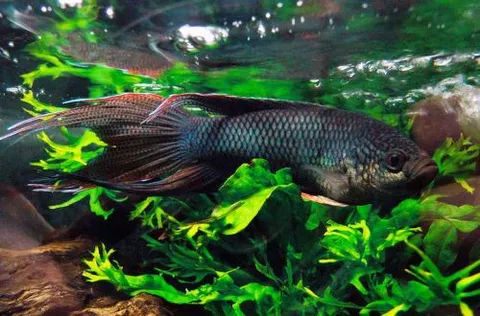
Macropodus spechti
The Black Paradise Fish, scientifically known as Macropodus spechti, belongs to the family Osphronemidae. Previously, it was often referred to as the Macropodus concolor, considered a color variation of the classic…
Trichogaster lalius
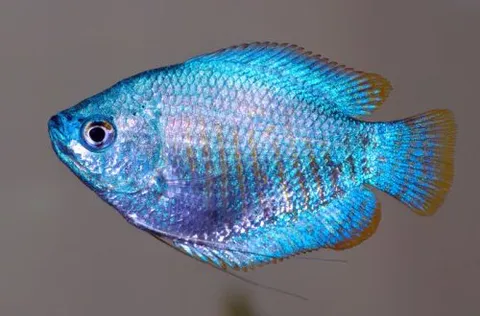
The Blue Dwarf Gourami, scientifically known as Trichogaster lalius, belongs to the family Osphronemidae. This beautiful miniature fish is an artificially bred variety of the common Dwarf Gourami. It stands out for its…