Temperature22 – 26 °C
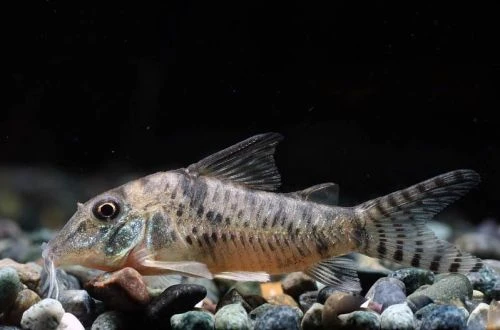
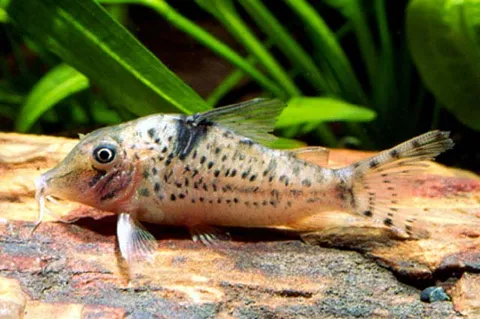
Corydoras aurofrenatus, known as the Goldstripe Corydoras, belongs to the family Callichthyidae, or Armored Catfishes. Its name is due to the unique pigmentation on its head and body, which shimmers with gold. The species was described as long ago as 1903, but in the aquarium trade it was long known as Corydoras sp. «Corrientes» and under the identifier CW005, and only in the 2000s were these fish matched to Corydoras aurofrenatus.
A detailed description of this catfish was published in 2003. It reaches a length of about 5 cm and is characterized by 24–26 lateral scutes. The coloration includes two dark spots on each flank: one located under the adipose fin, the other behind the head. An additional pattern of 3–4 dark stripes can be seen on the dorsal fin, and up to 8 stripes on the caudal fin. A distinctive feature is also that the upper lobe of the caudal fin is longer than the lower. An important characteristic that gives a golden hue under certain lighting is the pigmentation on the head and body.
The species inhabits South America, populating the Paraná and Paraguay River basins. Its range covers territories of Paraguay, Argentina, Bolivia, and the southern part of Brazil. In nature, the fish inhabit slow-moving waters, where they prefer to stay in areas with soft sandy or silty bottoms.
A peaceful schooling species, showing the most activity at dusk. For comfortable well-being, it is recommended to keep a group of 4–6 individuals. Compatible with most calm fish of comparable size. In the aquarium, fish often rise to the surface to gulp atmospheric air, which is natural behavior.
The Goldstripe Corydoras is an unpretentious species, which makes its keeping quite simple. The requirements for living conditions are similar to those of many freshwater aquarium fish. They need clean water of appropriate temperature and hydrochemical parameters, a balanced diet, and the absence of conflicting tank mates. The daily diet can be varied, including dry, freeze-dried, frozen, or live foods. The main condition is that the food must sink and be of suitable size. The choice of compatible species also presents no difficulties: almost any fish of comparable size that can adapt to similar conditions will be suitable.
An omnivorous species, feeding on small invertebrates and organic detritus in nature. In the aquarium, it is necessary to use sinking foods in the form of tablets, granules, or flakes, intended for bottom-dwelling fish. The diet should be diversified with frozen or live foods, such as bloodworms or daphnia. It is unacceptable to rely solely on finding leftover food from other inhabitants.
Spawning is communal, usually stimulated by imitating the rainy season through frequent water changes with softer and cooler water. The female lays eggs on hard surfaces: plant leaves, stones, or aquarium glass. After spawning, it is recommended to remove the parents to prevent them from eating the offspring. The incubation period is 2–3 days, after which the larvae begin to feed after the yolk sac has been absorbed.
The species is sensitive to water quality and substrate cleanliness. When kept on sharp or dirty substrate, damage to the sensitive barbels is possible, which opens the way for bacterial infections. It is important to maintain stable water parameters and avoid the accumulation of organic matter. When handling the fish, caution should be exercised, as the rigid fin rays can inflict painful stings.
When purchasing, choose active individuals with intact fins and undamaged barbels. Healthy fish should have a rounded body without signs of emaciation, ulcers, or spots on the skin. Avoid buying fish from tanks where dead individuals are observed, as this may indicate hidden diseases or poor keeping conditions in the store.
The essentials: size, tank volume, water parameters and care
An adult reaches 5 cm in length. Plan the tank around the maximum size: the fish quickly outgrows a cramped setup.
The recommended volume is 80 L. A smaller tank speeds up nitrate build-up and raises stress levels.
Temperature 22–26 °C, pH 6–8, hardness 2–15 dGH. Stability matters more than exact values: sudden swings are harder on the fish than a small deviation from the ideal.
Around 5 years when kept properly. Lifespan depends directly on tank volume, water quality and a varied diet.
Temperament: peaceful (regular). Keep this in mind when choosing tank mates.
Recommended setup: small group (5–6 individuals). Ignoring this is a common cause of stress and disease.
Diet type: sinking (any). Feed small portions that are finished within a couple of minutes — overfeeding does more harm than underfeeding.
The scientific name of the species is Corydoras aurofrenatus, family Armored Catfish (Callichthyidae).
The water suits 197 of 208 plants in the catalogue — the easiest ones are shown first.
Afzelius's AnubiasAnacharisAnubiasBrazilian PennywortDwarf CloverDwarf CloverDwarf HygrophilaDwarf SagittariaDwarf ValGuppy GrassHornwortJava FernJava MossMoneywortMud SwordNair's LagenandraNarrow Leaf AnacharisNarrow-leaf CloverStringy MossSüsswassertangTaiwan MossTape GrassTemple PlantUssuri Watermilfoil
Matched by family, categories and overlapping keeping conditions
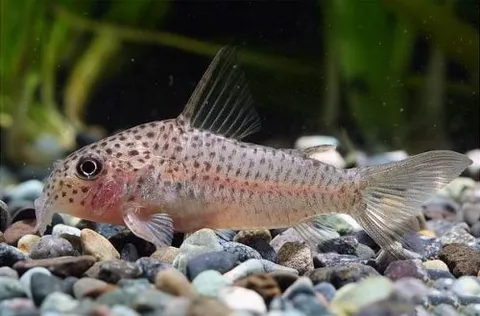
Corydoras albolineatus
The white-striped Corydoras, named Corydoras albolineatus, is a member of the Callichthyidae family (Armored or Callichthyid Catfishes). Before its official scientific description in 2004, this species was known by the…
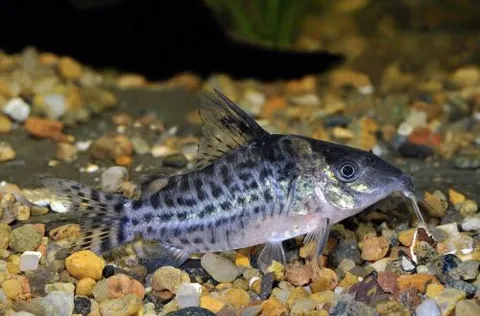
Corydoras lamberti
Lamberti's Corydoras, or Cory Catfish Lamberti, known to the scientific community as Corydoras lamberti, is a representative of the family Callichthyidae (Armored Catfish). The species was described in 1986 and named in…
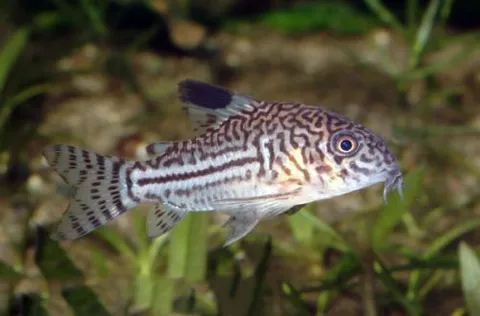
Corydoras trilineatus
Corydoras trilineatus, known as the leopard or three-stripe corydoras catfish, belongs to the family Callichthyidae. The habitat of this species covers the Amazon River basin, extending through Colombia, Peru, and…
Corydoras blochi
The fish, scientifically known as Corydoras blochi, belongs to the armored catfish family (Callichthyidae). Its natural range covers many river systems in South America, including the vast Amazon River basin. Bloch's…