Temperature20 – 26 °C
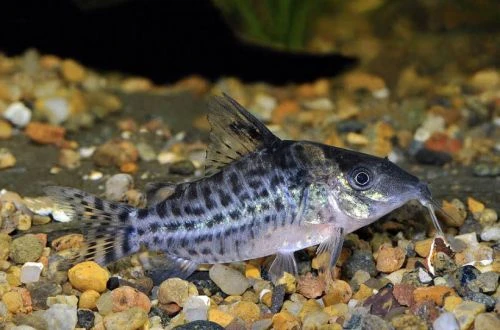
Lamberti's Corydoras, or Cory Catfish Lamberti, known to the scientific community as Corydoras lamberti, is a representative of the family Callichthyidae (Armored Catfish). The species was described in 1986 and named in honour of Lambertus van Tuijl; in aquarium catalogues it was long listed under the provisional designation C009. It is worth noting that in aquarium circles, both in specialized literature and in retail outlets, it is still often referred to by its former identifier C009.
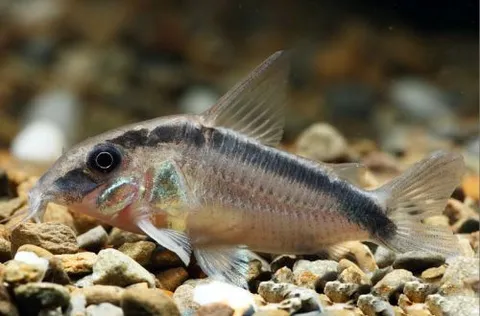
Adults of this species reach approximately 5 cm in length. Their body structure is typical for Corydoras catfish: it appears quite massive and stocky, and their scales have taken on the appearance of strong plates, resembling medieval armor. A distinctive feature of Corydoras lamberti, compared to most closely related species, is a slightly elongated head shape. The body coloration consists of black speckles, evenly distributed over a silvery background and extending onto the caudal fin. Overall, this pattern gives the fish a gray hue.
The species inhabits South America, in the Pastaza River basin, which is a tributary of the Marañón River in the upper Amazon (territory of Peru and Ecuador). It lives in freshwater bodies with slow currents. In nature, it prefers the bottom layers of the water.
A peaceful and schooling fish, leading a bottom-dwelling lifestyle. It is recommended to keep them in a group of at least 6 individuals, as solitary fish become timid and stressed. They are well compatible with most small and peaceful aquarium fish that occupy the middle and upper water layers.
The requirements for maintaining the health of Lamberti's Corydoras in an aquarium are similar to the conditions necessary for other Corydoras catfish species. This species is considered quite undemanding, demonstrating good adaptability to various conditions, provided that water temperature and hydrochemical parameters remain within acceptable limits. It is also important to provide them with a balanced diet and protection from aggressive tank mates. Standard aquarium maintenance procedures, including regular weekly partial water changes combined with the removal of organic waste (e.g., uneaten food and excrement), as well as equipment maintenance, will be sufficient.
An omnivorous species. In aquarium conditions, it accepts high-quality dry foods in the form of sinking tablets or granules. The diet should be varied with live or frozen foods, such as bloodworms, daphnia, or tubifex. Feeding should be done 1-2 times a day in small portions that the fish can eat within a few minutes.
Breeding is typical for corydoras. Spawning is paired or in groups, stimulated by frequent water changes to softer and cooler water. The female lays eggs on hard substrates, such as broad plant leaves or aquarium glass. After spawning, it is recommended to remove the parents to prevent them from eating the eggs.
The species has a strong immune system when kept under proper conditions. The main risks are associated with poor water quality, accumulation of organic matter, and the use of unsuitable substrate, which can injure the sensitive barbels of the catfish. Prevention includes regular gravel vacuuming and weekly water changes.
When choosing, pay attention to the activity of the fish and the integrity of their skin. Healthy individuals should have clean fins, clear eyes, and undamaged barbels. Avoid purchasing fish with signs of emaciation, whitish spots on the body, or lethargic behavior, as these may indicate the presence of infections or parasites.
The essentials: size, tank volume, water parameters and care
An adult reaches 5 cm in length. Plan the tank around the maximum size: the fish quickly outgrows a cramped setup.
The recommended volume is 70 L. A smaller tank speeds up nitrate build-up and raises stress levels.
Temperature 20–26 °C, pH 6–8, hardness 2–15 dGH. Stability matters more than exact values: sudden swings are harder on the fish than a small deviation from the ideal.
Around 5 years when kept properly. Lifespan depends directly on tank volume, water quality and a varied diet.
Temperament: peaceful (regular). Keep this in mind when choosing tank mates.
Recommended setup: small group (5–6 individuals). Ignoring this is a common cause of stress and disease.
Diet type: sinking (any). Feed small portions that are finished within a couple of minutes — overfeeding does more harm than underfeeding.
The scientific name of the species is Corydoras lamberti, family Armored Catfish (Callichthyidae).
The water suits 197 of 208 plants in the catalogue — the easiest ones are shown first.
Afzelius's AnubiasAnacharisAnubiasBrazilian PennywortDwarf CloverDwarf CloverDwarf HygrophilaDwarf SagittariaDwarf ValGuppy GrassHornwortJava FernJava MossMoneywortMud SwordNair's LagenandraNarrow Leaf AnacharisNarrow-leaf CloverStringy MossSüsswassertangTaiwan MossTape GrassTemple PlantUssuri Watermilfoil
Matched by family, categories and overlapping keeping conditions
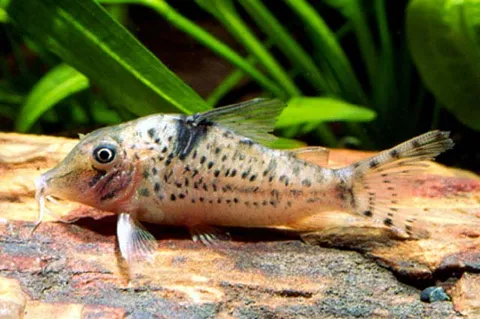
Corydoras blochi
The fish, scientifically known as Corydoras blochi, belongs to the armored catfish family (Callichthyidae). Its natural range covers many river systems in South America, including the vast Amazon River basin. Bloch's…
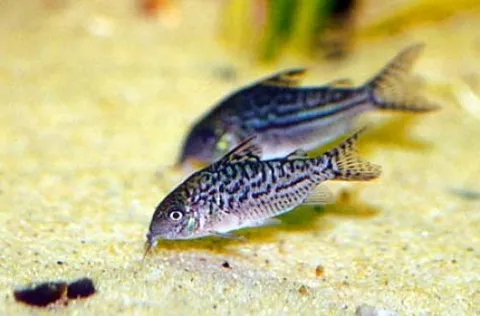
Corydoras sodalis
Corydoras sodalis, known as the reticulated corydoras, belongs to the family Callichthyidae, which includes armored catfishes. The historical habitat of this fish is South America. It can be found in the upper Amazon…
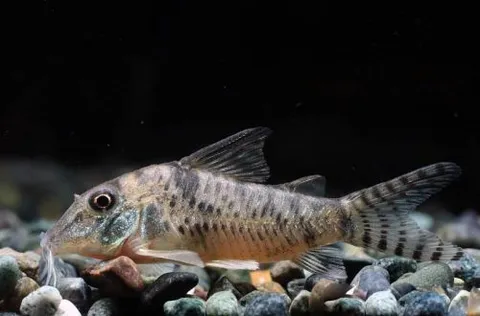
Corydoras aurofrenatus
Corydoras aurofrenatus, known as the Goldstripe Corydoras, belongs to the family Callichthyidae, or Armored Catfishes. Its name is due to the unique pigmentation on its head and body, which shimmers with gold. The…
Corydoras arcuatus
Corydoras arcuatus, also known as the Arched Cory or Skunk Cory, is scientifically classified as Corydoras arcuatus and belongs to the Callichthyidae family. Its natural range extends across almost the entire upper…