Temperature24 – 28 °C
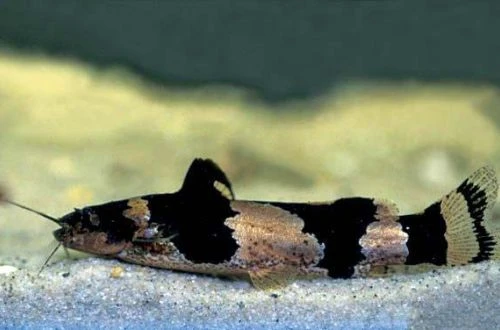
The scientific name Microglanis iheringi is assigned to this member of the Pseudopimelodidae family, known as the Harlequin Catfish or American Bumblebee Catfish. The natural habitat of this species is the Turmero River basin, which flows into Lake Valencia, located near Caracas in northern Venezuela.
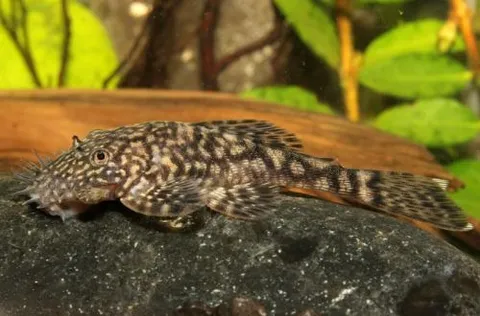
Adults of this species reach up to 6 cm in length. Their body is characterized by a yellowish coloration, complemented by a pattern of alternating black stripes. This distinctive coloring served as the basis for colloquial names such as "harlequin" and "bumblebee". It is important to remember that this species should not be confused with the Asian Bumblebee Catfish, despite the similarity in names.
The species inhabits freshwater bodies in Colombia, Venezuela, and Peru. In nature, it prefers flowing rivers with clear water, where it stays in the bottom layers. Typical habitats are characterized by the presence of stones, gravel, and various shelters on the bottom.
This species is distinguished by its peaceful and calm nature. It demonstrates excellent compatibility with most popular aquarium inhabitants. Nevertheless, it is worth noting that the Harlequin Catfish is not particular about food, so if given the opportunity, it will certainly eat any small fish or fry that fit into its mouth.
For a pair of catfish, an aquarium with a volume of 50 to 60 liters will be optimal. When decorating, it is important to provide various shelters, for example, in the form of snags, dense thickets of plants (such as Java fern or Echinodorus bleheri), or piles of stones creating caves and crevices. This species is not often found for sale, which explains the scarcity of complete and reliable information about its keeping. However, based on data for related Pimelodus species, it can be assumed that the American bumblebee catfish is not difficult to care for. This is supported by its ability to adapt to a wide range of hydrochemical water parameters and its unpretentiousness in feeding.
Being an omnivorous species, these fish readily accept most common aquarium fish foods. A particular preference is given to high-protein products such as bloodworms, Artemia, and Daphnia, which can be offered fresh or frozen.
Sexual maturity occurs at about 1.5 years of age. Breeding requires a separate aquarium of 60 liters or more with soft water, dim lighting, and many shelters. Spawning is in pairs, stimulated by creating a flow, daily water changes of up to 50% of the volume, or lowering the temperature by 2–3 degrees. The female lays 100 to 250 greenish eggs, after which the parents are removed. Fry begin to feed 5–6 days after hatching, with rotifers and Artemia nauplii serving as initial food.
No specific species-specific diseases have been described for Microglanis iheringi; however, the fish are sensitive to water quality and the accumulation of organic waste. If keeping parameters are not met and filtration is poor, there is a high risk of bacterial skin and fin infections. Like other bottom-dwelling catfishes, these fish are susceptible to invasive diseases if parasites are introduced with poor-quality live food. Prevention includes mandatory quarantine of new individuals, maintaining substrate cleanliness, regular water changes, and using only tested or pre-disinfected feeds.
When purchasing, choose active individuals with clean skin without visible damage, ulcers, or spots. It is important to ensure that the fins show no signs of deterioration and that the eyes are clear and bright. It is recommended to observe the fish's behavior in the store: healthy catfish should show interest in food and not look emaciated. Avoid purchasing fish from aquariums where dead or sick neighbors have been observed.
The essentials: size, tank volume, water parameters and care
An adult reaches 6 cm in length. Plan the tank around the maximum size: the fish quickly outgrows a cramped setup.
The recommended volume is 50 L. A smaller tank speeds up nitrate build-up and raises stress levels.
Temperature 24–28 °C, pH 6–8, hardness 5–12 dGH. Stability matters more than exact values: sudden swings are harder on the fish than a small deviation from the ideal.
Around 5 years when kept properly. Lifespan depends directly on tank volume, water quality and a varied diet.
Temperament: peaceful (regular). Keep this in mind when choosing tank mates.
Recommended setup: both solitary and in group (flexible). Ignoring this is a common cause of stress and disease.
Diet type: sinking (any). Feed small portions that are finished within a couple of minutes — overfeeding does more harm than underfeeding.
The scientific name of the species is Microglanis iheringi, family Pseudopimelodidae.
The water suits 196 of 208 plants in the catalogue — the easiest ones are shown first.
Afzelius's AnubiasAnacharisAnubiasBrazilian PennywortDwarf CloverDwarf CloverDwarf HygrophilaDwarf SagittariaDwarf ValGuppy GrassHornwortJava FernJava MossMoneywortMud SwordNair's LagenandraNarrow Leaf AnacharisNarrow-leaf CloverStringy MossSüsswassertangTaiwan MossTape GrassTemple PlantUssuri Watermilfoil
Matched by family, categories and overlapping keeping conditions
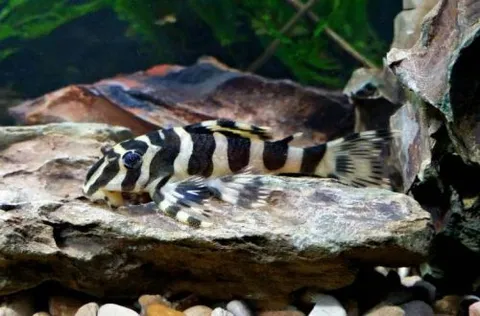
Peckoltia compta
Peckoltia compta, a representative of the armored catfish family (Loricariidae), is one of the most popular pleco species. Its popularity is due to its bright, contrasting coloration, modest size, peaceful nature, and…
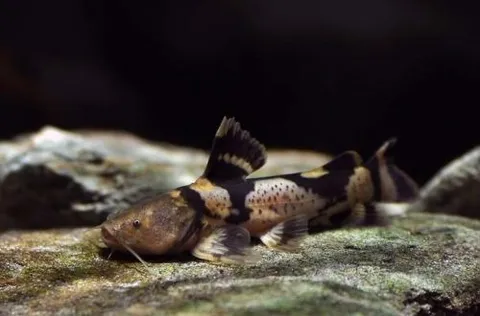
Pseudopimelodus bufonius
Pseudopimelodus bufonius, known by its scientific name Pseudopimelodus bufonius, belongs to the family Pseudopimelodidae. This catfish originates from South America, predominantly in Venezuela and the northern Brazilian…
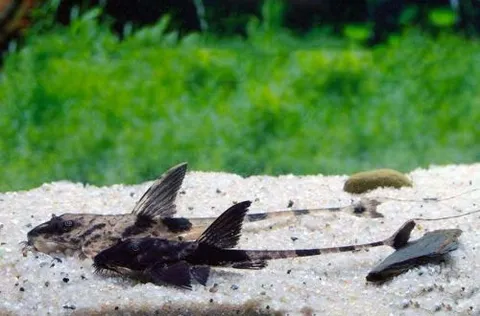
Loricaria simillima
The Marbled Whiptail, also known as Loricaria simillima (scientific name Loricaria simillima), is a member of the family Loricariidae, or Armored Catfishes. The native habitat of this fish is South America, where it is…
Ancistrus claro
Ancistrus claro, scientifically named Ancistrus claro, belongs to the family Loricariidae, also known as Armored Catfish. Its name originates from the Claro River, a small tributary of the Cuiabá River in the Brazilian…