Temperature20 – 25 °C
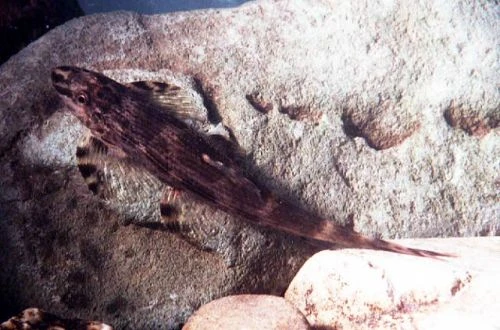
Homalopteroides stephensoni, known as Stephenson's Homaloptera, belongs to the family Balitoridae, which includes river loaches. This fish received its scientific name in honor of John Stephenson (1871–1933), a professor of biology at Government College Lahore in Pakistan, who made significant contributions to the study of the fauna of Southeast Asian islands.
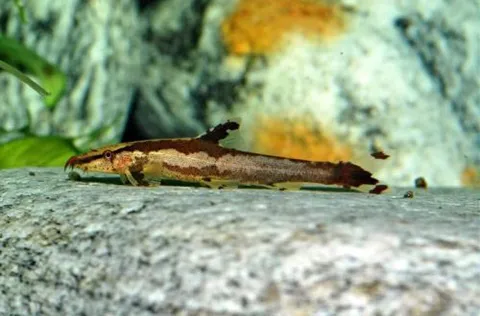
Adults reach approximately 6 cm in length. A distinctive feature is an elongated, slender body with a pointed head. Well-developed, large pelvic and pectoral fins are positioned horizontally, allowing the fish to cling firmly to rocks and maintain a stable position in strong currents. The Homaloptera's coloration is gray, with characteristic large, dark, rounded spots. This coloration, when viewed from above, helps camouflage the fish against a rocky bottom.
This species of loach is endemic to the island of Kalimantan (Borneo), located in Southeast Asia. Its natural habitat consists of shallow sections of fast-flowing rivers and streams that descend from mountain slopes. The bottom of these bodies of water is predominantly rocky, composed of boulders, stones, and gravel, with aquatic vegetation being quite rare.
This fish exhibits a peaceful and calm disposition; however, its specific habitat requirements limit the choice of tank mates. Suitable companions include closely related Homalopteras, other species of non-aggressive and non-territorial loaches, as well as representatives of other fish groups that can comfortably exist in strong currents.
For aquarium design, it is recommended to create conditions that closely mimic a mountain riverbed: use a rocky substrate, add several large boulders and snags. Hardy types of live plants, such as mosses or ferns, capable of attaching to surfaces, can also be placed. It is critically important to ensure a strong internal current in the aquarium, where all the water in the system should be renewed 10–15 times per hour. This means that a filter or pump for a 100-liter aquarium must circulate more than 1000 liters of water per hour. For successful long-term keeping, it is necessary to maintain pH parameters close to neutral, ensure medium carbonate hardness, and a high level of dissolved oxygen. Since Stephenson's Homaloptera inhabits flowing waters, it is extremely sensitive to the accumulation of organic waste (excrement, food remnants), so these should be regularly removed from the aquarium. It is recommended to combine this procedure with partial water changes.
In nature, these fish actively search for small invertebrates among the rocks, which constitute their main diet. When kept in a home aquarium, they should be offered fresh, frozen, or live brine shrimp, bloodworms, daphnia, and similar foods. Additionally, dry sinking or bottom-fastening foods enriched with protein can be included in their diet.
No spawning has been recorded in aquaria. In the wild the species is presumably a seasonal breeder. Hillstream loaches require strong current and a high oxygen content, and the conditions that trigger their spawning have so far not been reproduced in an aquarium.
The best protection against diseases is to provide suitable living conditions, a balanced diet, and the absence of external stressors, such as aggression from tank mates. The appearance of disease symptoms may indicate problems in the living conditions. Often, normalizing the environment contributes to self-recovery, but if the fish's body is too weakened, medicinal treatment may be required.
When purchasing, caution should be exercised, as representatives of the Balitoridae family often arrive in an emaciated state due to transportation and feeding issues. A healthy fish should be active, well-fed, without visible fin damage, ulcers, or spots on the body. Avoid individuals that appear excessively thin, have sunken sides, or exhibit sluggish behavior, lying on open areas of the bottom without attempting to move when approached. It is recommended to acquire a group of six or more individuals, as these fish feel more confident in a shoal and adapt more quickly to new conditions.
The essentials: size, tank volume, water parameters and care
An adult reaches 6 cm in length. Plan the tank around the maximum size: the fish quickly outgrows a cramped setup.
The recommended volume is 50 L. A smaller tank speeds up nitrate build-up and raises stress levels.
Temperature 20–25 °C, pH 6–7.5, hardness 1–10 dGH. Stability matters more than exact values: sudden swings are harder on the fish than a small deviation from the ideal.
Around 5 years when kept properly. Lifespan depends directly on tank volume, water quality and a varied diet.
Temperament: peaceful (regular). Keep this in mind when choosing tank mates.
Recommended setup: both solitary and in group (flexible). Ignoring this is a common cause of stress and disease.
Diet type: sinking (meat / protein). Feed small portions that are finished within a couple of minutes — overfeeding does more harm than underfeeding.
The scientific name of the species is Homalopteroides stephensoni, family River Loaches (Balitoridae). It also appears in the literature as: Homaloptera stephensoni.
The water suits 196 of 208 plants in the catalogue — the easiest ones are shown first.
Afzelius's AnubiasAnacharisAnubiasBrazilian PennywortDwarf CloverDwarf CloverDwarf HygrophilaDwarf SagittariaDwarf ValGuppy GrassHornwortJava FernJava MossMoneywortMud SwordNarrow Leaf AnacharisNarrow-leaf CloverStringy MossSüsswassertangTaiwan MossTape GrassTemple PlantUssuri WatermilfoilWater Wisteria
Matched by family, categories and overlapping keeping conditions
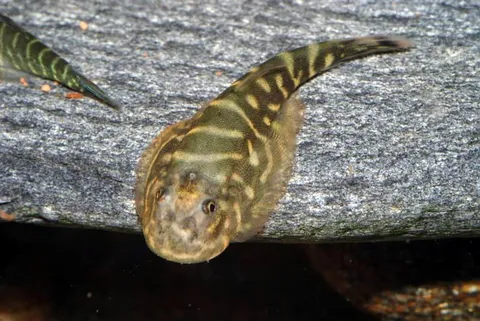
Gastromyzon zebrinus
The Zebra Gastromyzon, also known by its scientific name Gastromyzon zebrinus, belongs to the family Balitoridae. This species does not attract the attention of all aquarists, which is due to its unusual appearance,…
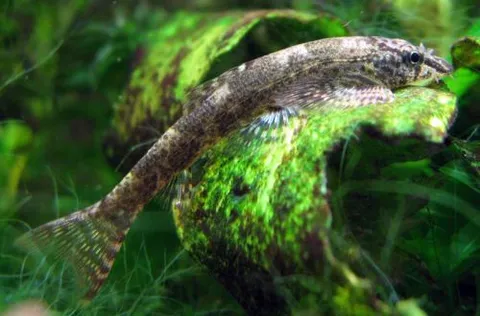
Homalopteroides smithi
Homalopteroides smithi, known as Smith's Homaloptera, belongs to the family Balitoridae, or river loaches. This fish was named after the ichthyologist Hugh Smith (1865–1941), who discovered many tropical fish in Siam,…
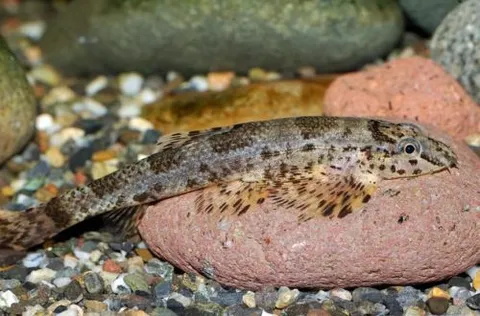
Homalopteroides tweediei
Homalopteroides tweediei, or Homaloptera tweediei, belongs to the family Balitoridae, known as river loaches. This fish was named after the naturalist and archaeologist Michael Tweedie (1907–1993), Assistant Curator of…
Homaloptera bilineata
Homaloptera bilineata, also known as the Two-lined Homaloptera, belongs to the family Balitoridae, or river loaches. Although this species is undemanding to keep and peaceful, its breeding in aquarium conditions…