Temperature24 – 27 °C
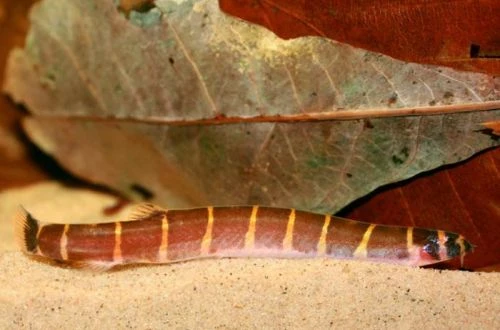
The fish known as Myers's Loach, or Pangio myersi by its scientific name, is a member of the Cobitidae family, which includes loaches. It was named in honor of Dr. George Sprague Myers of Stanford University, whose research significantly contributed to the study of the ichthyofauna of Southeast Asian river systems.
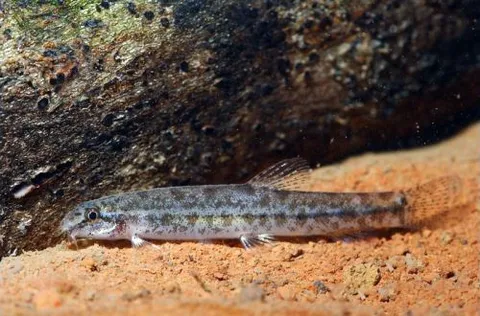
Adults can reach a length of approximately 10 cm. Their elongated, sinuous body resembles that of an eel. The coloration is dark, adorned with a dozen orange stripes arranged symmetrically. Their fins are short, and the tail has a dark hue. Two pairs of barbels are located near the mouth. It is worth noting that Myers's Loach bears a resemblance to closely related species, such as Kuhli Loach and Half-banded Loach, which often leads to confusion. However, for aquarists, this inaccuracy does not pose serious problems, as their care requirements are identical.
The natural habitats of this species are found in Southeast Asia, covering vast areas of the lower Mekong River basin, located in modern-day Thailand, Vietnam, Cambodia, and Laos. These fish prefer swampy waters with slow currents—these can be forest streams, peat bogs, or river backwaters. They typically stay in the bottom layer, among dense plant thickets, numerous snags, and submerged riparian flora.
These fish are distinguished by their peaceful and friendly disposition, coexisting well both with their own kind and with other non-aggressive species of comparable size. Excellent tank mates for them include miniature rasboras, small livebearers, danios, dwarf gouramis, and other inhabitants of Southeast Asian rivers and swamps. It is important to note that Myers's Loach needs the company of its own kind, so it is recommended to acquire a group of at least 5–6 individuals. They are primarily nocturnal, preferring to hide during the day. When choosing tank mates from among catfish, cichlids, or other loaches, caution should be exercised, as some of them may exhibit aggressive territorial behavior.
For a group of 5–6 Myers's Loaches, the optimal aquarium volume starts from 60 liters. When setting up the tank, it is important to provide a sufficient number of hiding places—these can be snags or plant thickets where the fish can hide during the day. Another essential element is the substrate: it is necessary to use soft, fine-grained substrate, such as sand, so that the fish can partially burrow into it. Keeping these fish will not cause great difficulties if the hydrochemical parameters of the water are normal and the level of organic pollution is kept low. Regular aquarium maintenance is standard: at least weekly, a partial water change with fresh water should be performed, combined with gravel vacuuming and equipment checks. In natural conditions, their diet consists of small zoo- and phytoplankton, which they find by sifting portions of substrate on the bottom with their mouths. In aquarium conditions, the main diet can consist of popular sinking foods, such as flakes or granules. It is advisable to feed the fish in the evening, just before the lights are turned off.
In their natural environment, these fish feed on small zoo- and phytoplankton, obtaining it from the bottom by sifting substrate particles with their mouths. In aquarium conditions, their diet can be based on popular sinking foods, such as flakes or granules. Feeding is recommended in the evening, before turning off the lights.
Breeding Myers's Loach in home aquariums is extremely difficult and practically never occurs without hormonal stimulation. In the natural environment, spawning takes place in the water column or among vegetation, where the female lays eggs, and the male fertilizes them by coiling around the female's body. The eggs have a greenish tint and attach to the substrate. In aquarium conditions, attempts at breeding require a spawning tank with a low water level and a mesh bottom to prevent parents from eating the eggs.
The species has a relatively strong immune system, but it is sensitive to water quality and substrate composition. Due to the absence of scales on their heads and sensitive skin, the fish are extremely susceptible to aggressive chemical preparations and medications. Major health problems are often caused by poor keeping conditions, leading to bacterial infections, the signs of which may include bloating, red gills, discoloration, or unnatural behavior, such as swimming at the surface or loss of coordination.
When selecting individuals, attention should be paid to the fish's activity and plumpness. Healthy loaches should have clean skin without visible damage, ulcers, or film, and should exhibit natural caution. Avoid purchasing emaciated, lethargic specimens with sunken bellies or signs of fin damage. Since most fish are sold from the wild, they may be subject to stress and parasitic diseases, so it is recommended to carefully inspect the condition of all individuals in the display tank before purchase.
The essentials: size, tank volume, water parameters and care
An adult reaches 10 cm in length. Plan the tank around the maximum size: the fish quickly outgrows a cramped setup.
The recommended volume is 60 L. A smaller tank speeds up nitrate build-up and raises stress levels.
Temperature 24–27 °C, pH 5.5–7, hardness 1–10 dGH. Stability matters more than exact values: sudden swings are harder on the fish than a small deviation from the ideal.
Around 8 years when kept properly. Lifespan depends directly on tank volume, water quality and a varied diet.
Temperament: peaceful (regular). Keep this in mind when choosing tank mates.
Recommended setup: small group (5–6 individuals). Ignoring this is a common cause of stress and disease.
Diet type: sinking (any). Feed small portions that are finished within a couple of minutes — overfeeding does more harm than underfeeding.
The scientific name of the species is Pangio myersi, family Cobitidae (Loaches). It also appears in the literature as: Acanthophthalmus myersi.
The water suits 197 of 208 plants in the catalogue — the easiest ones are shown first.
Afzelius's AnubiasAnacharisAnubiasBrazilian PennywortDwarf CloverDwarf CloverDwarf HygrophilaDwarf SagittariaDwarf ValGuppy GrassHornwortJava FernJava MossMoneywortMud SwordNair's LagenandraNarrow Leaf AnacharisNarrow-leaf CloverStringy MossSüsswassertangTaiwan MossTape GrassTemple PlantUssuri Watermilfoil
Matched by family, categories and overlapping keeping conditions
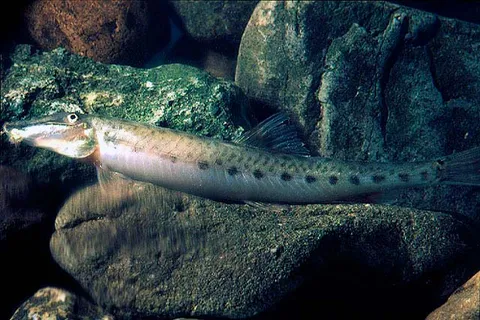
Acantopsis octoactinotos
Acantopsis octoactinotos, or the Long-nosed Loach, belongs to the family Cobitidae. This species is native to Southeast Asia, where it is found in the river systems of northern Borneo — the Indonesian part and the…
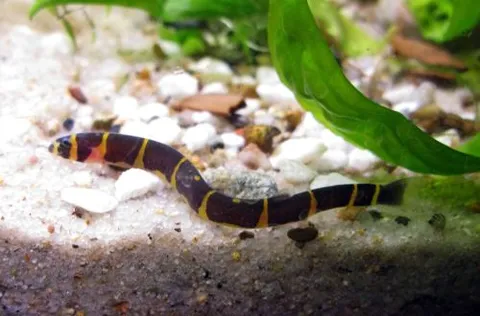
Pangio semicincta
Pangio semicincta, known as the Half-banded Kuhli Loach, belongs to the family Cobitidae. These fish are often sold under the name Pangio kuhlii, but it is important to note that this is a completely different species,…
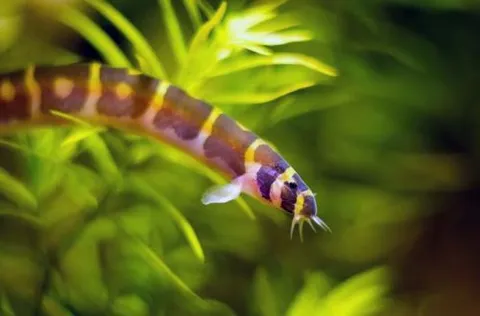
Pangio kuhlii
The Kuhli Loach, also known as the Coolie Loach, bears the scientific name Pangio kuhlii and belongs to the family Cobitidae (loaches). This fish originates from Southeast Asia, particularly common on the islands of…
Lepidocephalichthys hasselti
Hasselt's Loach, scientifically known as Lepidocephalichthys hasselti, belongs to the family Cobitidae. This species of aquarium fish is known for its hardiness and undemanding nature regarding keeping conditions.…