Temperature23 – 30 °C
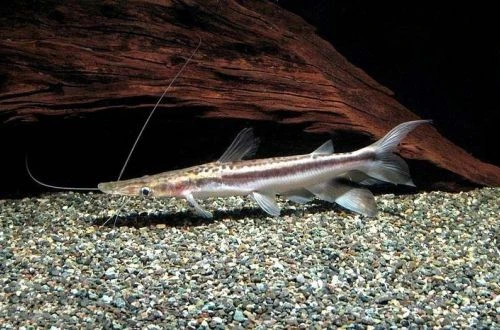
Sorubim lima, known as the Paddle-nosed Catfish, is a member of the family Pimelodidae (Long-whiskered Catfishes). This catfish originates from South America, where it is considered one of the continent's most common fish. Its natural habitat spans numerous river systems located east of the Andes Mountains, including large basins such as the Amazon and Orinoco. The fish is found in diverse biotopes: both in swift currents and calmer rivers, as well as in floodplain lakes and backwaters. It prefers to stay in the bottom layers, finding shelter among aquatic plants and submerged snags.
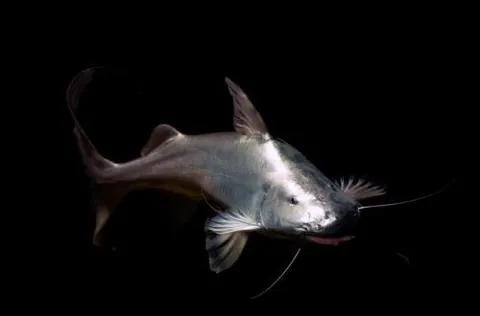
Adult catfish can reach 40–50 cm in length, depending on their keeping conditions. In the wild, the maximum recorded length for an individual was 54 cm. A distinctive feature of the species is its flattened head shape, which gives the fish its "paddle-nosed" name. The catfish has a robust, elongated body, with short fins and a prominent forked tail. The coloration is predominantly gray, with a characteristic broad black stripe running from head to tail. The underside of the body is usually lighter. The back is dark; some geographical variations may have rounded spots in their coloration.
The species is widely distributed in the Amazon, Orinoco, Paraná, and Parnaíba river basins in South America. It inhabits various bodies of water, including river channels with moderate currents, floodplain lakes, and backwaters. It prefers murky waters with sandy, clay, or silty bottoms, where it often stays among submerged snags, tree roots, and dense aquatic vegetation.
Despite its predatory lifestyle, this species does not exhibit aggression. It poses a danger only to small fish whose size allows them to fit into the catfish's mouth. When choosing tank mates, it is appropriate to select peaceful fish of comparable size. Good companions can include large South American cichlids, characins, as well as non-territorial catfish from the genera Pleco and Pimelodus. Paddle-nosed Catfish coexist well with members of their own species and can be kept in groups.
For the comfortable existence of the Paddle-nosed Catfish, a spacious aquarium is required: for a single fish, the minimum volume is 800 liters, and for a group of three individuals, a tank of at least 1200 liters will be needed. An important part of the decor will be reliable shelters created from massive snags — branches, roots, or even small tree trunks will suffice. When choosing live plants, preference should be given to those with strong root systems, or specimens capable of attaching and growing directly on snags. Delicate, weakly rooted species are likely to be uprooted from the substrate. The long-term well-being of these catfish directly depends on maintaining crystal clear, well-oxygenated water, as well as minimal organic pollution. To ensure such water quality, it is necessary to replace 35–50% of the total volume weekly and install an effective, high-performance filtration system in the aquarium.
In its natural habitat, the Paddle-nosed Catfish feeds on small fish, crustaceans, and other invertebrates. Therefore, in a home aquarium, it is necessary to provide it with a diet that closely mimics its natural one. Before acquiring a catfish, it is worth clarifying its feeding habits. In some cases, breeders manage to accustom these fish to alternative protein-rich food sources, including dry sinking pellets. They must not be fed mammalian or avian meat: the lipids it contains cannot be properly metabolised by the fish and lead to excess fat deposits and even organ degeneration.
Little has been established about reproduction in the genus Sorubim: the fish spawn at the onset of the rainy season, as do many other Amazonian species. No spawning has been recorded in a home aquarium — the size of the adults and the need for a migratory trigger both stand in the way; in the farming of related pimelodids fry are obtained through hormonal induction.
The fish is sensitive to water quality and the presence of organic pollutants. Under unfavorable conditions, such as the presence of ammonia or nitrates, the catfish exhibits a characteristic shedding of its mucous layer, which outwardly resembles the molting process in reptiles. To prevent diseases, it is necessary to ensure powerful filtration and regular water changes, avoiding the use of live foods of dubious origin, which can be a source of parasites.
When selecting, attention should be paid to the fish's activity and the condition of its skin. Healthy individuals should have clean skin without visible ulcers, spots, or damage, and should show a natural reaction to movement. Caution should be exercised during transportation, as the catfish's fins are equipped with sharp spines capable of puncturing a bag and causing injury to a person.
The essentials: size, tank volume, water parameters and care
An adult reaches 50 cm in length. Plan the tank around the maximum size: the fish quickly outgrows a cramped setup.
The recommended volume is 800 L. A smaller tank speeds up nitrate build-up and raises stress levels.
Temperature 23–30 °C, pH 6.5–7.8, hardness 2–20 dGH. Stability matters more than exact values: sudden swings are harder on the fish than a small deviation from the ideal.
Around 15 years when kept properly. Lifespan depends directly on tank volume, water quality and a varied diet.
Temperament: predator, but semi-peaceful (gets along with large ones). This is a predatory species — any fish small enough to fit in its mouth will eventually be eaten.
Recommended setup: mixed (solitary / pair / group). Ignoring this is a common cause of stress and disease.
Diet type: meat / protein (live, frozen, fresh). Feed small portions that are finished within a couple of minutes — overfeeding does more harm than underfeeding.
The scientific name of the species is Sorubim lima, family Pimelodidae (Long-whiskered Catfishes). It also appears in the literature as: Platystoma lima, Platystoma luceri, Silurus gerupensis.
The water suits 197 of 208 plants in the catalogue — the easiest ones are shown first.
Afzelius's AnubiasAnacharisAnubiasBrazilian PennywortDwarf CloverDwarf CloverDwarf HygrophilaDwarf SagittariaDwarf ValGuppy GrassHornwortJava FernJava MossMoneywortMud SwordNair's LagenandraNarrow Leaf AnacharisNarrow-leaf CloverStringy MossSüsswassertangTaiwan MossTape GrassTemple PlantUssuri Watermilfoil
Matched by family, categories and overlapping keeping conditions
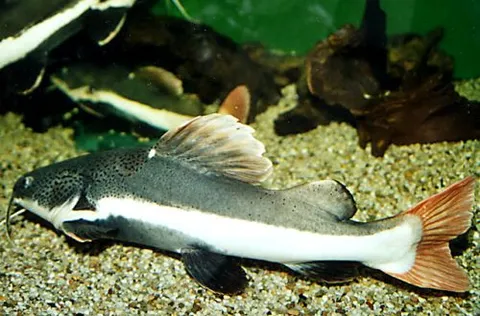
Phractocephalus hemioliopterus
The Redtail Catfish, also known as the Flat-headed Catfish, has the scientific name Phractocephalus hemioliopterus and belongs to the family Pimelodidae. This very large representative of the order Siluriformes is…
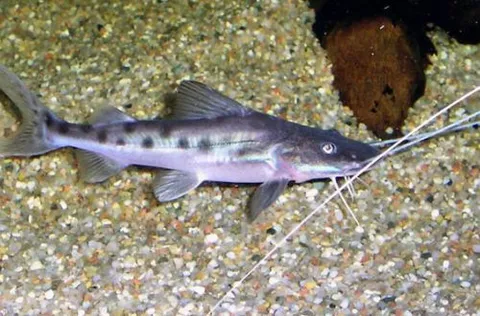
Brachyplatystoma capapretum
The False Piraíba, scientifically named Brachyplatystoma capapretum, belongs to the family Pimelodidae, also known as long-whiskered or flat-headed catfishes. This large predatory fish is often found in public aquariums…
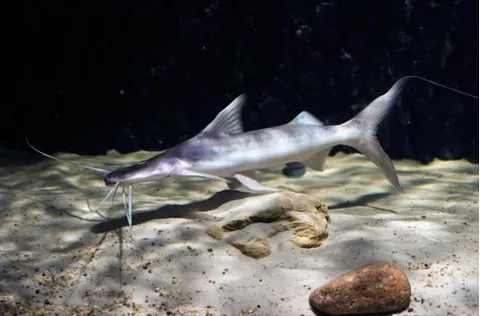
Brachyplatystoma platynema
The scientific name Brachyplatystoma platynema is assigned to the slime catfish, a representative of the family Pimelodidae (long-whiskered or flat-headed catfishes). Fishermen gave it this unusual name because bubbles…
Brachyplatystoma rousseauxii
Dourada, known scientifically as Brachyplatystoma rousseauxii, belongs to the family Pimelodidae, also called pimelodid or flat-headed catfishes. This large predatory fish is highly valued by the local population as an…