Temperature22 – 29 °C
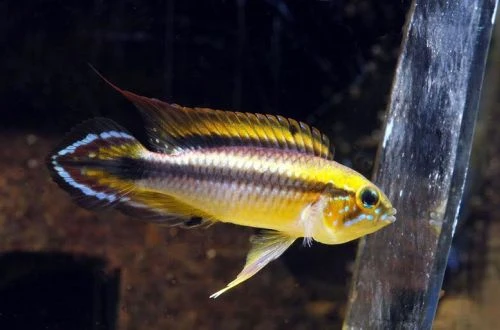
Agassiz's Dwarf Cichlid, also known as Apistogramma agassizii, belongs to the family Cichlidae. This attractive fish is popular and comes in many selective breeding forms, which differ mainly in coloration. The species is considered undemanding, and its keeping and breeding are not difficult, making it a suitable choice even for beginner aquarists.
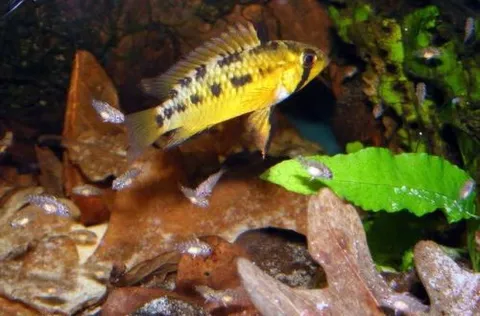
Adult Agassiz's Dwarf Cichlids reach a length of 5–7 cm. Males are usually larger and more brightly colored than females, and their fins are more elongated. Several ornamental forms have been bred, differing in a variety of colors, but yellow hues are dominant. Characteristic features of the body pattern include a dark horizontal stripe running along the lateral line, a small dash, and fin edgings with speckles.
The natural habitat of this species covers the central part of the Amazon basin in modern-day Brazil, particularly the Manacapuru and Solimões river basins. In this region, the Amazon tributaries are characterized by wide floodplains, often compared to lakes. The fish prefers marshy river sections with slow currents and abundant aquatic vegetation. Its habitat conditions are subject to minor seasonal fluctuations. For example, during the winter months (which correspond to summer in our hemisphere), rainfall significantly decreases, sometimes by more than three times. This leads to a reduction in the area of marshy zones and changes in the hydrochemical composition of the water.
This fish exhibits a peaceful and calm disposition, except during spawning periods. At this time, females, and especially males, can show excessive aggression in small aquariums. Agassiz's Dwarf Cichlid coexists well with other species of similar size and temperament. However, cohabitation with related Apistogramma species should be avoided due to the high risk of hybrid offspring.
The keeping conditions and aquarium setup for selective breeding forms of Agassiz's Dwarf Cichlid are less demanding than for wild-caught specimens. The latter are extremely rare in trade, especially in Europe and Asia. An aquarium of 60 liters or more will be suitable for keeping several fish. The setup should include sandy substrate, several snags (driftwood), and dense vegetation, which will serve as shelters. Lighting should be subdued. The water in the aquarium should have slightly acidic pH values and low carbonate hardness. To recreate the brownish tint of water characteristic of its natural habitat, beech, oak, Indian almond leaves, or special essences can be added. The leaves are first dried, soaked, and then placed in the aquarium. As they decompose, the water will be enriched with tannins and acquire a characteristic tea color. When maintaining the aquarium, it is advisable to renew up to 10–15% of the water to avoid prematurely triggering the breeding period in the fish.
In natural conditions, the cichlid's diet consists of small benthic invertebrates, crustaceans, and insect larvae. In a home aquarium, its diet should also primarily consist of meaty foods. These include live or frozen foods such as bloodworms, daphnia, and brine shrimp. As a supplementary diet, sinking foods like flakes or granules with high protein content can be used.
Under optimal conditions, including suitable hydrochemical composition and water temperature, as well as a balanced diet, the likelihood of fry appearing is very high. The stimulus for spawning, as mentioned, is a single renewal of a significant volume of water (about 50%). This simulates the onset of the rainy season, when heavy rainfall occurs after a dry period. The female lays eggs in shelters and stays near the clutch to guard it. Her parental instincts continue: she will protect the fry, which stay close to her. The male also participates in protecting the offspring, but sometimes he becomes too aggressive, and then he has to be temporarily moved to a separate aquarium. If several females are kept in the aquarium, all of them can produce offspring. In this case, it is important to ensure that the number of shelters corresponds to the number of females and that they are located at a sufficient distance from each other.
The main cause of most diseases in these fish is unsuitable keeping conditions and poor-quality nutrition. If initial symptoms are observed, it is first necessary to check water parameters and the concentration of dangerous substances such as ammonia, nitrites, and nitrates. If the indicators deviate from the norm, they should be brought back into order, and only then should treatment begin.
When purchasing, choose active fish with clean fins, without visible damage, spots, or film on the body. It is important to assess the overall condition: healthy individuals show curiosity, do not constantly stay at the surface, and do not show signs of emaciation, such as a sunken belly. Avoid specimens that appear apathetic, hide in corners, or have unnaturally clamped fins. It is recommended to purchase individuals from the same aquarium to minimize the risk of infection transfer, and to clarify the keeping conditions with the seller beforehand, as wild forms require stricter adaptation to water parameters than selectively bred ones.
The essentials: size, tank volume, water parameters and care
An adult reaches 5–7 cm in length. Plan the tank around the maximum size: the fish quickly outgrows a cramped setup.
The recommended volume is 60 L. A smaller tank speeds up nitrate build-up and raises stress levels.
Temperature 22–29 °C, pH 5–7, hardness 1–10 dGH. Stability matters more than exact values: sudden swings are harder on the fish than a small deviation from the ideal.
Around 5 years when kept properly. Lifespan depends directly on tank volume, water quality and a varied diet.
Temperament: semi-peaceful (including aggression during spawning / intraspecific conflicts). Keep this in mind when choosing tank mates.
Recommended setup: harem (1 male and several females). Ignoring this is a common cause of stress and disease.
Diet type: meat / protein (live, frozen, fresh). Feed small portions that are finished within a couple of minutes — overfeeding does more harm than underfeeding.
The scientific name of the species is Apistogramma agassizii, family Cichlids (Cichlidae). It also appears in the literature as: Apistogramma parva, Biotodoma agassizii, Geophagus agassizii.
The water suits 198 of 208 plants in the catalogue — the easiest ones are shown first.
Afzelius's AnubiasAnacharisAnubiasBrazilian PennywortDwarf CloverDwarf CloverDwarf HygrophilaDwarf SagittariaDwarf ValGuppy GrassHornwortJava FernJava MossMoneywortMud SwordNair's LagenandraNarrow Leaf AnacharisNarrow-leaf CloverStringy MossSüsswassertangTaiwan MossTape GrassTemple PlantUssuri Watermilfoil
Matched by family, categories and overlapping keeping conditions
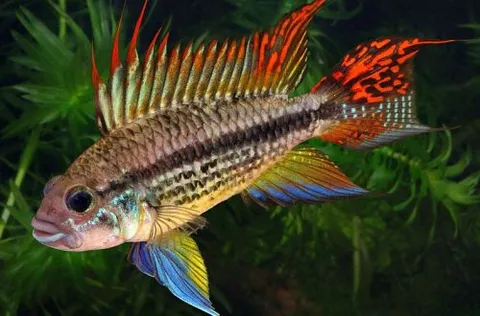
Apistogramma cacatuoides
The Cockatoo Dwarf Cichlid, also known as the Cockatoo Cichlid (Apistogramma cacatuoides), is a member of the Cichlidae family. This fish is one of the most striking representatives of South American cichlids and can…
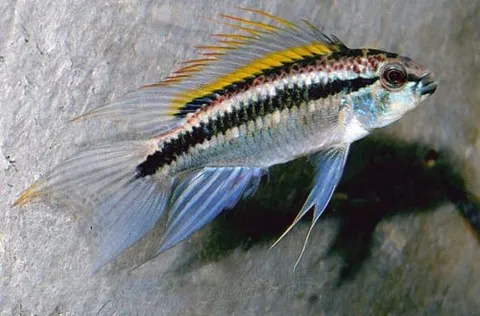
Apistogramma bitaeniata
Apistogramma bitaeniata, also known as the Two-striped Apistogramma, from the Cichlidae family, is a brightly colored and quite active fish. Males of this species are known for their complex character, which requires a…
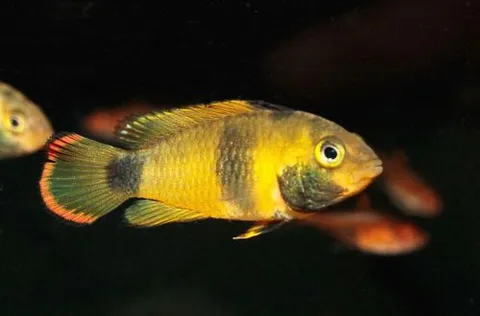
Apistogramma nijsseni
The Panda Apistogramma, or Panda Cichlid (scientific name Apistogramma nijsseni), belongs to the Cichlidae family. It is a beautiful and generally peaceful fish. However, keeping it in an aquarium can present some…
Apistogramma macmasteri
Apistogramma macmasteri, also known as the Red-tailed Dwarf Cichlid (scientific name Apistogramma macmasteri), belongs to the family Cichlidae. This fish attracts attention with its beauty, but its temperament can be…