Temperature22 – 29 °C
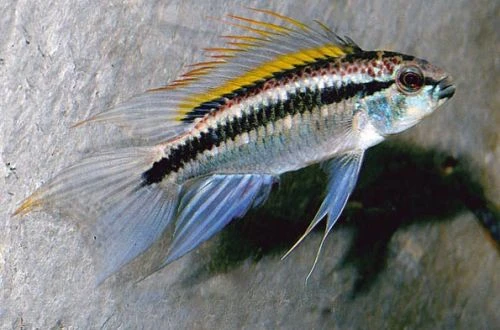
Apistogramma bitaeniata, also known as the Two-striped Apistogramma, from the Cichlidae family, is a brightly colored and quite active fish. Males of this species are known for their complex character, which requires a particularly careful approach when choosing tank mates. Nevertheless, Apistogramma bitaeniata is generally considered undemanding, and its keeping and breeding do not present significant difficulties. Until 2008, when the fish first appeared for sale, it was known as Apistogramma sp. Kelleri — hence the name Kelleri Apistogramma still in use; exporters sometimes call it the Leticia Apistogramma.
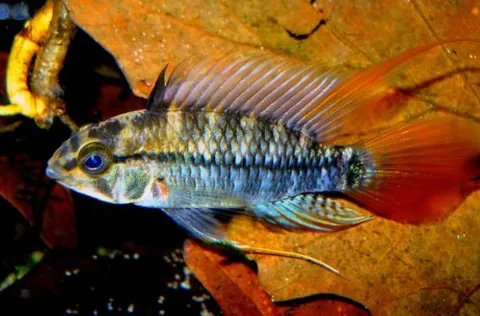
Adult Apistogramma bitaeniata typically reach a length of 5–7 cm. Their distinguishing feature is dark horizontal stripes on the body. Males are generally larger and display more intense coloration. Their bodies have silvery iridescence, and their elongated, large fins and tail are colored in bluish tones. The dorsal fin extends from the head to the tail; its base and tips are often yellow, while the central part remains translucent. Females are smaller and usually have a yellow base coloration, a similar hue also appearing on their fins and tail. Their pelvic fins are dark. It should be noted that body coloration can vary significantly depending on the specific region of origin and the degree of hybridization. For example, specimens from Brazilian waters more often exhibit a predominance of yellow hues, while fish from Peru are more inclined towards blue tones.
The natural habitat of this species extends across South America, covering Peru, Colombia, and the Brazilian state of Amazonas. These fish are found in the upper Amazon River basin, including large rivers such as the Marañón, Ucayali, and Solimões, as well as their numerous tributaries. Their preferred locations are areas of water bodies with weak currents, backwaters, and floodplain zones rich in snags. The bottom here is typically covered with a thick layer of fallen leaves. One of the characteristic features of their natural environment is the brown tint of the water, caused by the high content of tannins released during the decomposition of organic materials. Brief information about the species is presented below.
Males of this species are territorial and can display pronounced aggression towards each other. This is why it is recommended to keep only one male in a small aquarium. During the breeding period, their behavior becomes completely unpredictable; after spawning, when the female retreats to a hiding place, it is advisable to temporarily remove the male. Females, on the other hand, are peaceful and can be successfully kept in a group. The optimal option is a ratio of one male to several females. These fish are compatible with non-aggressive species of comparable size, with the exception of other Apistogramma species.
For keeping one or two fish, the minimum aquarium volume should be 50–60 L. Fish raised in captivity are usually not demanding regarding decor and can comfortably exist even in a fairly empty tank, as is often seen in pet stores before sale. However, in the long term, such keeping can lead to their coloration fading. The Two-striped Apistogramma will look much more harmonious in a setup that mimics its natural habitat. It is recommended to use a sandy substrate, place many snags and aquatic plants, forming secluded corners for hiding. Lighting should be subdued. When planning breeding, it is important to provide reliable hiding places, such as caves or grottoes, where females can hide with their fry. Experienced aquarists often add leaves from certain trees to the aquarium not only to give the decor a more natural look but also to create the necessary chemical composition of the water. The latter is achieved by the release of tannins from decomposing leaves, mimicking natural processes. Successful keeping largely depends on maintaining stable water parameters within the permissible range of temperatures and hydrochemical indicators characteristic of this species. For this, the aquarium must be equipped with appropriate technical equipment (filters, heaters, aerators, etc.) and regular maintenance procedures must be carried out. These include weekly partial water changes (10–15% of the total volume) with fresh water, monitoring nitrite, nitrate, and ammonia levels, removing organic waste, and prophylactic inspection of equipment.
This species is omnivorous. In a home aquarium, fish readily accept most common foods, such as dry flakes, granules, as well as frozen or live Artemia, Daphnia, and bloodworms. Specialized foods for South American cichlids will be most preferable, as they contain all the necessary additives, including components that enhance the natural coloration of the fish.
Under favorable conditions, breeding this species does not present serious difficulties. The only problem can be the overly active "attention" of males towards females. The worst-case scenario occurs when a female is alone in a small aquarium without the possibility of hiding, which can inevitably lead to injuries. The female lays eggs in a hiding place and remains nearby, ensuring their protection. The hatched fry are also under her care for some time until they reach a sufficient size.
The main cause of diseases often lies in the keeping conditions: if they go beyond acceptable limits, immunity decreases, making the fish vulnerable to various infections inevitably present in the environment. At the first suspicion of illness, it is important first of all to check the water parameters and ensure there are no dangerous concentrations of nitrogen cycle products. Often, restoring normal, suitable conditions promotes recovery. However, in some cases, medication may be required.
When choosing a Two-striped Apistogramma, attention should be paid to the activity of the fish and the cleanliness of their skin. Healthy individuals should be active, show curiosity, and have no visible damage, ulcers, white film, or fin erosion. It is important to avoid buying fish with severely sunken bellies, which may indicate emaciation or the presence of internal parasites. In the store, it is preferable to choose juveniles, as they adapt more easily to new keeping conditions than adults accustomed to specific water. Given the territorial nature of the species, it is recommended to plan the group composition in advance (for example, one male and several females) and avoid acquiring individuals with signs of severe stress or timid behavior caused by the dominance of other fish in the communal aquarium.
The essentials: size, tank volume, water parameters and care
An adult reaches 5–7 cm in length. Plan the tank around the maximum size: the fish quickly outgrows a cramped setup.
The recommended volume is 50 L. A smaller tank speeds up nitrate build-up and raises stress levels.
Temperature 22–29 °C, pH 4.5–7, hardness 0–5 dGH. Stability matters more than exact values: sudden swings are harder on the fish than a small deviation from the ideal.
Around 3 years when kept properly. Lifespan depends directly on tank volume, water quality and a varied diet.
Temperament: semi-peaceful (including aggression during spawning / intraspecific conflicts). Keep this in mind when choosing tank mates.
Recommended setup: harem (1 male and several females). Ignoring this is a common cause of stress and disease.
Diet type: high protein (predominantly meat). Feed small portions that are finished within a couple of minutes — overfeeding does more harm than underfeeding.
The scientific name of the species is Apistogramma bitaeniata, family Cichlids (Cichlidae). It also appears in the literature as: Apistogramma klausewitzi, Apistogramma kleei, Apistogramma pertense.
The water suits 197 of 208 plants in the catalogue — the easiest ones are shown first.
Afzelius's AnubiasAnacharisAnubiasBrazilian PennywortDwarf CloverDwarf CloverDwarf HygrophilaDwarf SagittariaDwarf ValGuppy GrassHornwortJava FernJava MossMoneywortMud SwordNair's LagenandraNarrow Leaf AnacharisNarrow-leaf CloverStringy MossSüsswassertangTaiwan MossTape GrassTemple PlantUssuri Watermilfoil
Matched by family, categories and overlapping keeping conditions
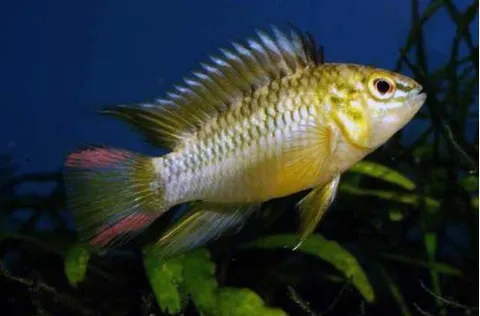
Apistogramma hoignei
Apistogramma hoignei, known as Hongslo's Dwarf Cichlid, belongs to the Cichlidae family. This is an energetic fish, especially the males, which are distinguished by their bright coloration. Experienced aquarists usually…
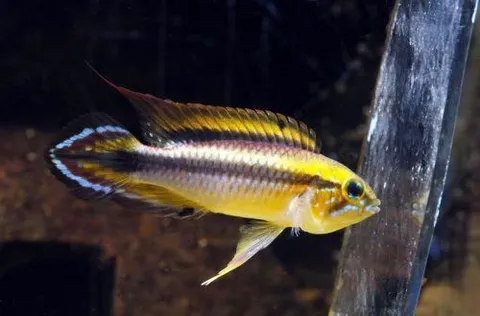
Apistogramma agassizii
Agassiz's Dwarf Cichlid, also known as Apistogramma agassizii, belongs to the family Cichlidae. This attractive fish is popular and comes in many selective breeding forms, which differ mainly in coloration. The species…
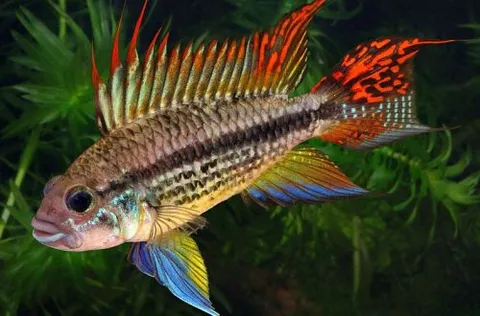
Apistogramma cacatuoides
The Cockatoo Dwarf Cichlid, also known as the Cockatoo Cichlid (Apistogramma cacatuoides), is a member of the Cichlidae family. This fish is one of the most striking representatives of South American cichlids and can…
Apistogramma eunotus
The High-fin Apistogramma (Apistogramma eunotus), a representative of the Cichlidae family, is one of the popular South American cichlids. Its keeping does not present particular difficulties for experienced aquarists,…